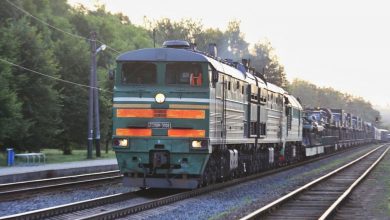
According to information at our disposal, the military communications bodies (VOSO)* of Belarus and Russia, with the participation of the Belarusian Railway, are currently engaged in active coordination on the rail transport of Russian military equipment, ammunition, and personnel to our country. This is also borne out by indirect signs, such as the intensified information exchange between these agencies of the two countries.
Presumably, the organization of military transport will be carried out within the framework of the so-called “Regional Force Grouping of the Russian Federation and Belarus.”
In addition to the primary objectives of the planned military transport, the possibility of rotational movement of troop trains** from Russian-occupied territories of Ukraine to Belarus and back is also being considered.
Similar rotational movements of Russian equipment and personnel to Belarus have been carried out previously—directly from the combat zone on Ukrainian territory and in the reverse direction.
To carry out such transport, preparatory measures are required, for which a number of mandatory actions are being reviewed and implemented. The main ones are outlined below.
In coordination with VOSO, preparatory measures are being developed for the Belarusian Railway infrastructure. At the destination (departure) stations for troop trains, a joint inspection of unloading (loading) sites must be carried out, which necessarily involves officials from Belarusian Railway divisions and Military Communications Commandant’s Offices. The need for appropriate repair of loading and unloading facilities (loading platforms and ramps, access roads for equipment to unloading and loading sites) is determined. For operational management of military transport, appropriate communication equipment is tested at stations. Responsible Belarusian Railway personnel are identified and assigned for the safe passage of military equipment through level crossings. These personnel are provided with appropriate communication equipment.
In addition, issues of providing the necessary rolling stock are being addressed. The condition of freight railcars intended for use in international traffic is assessed, along with their compliance with requirements from both the Belarusian Railway (“Belintertrans” – BTLC) and Russian Railways (“First Freight Company” – PGK, “Federal Freight Company” – FGK, and others). Appropriate draft contracts for railcar rental and servicing are prepared for subsequent conclusion with leasing organizations and carriers.
As part of organizing the actual movement of troop trains and conducting shunting operations with them at unloading-loading stations, shunting locomotives are assigned. Upon receipt of the military railway transport plan, train schedules will be developed for troop trains on the Belarusian Railway. Based on this, the required number of locomotive crews for expedited movement of troop trains is determined.
In order to expedite the return of empty consists to the Russian Federation for their reuse in loading troop trains of the Russian Armed Forces, appropriate coordination is being developed between the dispatching personnel of the Traffic Control Center (TCC) of the Belarusian Railway and the Central Directorate of Traffic Management—a branch of Russian Railways JSC (TsD).
In addition to the specified planned measures, steps are being taken to ensure the secrecy of military transport in accordance with the requirements of classified documents of the relevant security agencies of Belarus, with the involvement of specialized management departments and relevant Belarusian Railway divisions ensuring classified activities—state secrets protection units. Within the framework of these measures, the circle of persons directly granted access to documents and information concerning military transport is determined. Access restriction is implemented depending on the level (classification) of information secrecy.
As part of security measures for troop train movements on the Belarusian Railway, special attention is paid to protecting “sensitive” infrastructure facilities such as bridges, overpasses, and level crossings located in unfavorable terrain conditions (we have written about this). Additional security is allocated, technical measures to prevent unauthorized access are implemented, and remote monitoring is provided when necessary.
Particular attention is paid to the safety and security of troop train movement routes. The entire security and repressive apparatus of the illegitimate authorities is focused on this (see here and here). And even the “usurper” occasionally “reviews” such matters for show.
It is expected that the reception of troop trains with Russian equipment and personnel will be carried out predominantly through the interstate junction point (MGSP) Krasnoe (Moscow Railway (MSK), Russian Railways) – Osinovka (Belarusian Railway, NOD-1).
However, an alternative (backup) option for troop train transport is also being considered—through MGSP Zaverezhye (October Railway, Russian Railways) – Yezerishche (Belarusian Railway, NOD-6) in case of extreme necessity.
The use of the previously utilized MGSP Zlynka (MSK, Russian Railways) – Zakopytye (Belarusian Railway, NOD-4) for receiving/transferring troop trains is not being considered due to the high risk of sabotage activity on this route.
We continue monitoring this topic.
* Military communications bodies (VOSO) are special operational management bodies that represent the Ministry of Defence on railway, maritime, inland waterway, and air transport. They ensure coordination between the military command and the transport organizations of the relevant ministries on the use of transport in the interests of the armed forces, organize all types of military transport, develop and present special requirements for the preparation and use of transport routes and vehicles, and monitor their implementation. The tasks and functions of the VOSO bodies of Belarus and Russia are virtually identical.
The VOSO of Belarus is directly subordinate to the Transport Support Department of the Ministry of Defence of the Republic of Belarus.
To ensure coordination with Belarusian Railway organizations, the Ministry of Defence maintains VOSO offices on the railway, located in the Belarusian Railway administration (which coordinate the work of VOSO offices at the Belarusian Railway divisions) and in its divisions (Military Communications Commandant’s Offices of railway sections and stations).
A similar structure (VOSO) exists in Russia.
** A troop train is defined as a military unit (subunit, institution) organized for transport in a single train, as well as individual detachments and consignments of equipment