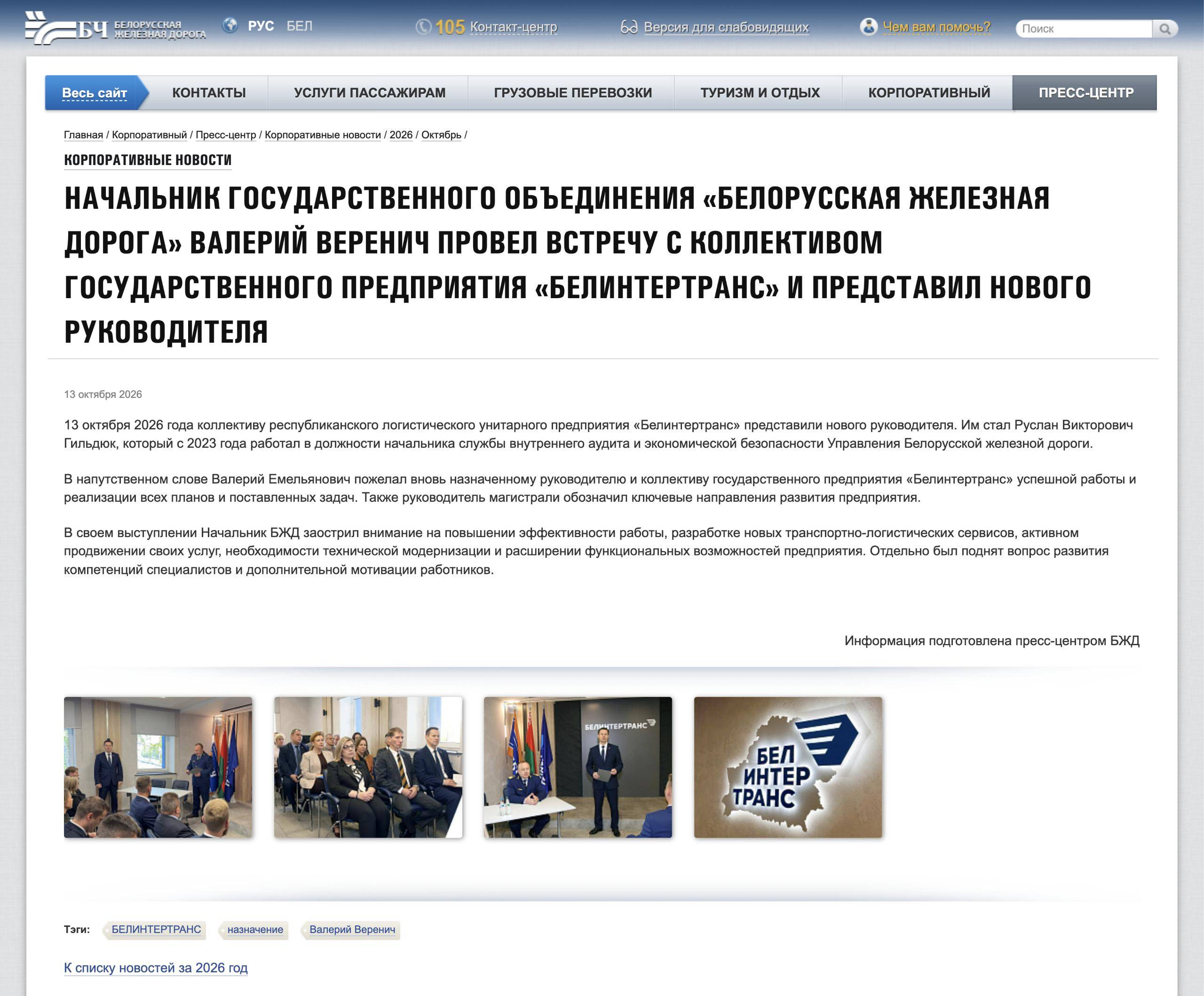
On October 13, 2026, Valery Verenich, Head of the Belarusian Railway, held a meeting with the staff of Belintertrans (BTLC) and personally introduced the new General Director. Ruslan Gildyuk, who had headed the internal audit and economic security service of the BCh Management since 2023, was appointed. The official statement from the railway included wishes for success and mentioned certain “key development areas.” There was no mention of the former director, Andrey Sladkevich, who had led the enterprise for about seven and a half years: neither gratitude for his work nor even a statement regarding his departure. Yet, he was relieved of his duties back in early August 2026 — the new head was introduced to the team only more than two months later.

Andrey Sladkevich took over BTLC in February 2019. He was appointed by the then-head of the BCh, Vladimir Morozov, from the position of deputy head of the transportation service, which Sladkevich had held for just over a year. Prior to that, he managed the Kolyadichi and Stepyanka stations, then the transportation department of the Minsk branch. For a person without a “prominent” surname, his career ascent, by BCh standards, was more than rapid.
For reference: Belintertrans is the official freight forwarder and logistics operator of the Belarusian Railway, effectively a monopolist in the country’s railway forwarding market. It operates through a network of subsidiaries and representative offices abroad. Since January 2023, the enterprise has been under Ukrainian sanctions.
Under Sladkevich, BTLC became one of the main organizers of military transport between Belarus and Russia, about which we wrote in detail. As per a letter from BTLC to the Arbitration Court of the Moscow District regarding the Russian Ministry of Defense’s debts for railcar demurrage, such transport operations were agreed upon at a general meeting of representatives from the Ministries of Defense of Belarus and Russia, the BCh, and Belintertrans itself — this is also stated in our joint report with BELPOL on the militarization of Belarus.
The enterprise was established in 1992, when, after the collapse of the USSR, railways needed an intermediary for transit settlements, and the BCh needed foreign currency. Since then, BTLC has transformed from a regular freight forwarder into a monopolist with administrative preferences from the railway that no one else possesses. Its reputation is commensurate: among 1520-mm gauge freight forwarders, the phrase “ready to work with anyone but BTLC” has long been circulating — we cited it back in 2023.
And the General Director’s chair here has never been a quiet one. The former head of BTLC, E. Rogachev, who later rose to First Deputy Minister of Transport, was convicted in 2017 in the “Seafood-Service” case — along with the former First Deputy Head of the BCh and the Deputy General Director of BTLC.
A change in leadership at a state enterprise is a common occurrence in itself. What is noteworthy is that the largest freight forwarder of the railway is now headed by a person who has spent almost three decades conducting inspections. As early as 1997, Gildyuk worked as an inspector-instructor for the Minsk branch, and from 2004, as an inspector in the BCh Management, later becoming deputy head of a department. The service he subsequently led replaced the control and audit service. In 2023, we noted that the regulations for the new service “left much to be desired,” and specialists and managers within it had hardly changed.
Another detail is also curious. The service’s regulations explicitly state its tasks include ensuring the reliability of internal monitoring in BCh organizations, as well as “preventing, identifying, and suppressing negative trends, violations, and shortcomings in their financial and economic activities.” Belintertrans is one such organization. In other words, the new director is joining an enterprise whose financial and economic activities his service was supposed to oversee for the past three years. And if there were problems at BTLC, questions also arise for his former service.
Did they find anything at BTLC, or has the new director been tasked with bringing order to matters we have already written about? Either way, against the backdrop of the enterprise’s financial problems, such a choice speaks volumes. Especially since questions regarding Belintertrans had been accumulating for a long time, and most of them were raised in our publications. Here are just a few examples.
In March 2026, we published an article “Transit on Credit – How BCh Finances Foreign Business for Tens of Millions of Dollars” about BTLC’s settlements with the Russian LLC “RTSB-RUS,” part of the international logistics group RTSB. According to the reconciliation statement, as of September 30, 2025, RTSB-RUS’s debt to BTLC amounted to $38,229,237.65. No penalties for late payment were accrued. We emphasize: this amount comes from a document signed by both parties.
We remind you that a regular BCh client operates on a prepayment basis: no money in the account means the cargo does not move further, and an automated system monitors this. Penalties are accrued for overdue payments, and a large debt leads to a contract review and court proceedings, which the BCh almost always wins. For RTSB-RUS, none of this applied: transport operations worth tens of millions of dollars, partial payments, settlements via mutual offsets — and not a single ruble in penalties. Client funds from Europe and China first settled in RTSB group structures and only then, in parts and with delays, arrived at BTLC, and from there, to the railway.
The BCh generally provides such benefits to only one organization — Belintertrans itself. The railway allows its freight forwarder to operate without prepayment, does not charge penalties, and permits it to manage settlement terms independently. It turns out that RTSB-RUS effectively enjoyed the same privileges as BTLC, and the railway’s money was working for someone else’s business all this time.
Even then, we wondered who made the decisions about deferrals and whether they were approved by the BCh management under Morozov. Now there is an answer: according to our sources, the deferrals were agreed upon with Petr Dulub — the then-First Deputy Head of the BCh, who directly oversaw BTLC.
In April, we published another document — a letter from BTLC dated 02.04.2026 No. 60-08-02-11/1660 to the Deputy Commercial Director of JSC “UTLC ERA.” It analyzed 44 cases from 2025 and early 2026, for which UTLC ERA presented claims totaling over a million dollars to the Belarusian side. Railcar delays, shunting operations, fees for third-party infrastructure, increased tariffs, the Kazakh coefficient for “non-ferrous metals” — all of this, according to the agreement, automatically fell on BTLC, regardless of who or where caused the expenses. In essence, the Belarusian side played the role of a financial buffer in this scheme: routes, cargo flows, and operating conditions were determined outside the BCh, and any deviation in transport turned into a monetary claim against it.
For reference: JSC “United Transport and Logistics Company – Eurasian Rail Alliance” (UTLC ERA) is the operator of container transit between China and Europe. Its founders are Russian Railways, Kazakhstan Temir Zholy, and the BCh, each owning one-third of the shares.
The picture is peculiar. Belintertrans patiently waited for 38 million from its Russian partner, without applying any penalties, while UTLC ERA presented claims exceeding a million and demanded immediate payment. The agreements are different, but together they clearly show how settlements with partners were structured under Sladkevich and who ultimately bore the risks.
In addition to this, there were everyday problems. In January of this year, we wrote that BTLC regularly became a defendant in administrative cases brought by Russian customs officials regarding allegedly inaccurate declarations of weight and names of transit goods.
Matters were no better within Belintertrans’s own operations. And the problems did not start yesterday. BTLC’s Lithuanian subsidiary — UAB “Belintertrans Baltic” — had revenues of over €50 million in 2019, but only €6.8 million by the end of 2022, with a loss of €866,000. The company was included in the Lithuanian list of entities controlled by a sanctioned subject, yet BTLC retained it. The assets of the Ukrainian subsidiary “BTLC-Ukraine” have been seized since May 2022. We reported this back in 2023, but neither BTLC nor the BCh management were concerned by such “achievements.”
The results for 2025, summarized at the BCh Technical and Economic Council, looked disastrous. Belintertrans’s revenue amounted to 162.1 million rubles against a plan of 200.5 million — 80.8% of the plan and almost 38.5 million rubles in lost revenue. Compared to 2024, when revenue was 192.7 million rubles, the drop exceeded 30 million. The main area — transport and logistics services — fell from 183.7 to 154.3 million rubles. Only one area showed growth — cargo processing and storage: 45.2 million rubles, 102% of the plan. This, of course, could not compensate for the decline in international logistics.
In reports, all of this was traditionally attributed to sanction restrictions, including the 12th EU package. They indeed impacted transit through Belarus. But when everything can be blamed on sanctions — from declining transit to failing to meet the plan — questions about the quality of management quietly recede into the background. And this is despite the fact that the authorities officially keep insisting that sanctions pose no threat to the economy.
Things did not improve in early 2026. For January and February, BTLC showed a loss of 1.64 million rubles with a profitability of minus 37.9%. Of the 1,261 railcars in its own fleet, 164 were idle, and another 93 were undergoing repairs. The situation was worst with gondola cars: only 110 out of 250 were operational. Flatcars were better utilized, but their turnover on the China-Europe route stretched from a normal 18–22 to 30–40 days. According to our calculations, idle time and slow turnover alone cost the enterprise 1–1.5 million rubles monthly.
Expenses, meanwhile, were rising: the total increase in costs was 154.8%, and depreciation increased by 232%. Large operators in the 1520-mm gauge space work based on cargo flow: first, cargo appears, and only then are railcars acquired for it. At BTLC, the logic was reversed — first, the fleet was formed, and then cargo was sought for it.
The official reasons for Sladkevich’s departure were not announced. According to our sources in the BCh and the Ministry of Transport, the main complaint against him was the decline in volumes and performance. As long as the enterprise was busy, there were almost no questions for the head. When volumes declined, he was unable to find ways to replace them or maintain previous salary levels.
Sladkevich had to explain himself at the ministry. According to sources, at a meeting where, among other things, large debts of Russian companies to Belintertrans were discussed, the conversation was heated, and the minister did not mince words. Sladkevich himself, according to available information, behaved defiantly. One interlocutor believes that the debts were more of a pretext: the claims concerned the overall management of the enterprise and why such debts accumulated in the first place.
There was also an inspection. According to sources, in April 2026, the BCh information security service — the one headed by a KGB officer — worked at BTLC. After this, the Deputy Head of the Railway for Security, Igor Kozlovsky — a former officer from the central apparatus of the KGB — suggested to Verenich that the head of Belintertrans be replaced. Thus, the fate of the railway’s commercial enterprise was ultimately decided by security personnel. For the current BCh, this is business as usual: the railway is a leading enterprise in terms of the number of security and law enforcement personnel on staff. Since late 2023, their number here has increased significantly, and the information security service that inspected BTLC was only created in 2025.
Why didn’t this happen sooner? Sources again name Petr Dulub. According to them, as long as volumes were high, BTLC’s curator shielded Sladkevich from serious claims — and had a personal interest in doing so. We described a similar episode in 2024: by an unofficial order from Dulub, BTLC’s debt to the BCh, arising from Belintertrans-Moscow, was “postponed” and did not hinder the enterprise’s work. In August 2025, Dulub received an 11-year sentence for bribes from freight forwarding companies. That protection ended long before Sladkevich’s dismissal, and after that, he apparently held on only as long as the performance indicators did.
There is also another story — with Alexander Danilenko, the former chief economist of the BCh, who quietly left this position at the end of January 2024.
According to sources, after this, Danilenko worked at BTLC as Deputy General Director for Financial and Economic Affairs. Disagreements arose between him and Sladkevich over how to reflect certain debts in reports. Danilenko refused to follow instructions on this matter, was dismissed, wrote to various authorities, and then went to court.
Two facts fit into this story. Among the current Deputy General Directors on the BTLC website, there is no Deputy for Finance and Economics. And on the state job portal, the enterprise has been seeking a Deputy General Director since late July. The materials from this legal dispute could reveal much about how financial decisions were made at Belintertrans.
The question remains, where is Sladkevich now? According to our information, after leaving Belintertrans, he moved to work at UTLC ERA.
The choice of his new workplace is telling. UTLC ERA is the very company whose claims for over a million dollars Sladkevich’s enterprise was reviewing this spring. It turns out that the former head of BTLC went to a counterparty with whom his enterprise had financial disputes. The question of a conflict of interest arises naturally here.
The man who once appointed Sladkevich had already taken this path before him. After leaving his post as head of the railway, Vladimir Morozov, who is under personal sanctions, “resurfaced” as a representative of UTLC ERA in Minsk. Igor Zgursky, former head of the BCh freight operations and foreign economic activity service, works as the company’s Vice President. He left the railway in the summer of 2016, and by 2019, he was already working as a deputy director at this company. In October 2025, both visited the BCh Traffic Control Center already as representatives of the “other side.” Now Sladkevich has joined them.
For former BCh leaders, this is almost a tradition: after leaving the railway, they end up in structures that work with it, and sometimes compete with it. Some, like the former head of the external relations service Alexander Sergienko, take a quiet position at OSJD. Others — at UTLC ERA, which, under Morozov, as we wrote, was granted unprecedented discounts on BCh tariffs. How the former BTLC director’s relationship with his former enterprise will now develop is an open question.
Gildyuk has plenty of issues on his desk. Counterparty debts and payment deferrals without penalties, UTLC ERA’s claims and an agreement under which BTLC pays for others’ decisions, idle railcars, and declining revenue — the new director will have to deal with all of this.
The new appointment should be judged by results: will debts be collected, will settlement terms with partners become transparent, will BTLC stop paying for others’ expenses, and will performance indicators improve? Otherwise, it will just be another personnel reshuffle, after which debts, claims, and idle railcars will remain. The experience of previous years and the “specificity” of the BCh as a state association leave little room for high hopes.
We continue to monitor the situation at Belintertrans. If you know why Sladkevich left, what the inspection revealed, or what is happening with BTLC’s debts — contact us.
Related materials:
Transit on Credit – How BCh Finances Foreign Business for Tens of Millions of Dollars;
Others’ Decisions – at BCh’s Expense: Million-Dollar Claims from UTLC ERA;
Results of Belintertrans’s Work Reviewed at the Final Technical and Economic Council for 2025;
Low Efficiency of Belintertrans Railcar Utilization in Early 2026;
Former Head of BCh Now “Plays for the Other Side”;
Dulub Sentenced, While Accomplice Company Again Avoids Responsibility;
Quiet Dismissal of BCh Chief Economist;
BCh Internal Audit: More Details on Nuances.