
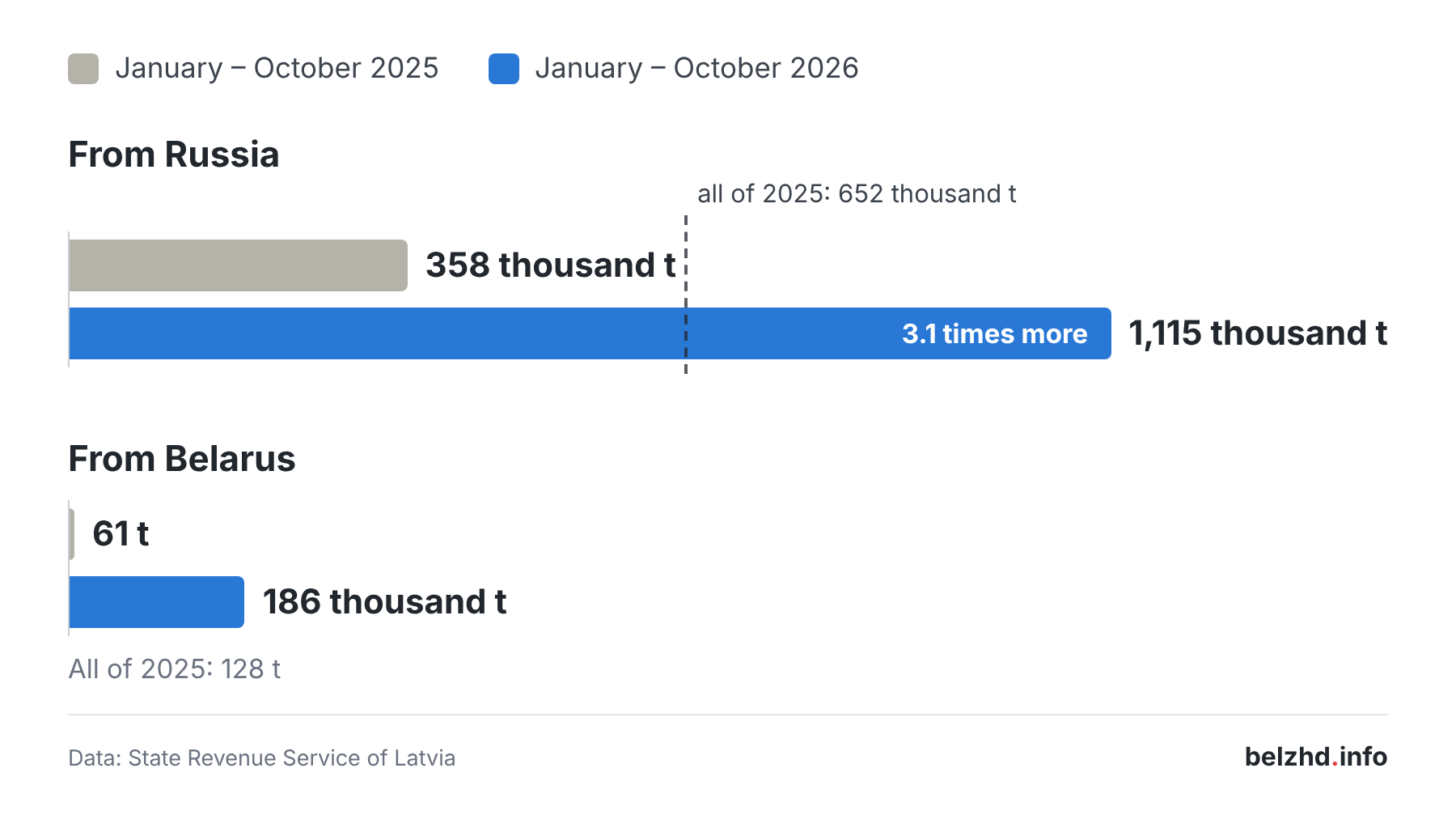
In the first ten months of 2026, Russian grain transit through Latvia grew 3.1-fold. According to Latvia’s State Revenue Service (SRS), 1.115 million tonnes passed through from Russia between January and October, compared to 358,000 tonnes a year earlier. The SRS also recorded another 186,000 tonnes as grain from Belarus — compared to just 128 tonnes for all of 2025. Latvia is debating a transit ban; Estonia has already introduced one.
We examined BCh and RZD freight data from the past 15 years, along with an analytical review of BCh freight traffic in 2024. Here’s what we found:
- the route through Belarus is not new: Russian grain has been moving along it since at least 2012, and in 2023 and 2024 volumes exceeded one million tonnes a year;
- from 2022 to 2025, roughly half of all Russian grain that Latvia let through in transit traveled via BCh;
- despite the recent surge, less Russian grain passed through Latvia in the first ten months of 2026 than in all of 2023 or 2024;
- in 2024, grain accounted for 71% of BCh’s transit traffic to Latvia;
- in 2025, more than 90% of wagons came from five Russian shippers, and more than two-thirds of the wagons arriving in Latvia went to a single company in Liepāja;
- in March and April 2026, all grain from Belarus to Latvian ports was shipped by a single Minsk-based company. During this period, almost no Russian wheat was being brought into Belarus by rail;
- according to our sources, the turnaround time for a grain wagon is approaching a month. If Latvia closes transit as quickly as Estonia did, wagons already en route would be left stranded at BCh stations.

The route is over a decade old
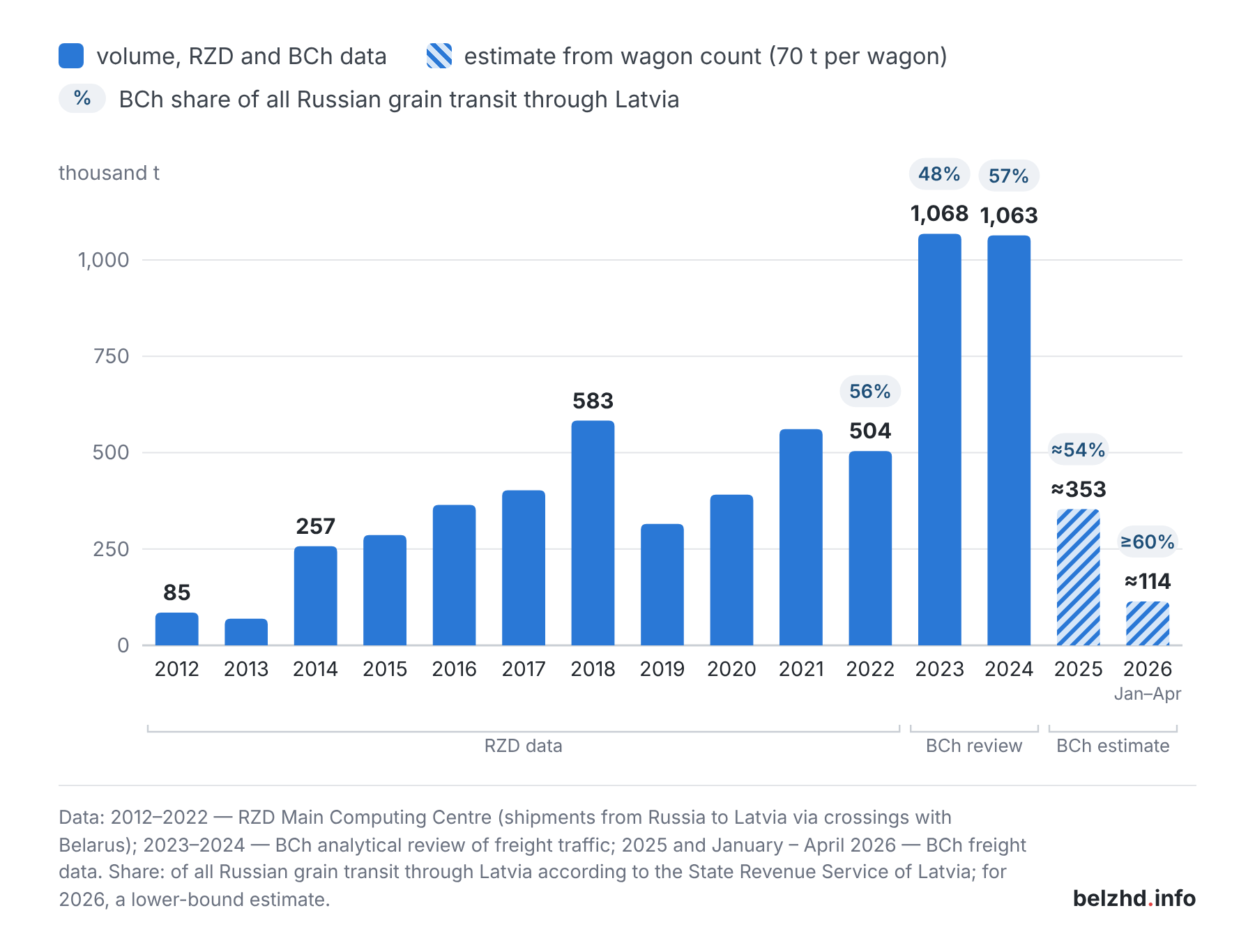
As early as 2012, according to RZD, 85,000 tonnes of Russian grain passed through Belarus to Latvia. Between 2014 and 2022, volumes on this route ranged from 257,000 to 583,000 tonnes a year.
In 2023 and 2024, the flow roughly doubled: according to the analytical review of BCh freight traffic, 1.068 million and 1.063 million tonnes of grain passed through to Latvia in transit, respectively. In 2024, grain accounted for 71% of all BCh transit to Latvia — 1.06 million out of 1.50 million tonnes. In 2023, the main cargo on this route was coal, but in 2024 its transit volume dropped from 1.15 million to 0.14 million tonnes.
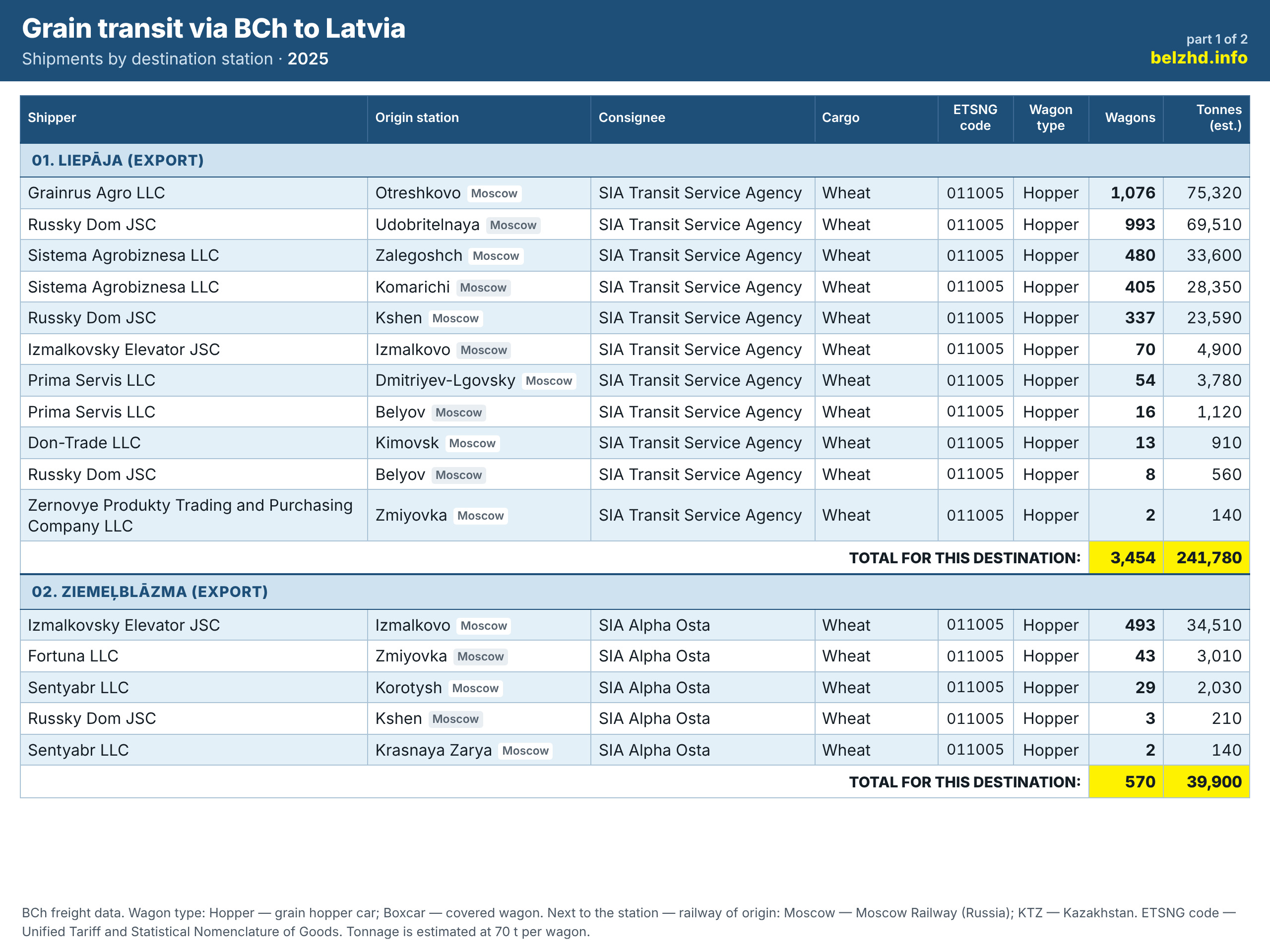
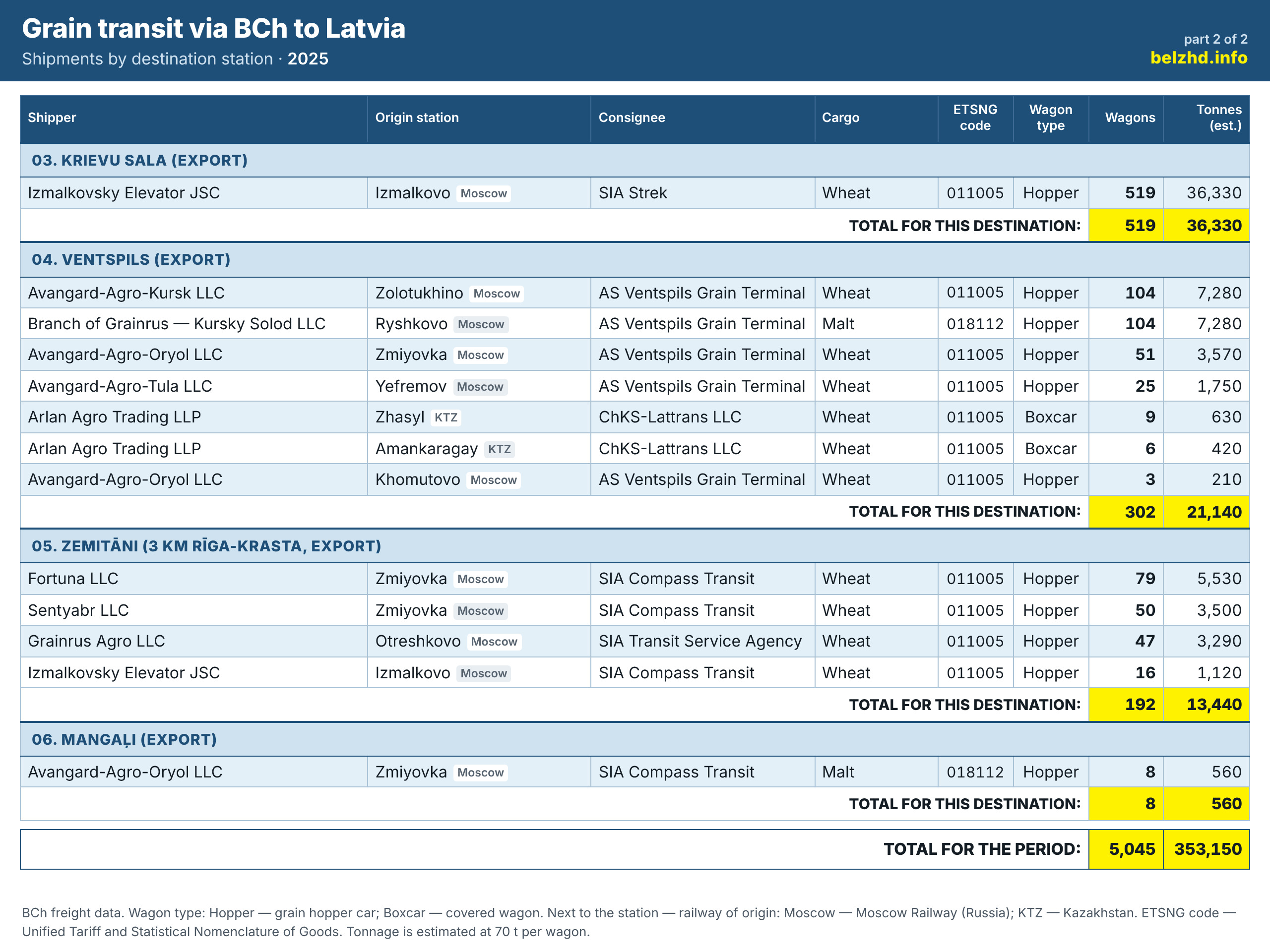
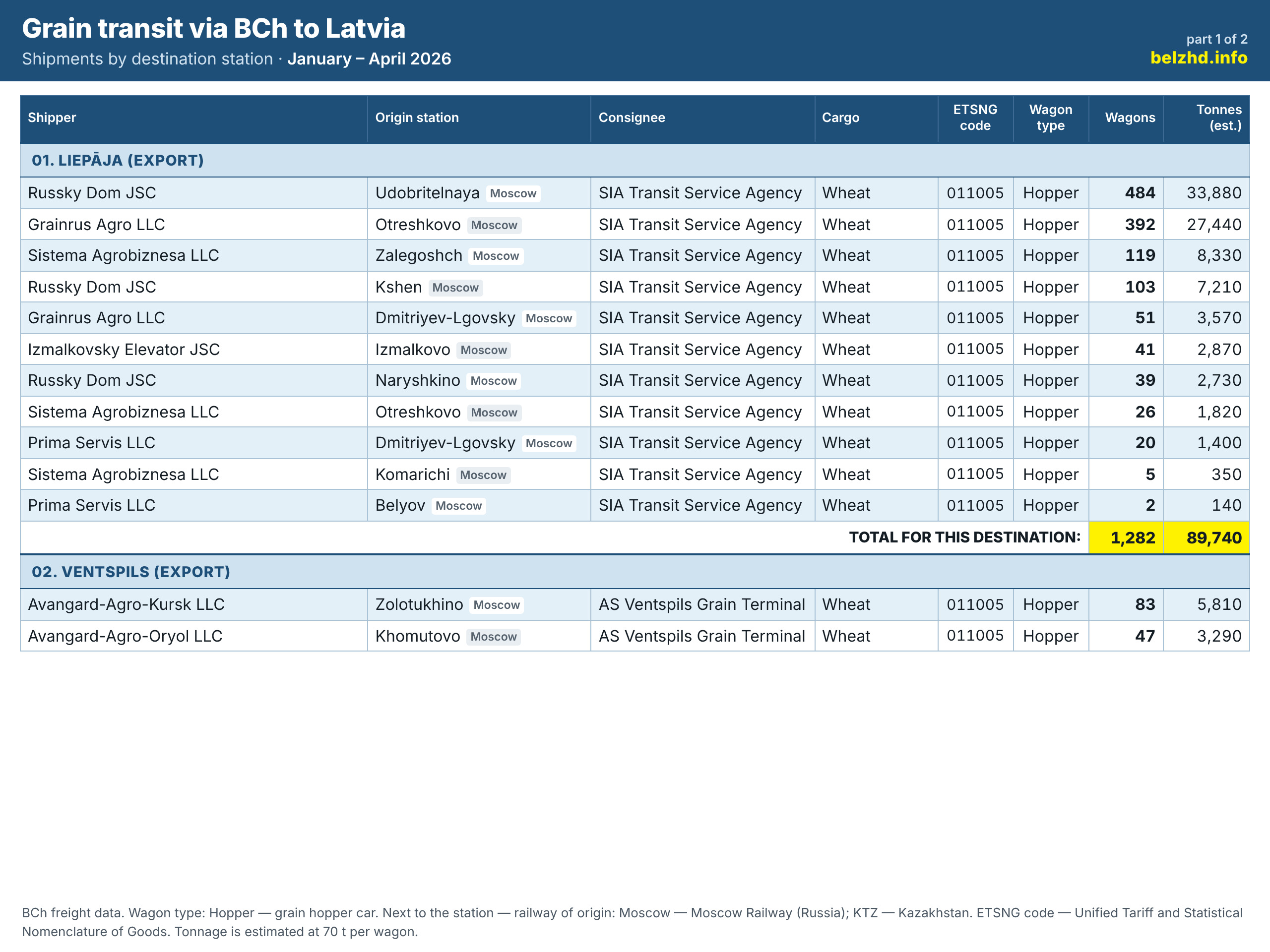
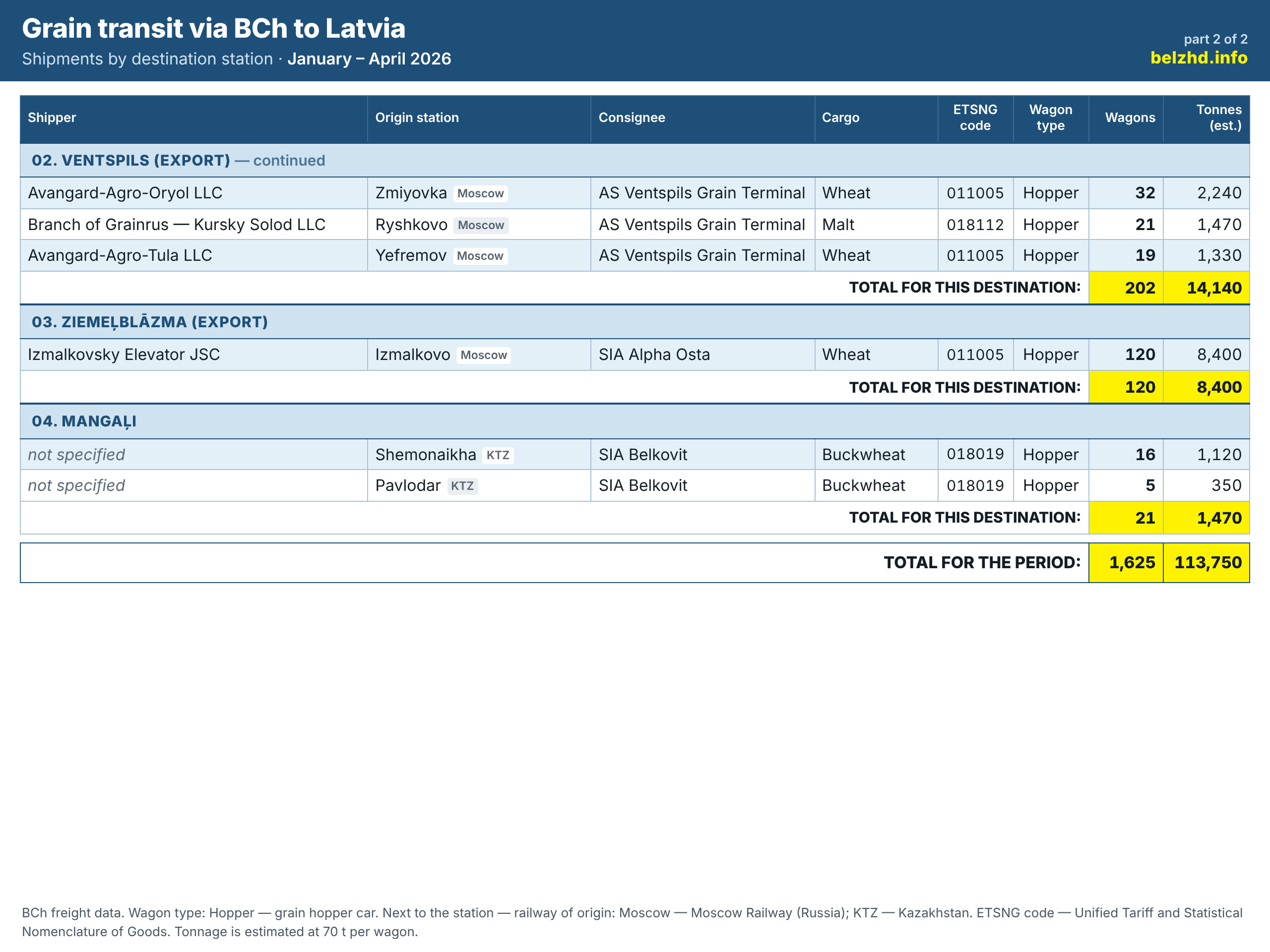
In 2025, the flow fell by two-thirds. According to BCh freight data, 5,045 wagons carrying grain — roughly 0.35 million tonnes — passed through to Latvia in transit over the year, with more than 60% of them between October and December. In the period from January to April 2026, another 1,625 wagons passed through, roughly 0.11–0.12 million tonnes. The flow is seasonal: according to RZD data from previous years, grain volumes peak from September to January, after the harvest, and are lowest from May to July.
From 2022 to 2025, roughly half of all Russian grain transiting through Latvia traveled via BCh. Compared with SRS data, that’s 56% in 2022, 48% in 2023, 57% in 2024, about 54% in 2025, and at least 60% in January–April 2026. The rest of the grain was mostly shipped directly from Russia via the Posin — Zilupe border crossing.
Latvia is not the only destination. Of the 2.06 million tonnes of transit grain carried by BCh in 2024, 1.06 million went to Latvia and 0.97 million to Kaliningrad Region. Grain bound for Kaliningrad travels in transit through Lithuania. As for Lithuania itself, according to BCh freight data, the only grain arriving there is buckwheat from Kazakhstan: 152 wagons to Varėna station in 2025.
Where the wagons come from and where they go
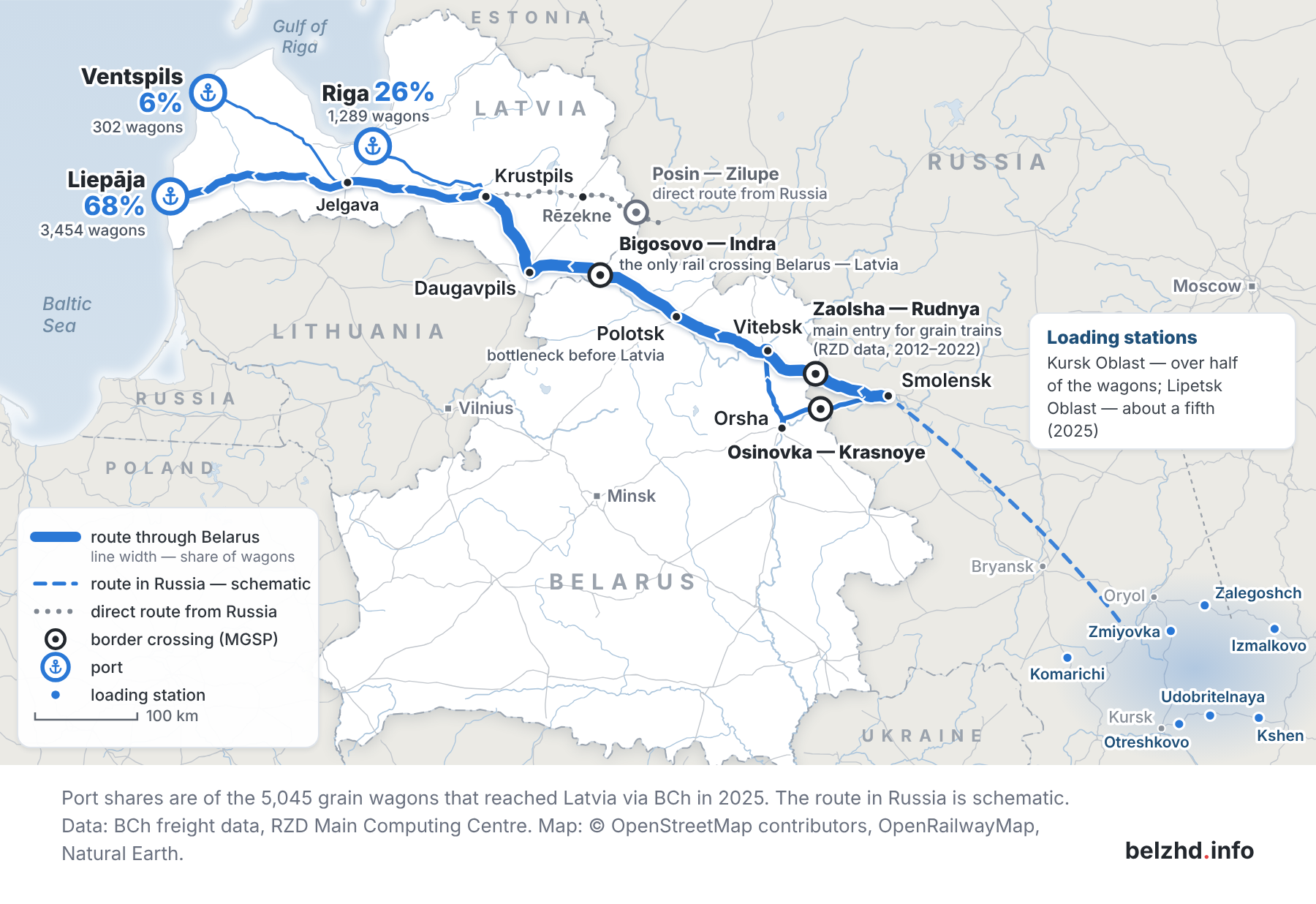
Russian grain is loaded at stations on the Moscow Railway. In 2025, more than half of the wagons were dispatched from Kursk Region, about a fifth from Lipetsk Region, and almost all the rest from Oryol, Bryansk and Tula regions. Most came from the stations of Otreshkovo, Izmalkovo, Udobritelnaya in Shchigry, Zalegoshch, Komarichi, Kshen and Zmiyovka. Otreshkovo station is home to a grain elevator belonging to the Kursk-based Grainrus group; according to the company, it can load up to 60 wagons in 10 hours.
The BCh freight data on loading points include no stations in the occupied territories of Ukraine. But the loading station alone can’t tell you where the grain was actually grown. It could be brought into Kursk Region from the occupied territories by truck or in separate rail shipments and then relabeled there as Russian. From that point, such grain is exported from local stations, making any substitution extremely hard to detect.
Almost all the wagons are grain hoppers: 5,030 out of 5,045 in 2025. According to RZD data for 2012–2022, such wagons almost always entered Belarus via the Zaolsha — Rudnya crossing. Now grain also moves via the Osinovka — Krasnoye crossing, and from there through Orsha. The wagons then continue through Vitebsk and Polotsk to the Bigosovo — Indra crossing, the only rail link between Belarus and Latvia. From Daugavpils, the grain is distributed among the ports.
The main port is Liepāja. In 2024, it received 611,000 tonnes of grain via BCh, while Riga received 262,000 tonnes and Ventspils 190,000 tonnes. In 2025, Liepāja accounted for more than two-thirds of all wagons, and from January to April 2026, for nearly four-fifths.
In RZD data for 2012–2022, the destination country listed most often is Switzerland, where many grain traders are registered: it accounted for nearly 40% of the total volume, and 60% in 2022 alone. Egypt and Bangladesh follow. Latvian Prime Minister Andris Kulbergs has said that the grain currently moving through Latvia belongs to companies from the United States, Switzerland and Japan.
Who’s shipping it
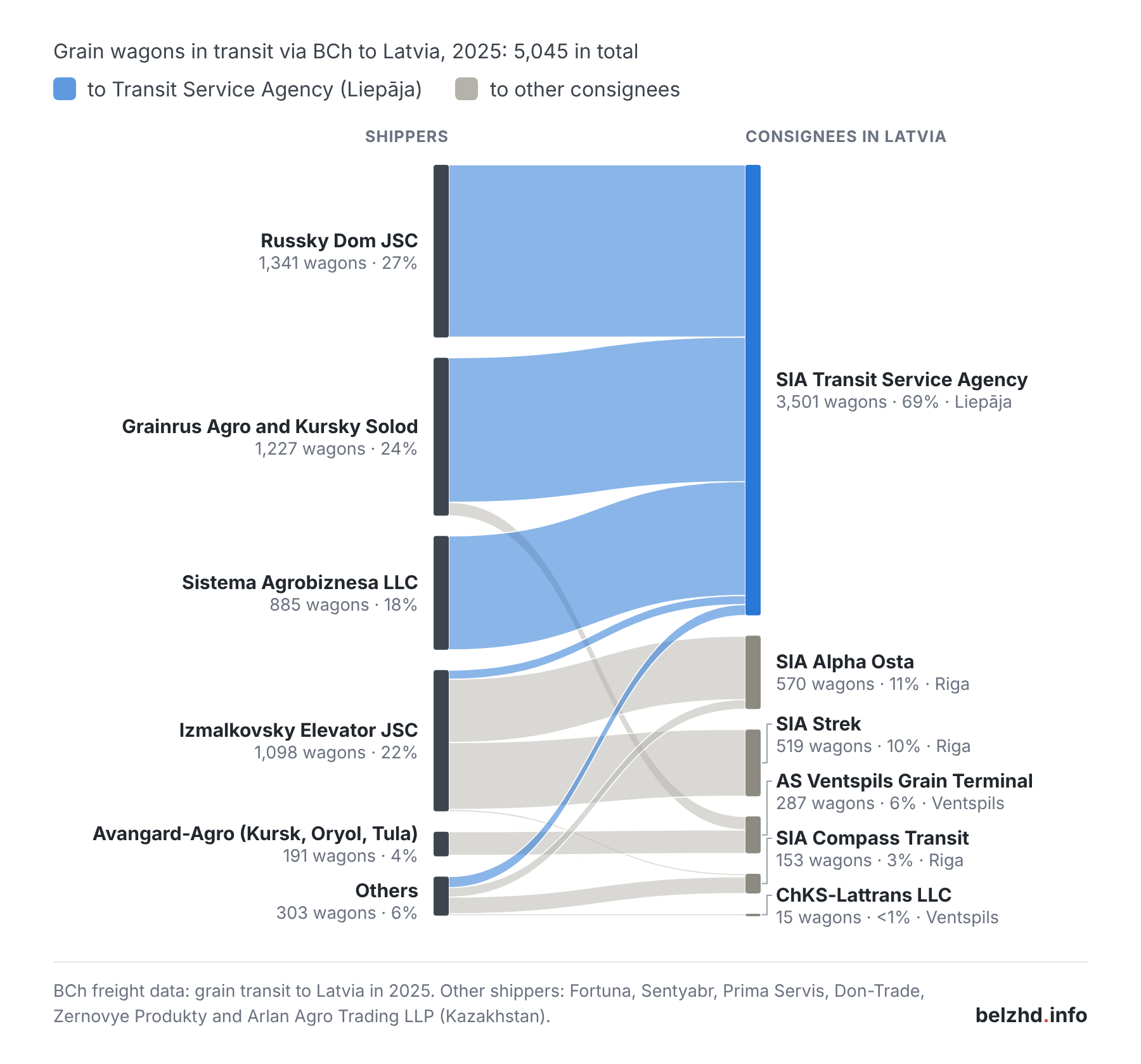
In 2025, more than 90% of wagons came from five shippers:
- Russky Dom JSC — 1,341 wagons, almost all from the Udobritelnaya and Kshen stations;
- the Grainrus group — 1,227 wagons from the Otreshkovo and Ryshkovo stations, shipped by Grainrus Agro LLC and the Kursk branch of Grainrus — Kursky Solod LLC;
- Izmalkovsky Elevator JSC, based in Lipetsk Region — 1,098 wagons;
- Sistema Agrobiznesa LLC, based in Oryol — 885 wagons from the Zalegoshch and Komarichi stations;
- companies of the Avangard-Agro agricultural holding, from Oryol, Kursk and Tula regions — 191 wagons.
Russky Dom JSC is the main operating company of the Kursk-based grain group of the same name. Kommersant has described the group as one of the largest grain exporters in the Black Earth region, naming Oleg Kananykhin — the group’s co-founder and longtime head — as one of its beneficiaries. Russky Dom shipped grain to Latvia from locations where the group operates its own facilities. In Shchigry, home to Udobritelnaya station, that’s a bread-products plant; in Kshen, a grain-receiving facility. On its website, the company describes itself as Belarus’s No. 1 grain supplier by rail shipments for the 2021/22 season.
The Kursk-based Grainrus group started out in 1997 as a malt importer. Today, by its own account, the group operates three malthouses and farms 101,000 hectares of cropland.
As of the end of 2023, according to the Abireg news agency, 75% of the Avangard-Agro agricultural holding was owned by Alkor Holding Group, controlled by Kirill Minovalov, the owner of Avangard Bank.
In 2021–2022, according to our data, the main freight forwarder for grain shipments to Latvia was the foreign unitary enterprise Gradalogistic, which accounted for more than two-thirds of all wagons. In 2021, another fifth of wagons went through BTLC.
The list of shippers keeps shifting. We compiled all grain shipments by destination station into tables by period, calculating weight at 70 tonnes per wagon. In 2024, the top shippers by wagon count were Russky Dom (about 29%), Avangard-Agro (about 19%) and Izmalkovsky Elevator (about 17%).
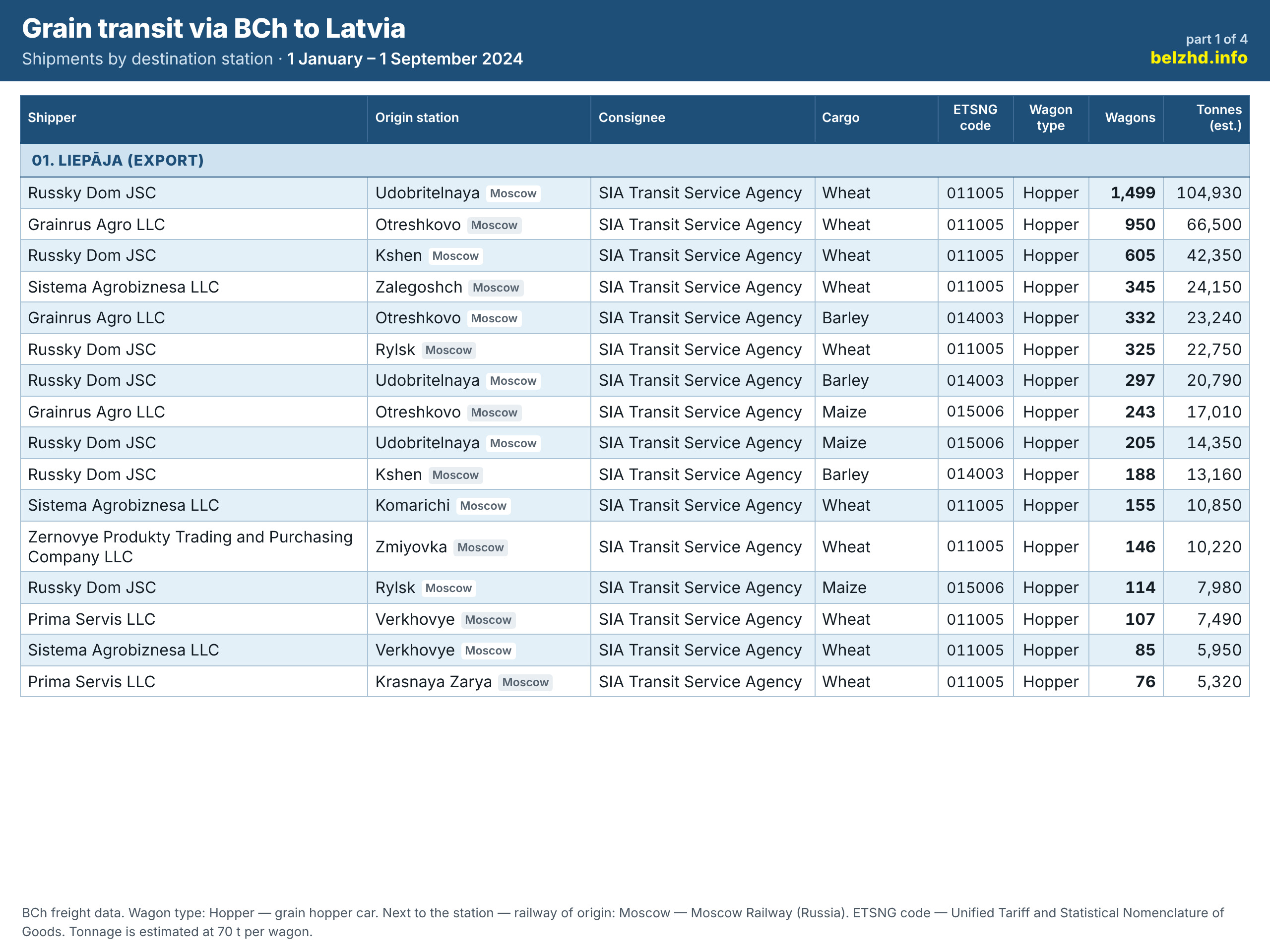
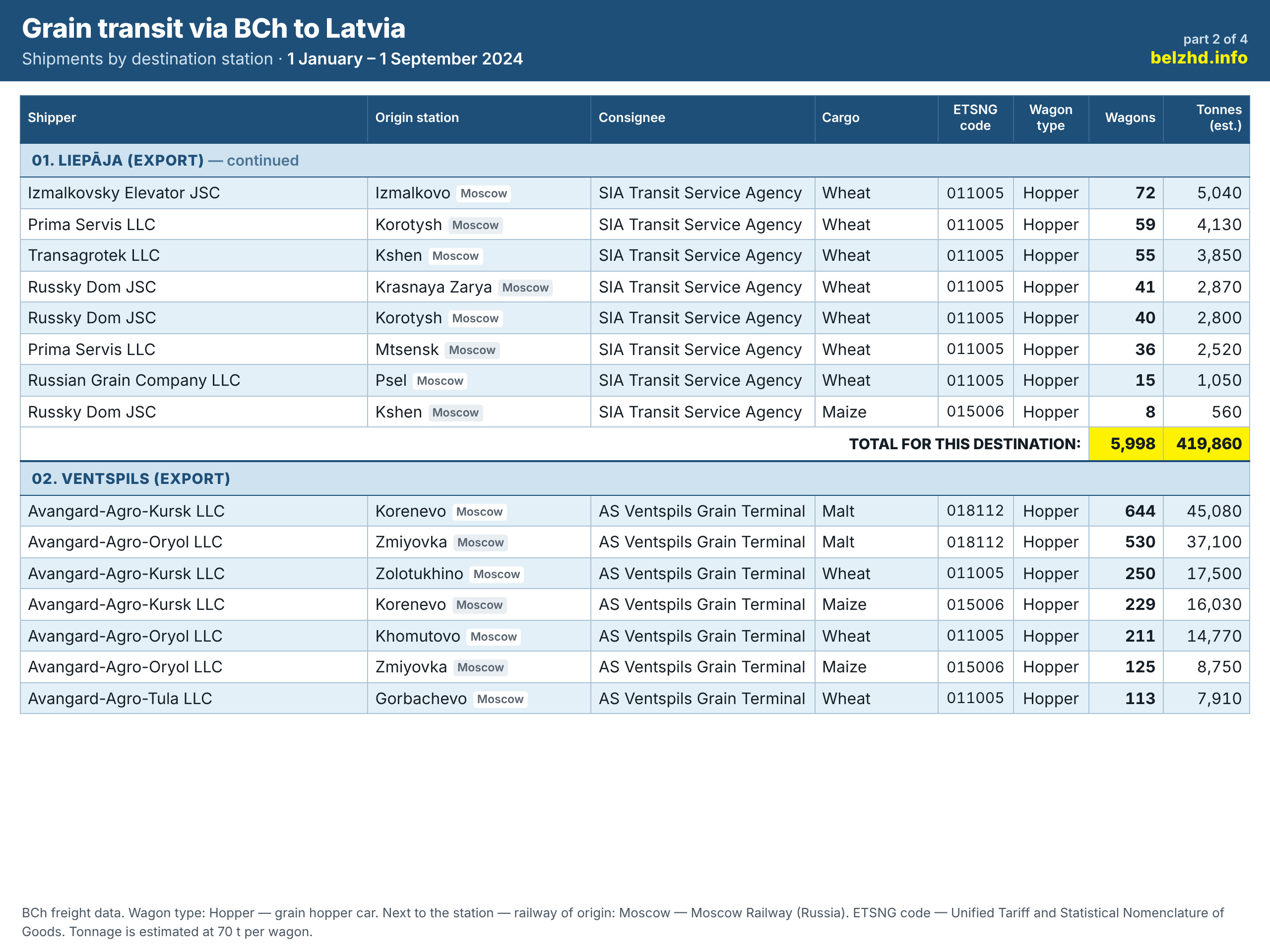
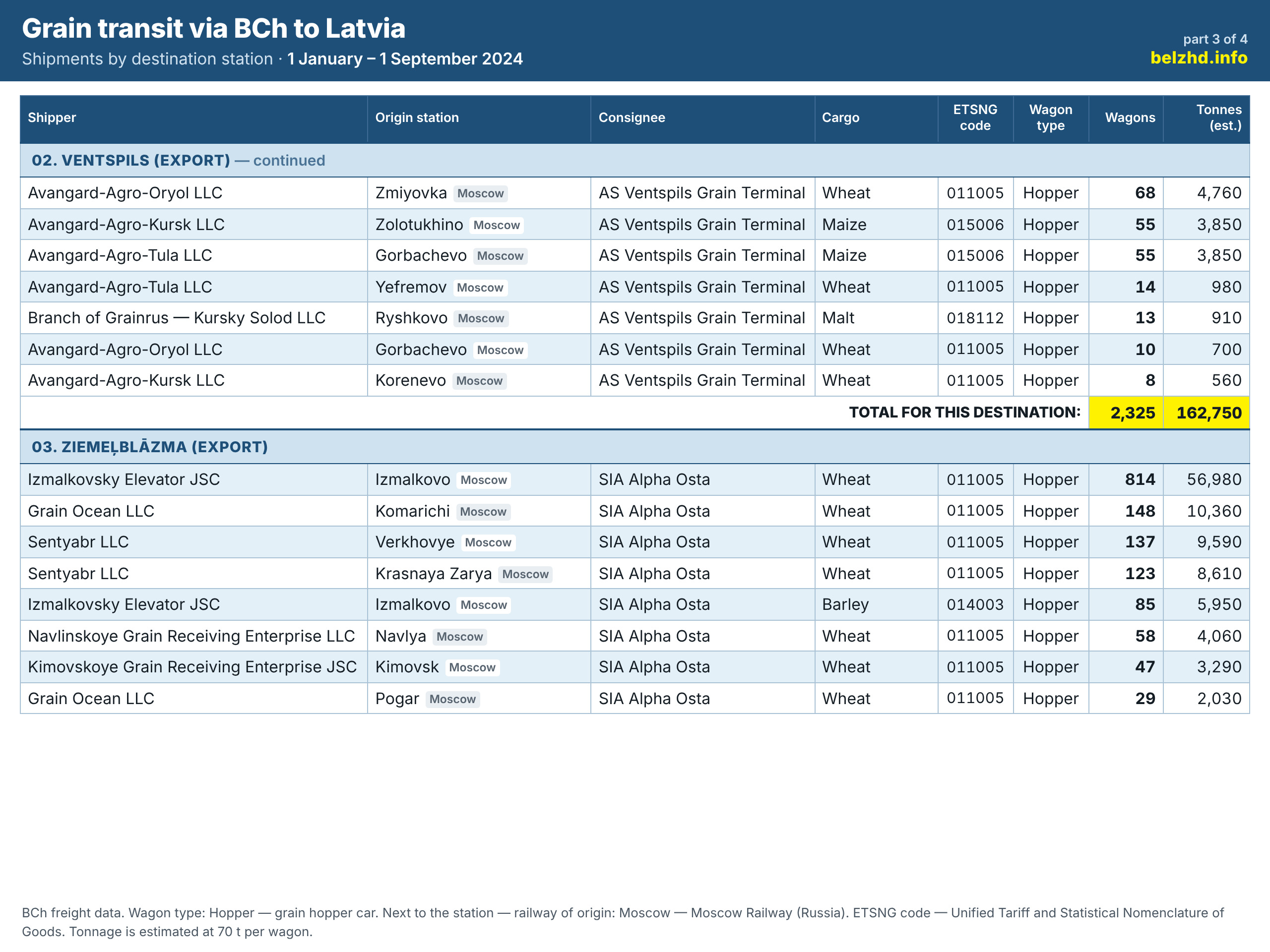
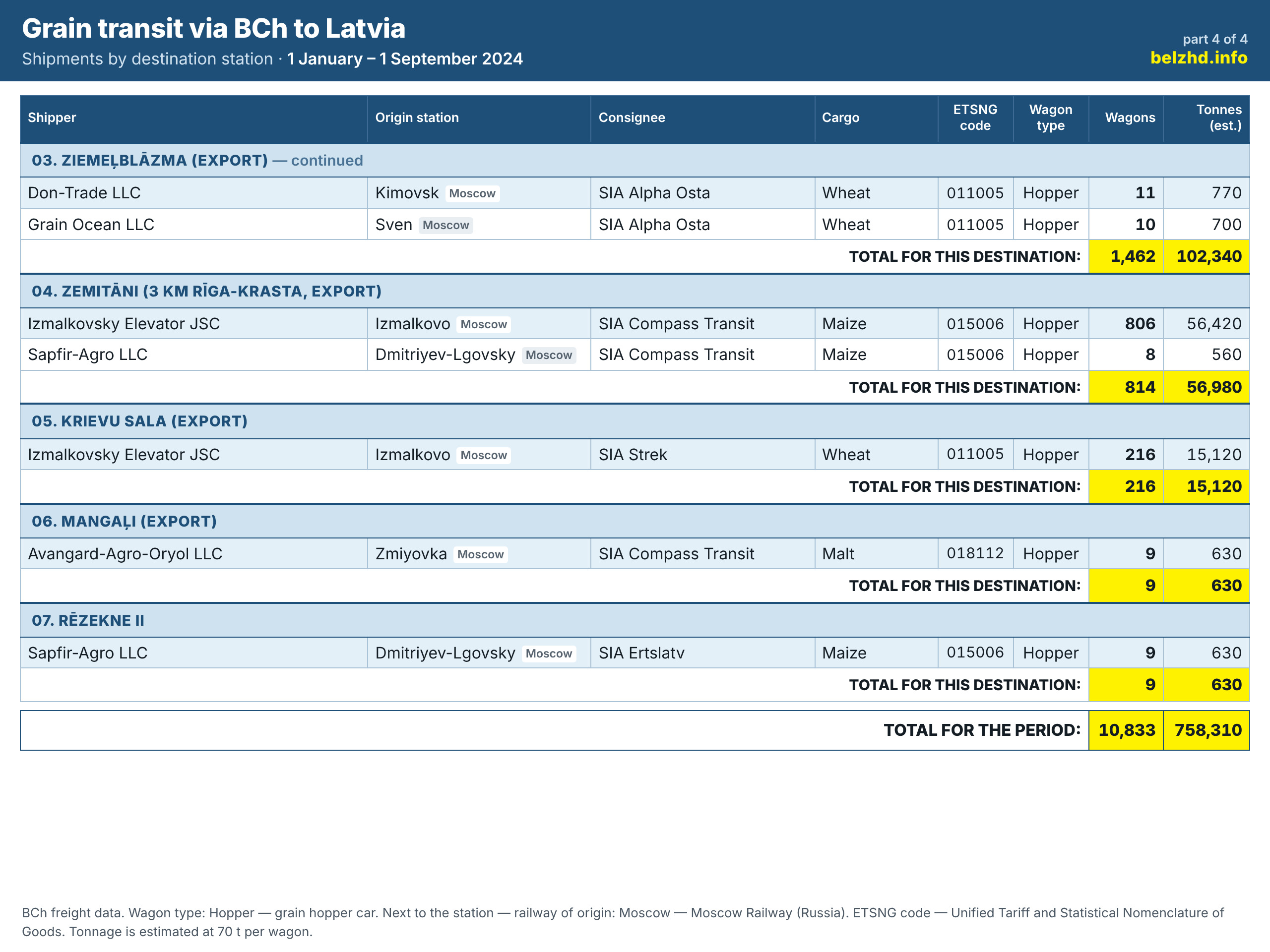
In 2024, nearly a fifth of all wagons were headed to Ventspils — almost all of it Avangard-Agro grain.
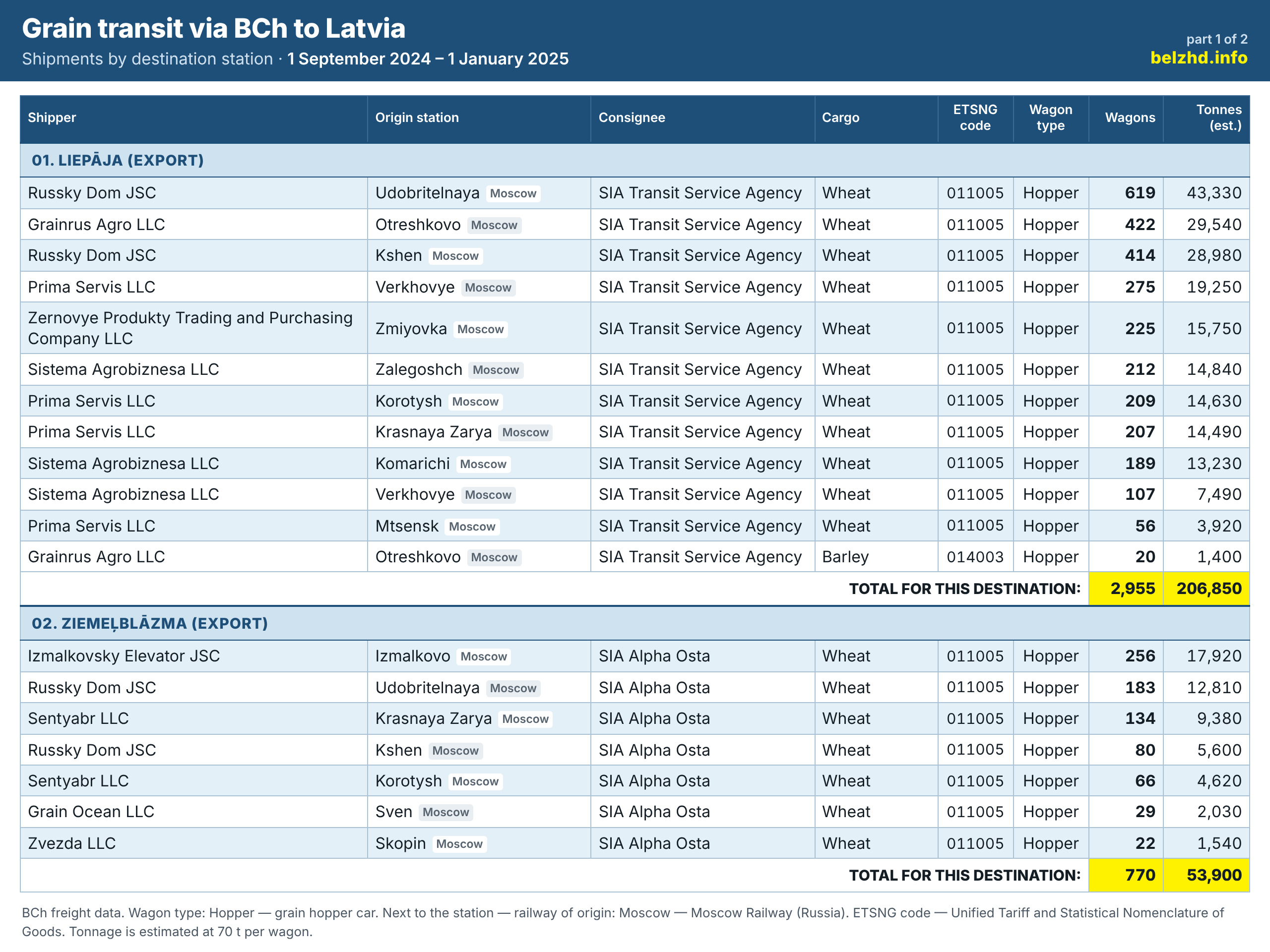
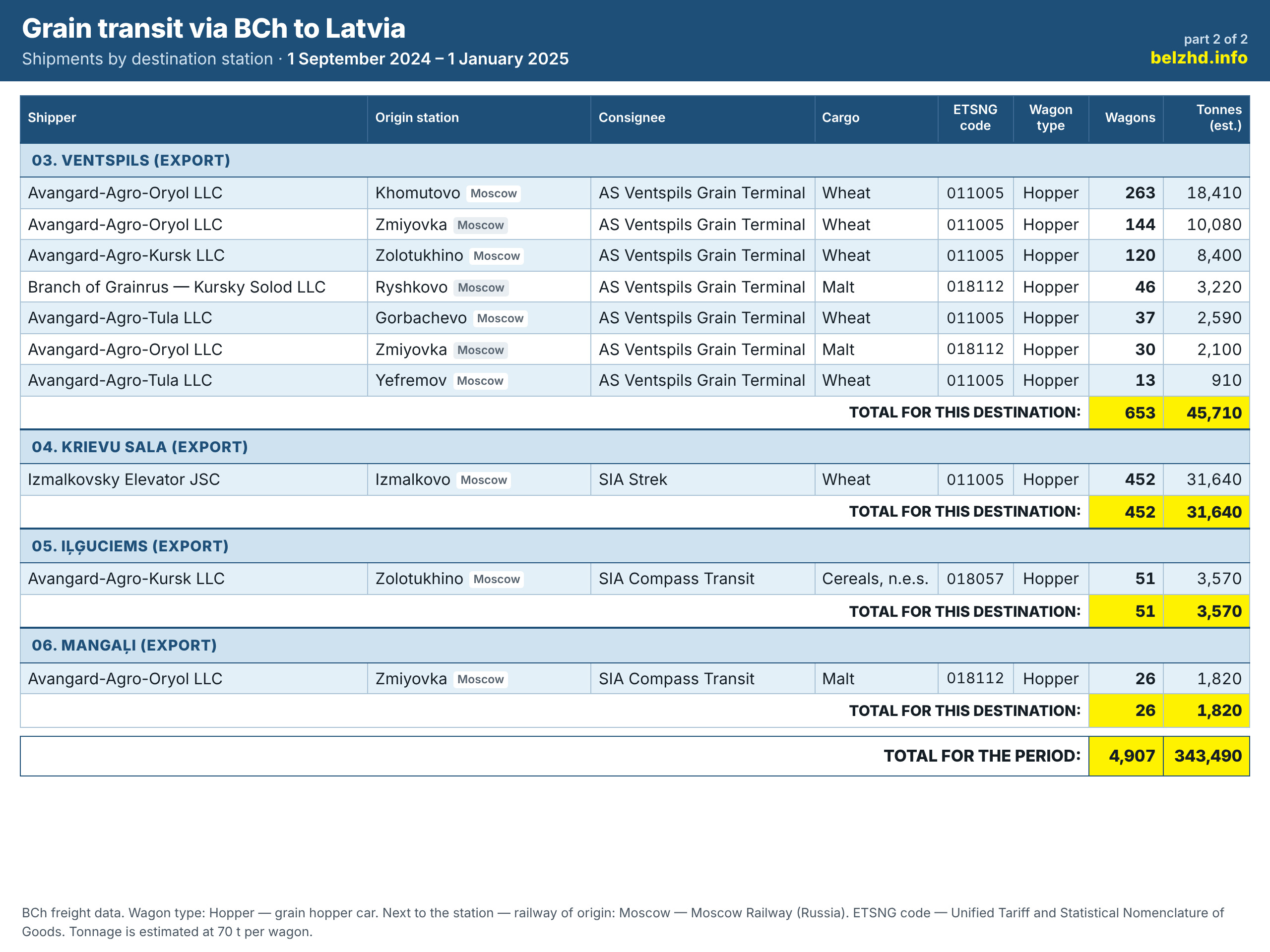
In 2025, Avangard-Agro shipped just 191 wagons, about 4% of the total. Ventspils received 302 wagons over the year — 6%.
From January to April 2026, the leaders were Russky Dom (39% of wagons) and Grainrus Agro together with Kursky Solod (29%).
Who’s receiving it in Latvia
Almost all wagons carrying Russian grain that travel via BCh to Liepāja are received by a single company — the freight forwarder Transit Service Agency. It accounted for more than half of all wagons arriving in Latvia in 2024, more than two-thirds in 2025, and nearly four-fifths from January to April 2026. It receives grain from Russky Dom, Grainrus Agro and Sistema Agrobiznesa.
According to Latvian business-data services that publish information from the Enterprise Register, Transit Service Agency was registered in Liepāja in 2000 and was known as Transwide Services Agency until 2009. Its sole owner is Irina Khrapova. The company’s revenue grew from €24.9 million in 2021 to €55 million in 2023, before falling to €41.6 million in 2024. That year, the company employed 28 people.
In 2025, grain from Izmalkovsky Elevator went mainly to Riga — to the Strek terminal on Krievu Sala island and the Alpha Osta terminal near Ziemeļblāzma station.
In 2021, the Latvian agricultural cooperative LATRAPS became a partner in Alpha Osta, when ASNS Investment, a company within its group, bought a stake in the terminal. In December 2023, LATRAPS, an indirect co-owner of the terminal, stated that it had demanded a halt to the transshipment of Russian and Belarusian agricultural products. An independent external audit of Alpha Osta was assigned to that same ASNS Investment.
Yet according to BCh freight data, Alpha Osta received about 2,200 wagons of Russian grain in 2024, 570 in 2025, and 120 between January and April 2026. In September 2025, as LATRAPS reported, ASNS Investment sold its stake to the other co-owners. According to Latvia’s Enterprise Register, half of the company’s shares are now held by Cyprus-based RRE Tradecenters Holding Limited, with another quarter held by Cyprus-based ROKRYMA Limited.
In Ventspils, grain from Avangard-Agro and Kursky Solod is received by Ventspils Grain Terminal. In 2021, its Kazakh owner, AIC-INVEST LLP, put the terminal up for sale, but according to Latvia’s Enterprise Register, it still holds a 91.5% stake today.
Grain from Belarus appeared this spring
In 2026, Latvian statistics began showing grain that the SRS records as Belarusian. From January to October, 186,000 tonnes of it accumulated: about 27,000 tonnes in August, about 55,000 in September, and about 54,000 in October. For all of 2025, only 128 tonnes had come from Belarus.
According to BCh freight data, not a single wagon of grain was sent from Belarus to Latvia in 2024 — only peas. In 2025, two wagons of grain were shipped, and in March and April 2026, 130 wagons — about 9,000 tonnes. All of them were sent by the Belarusian company Ditalan ALC: 25 wagons of wheat in March, and 105 wagons of wheat and barley in April.
Loading took place at seven stations — Klimovichi, Orsha-Vostochnaya, Buda-Koshelevskaya, Rechitsa, Tolochin, Pukhovichi and Koydanovo. The recipients were the stevedoring company Ekers Stividors LP in Liepāja (107 wagons) and WT Terminal near Riga’s Bolderāja station (23 wagons).
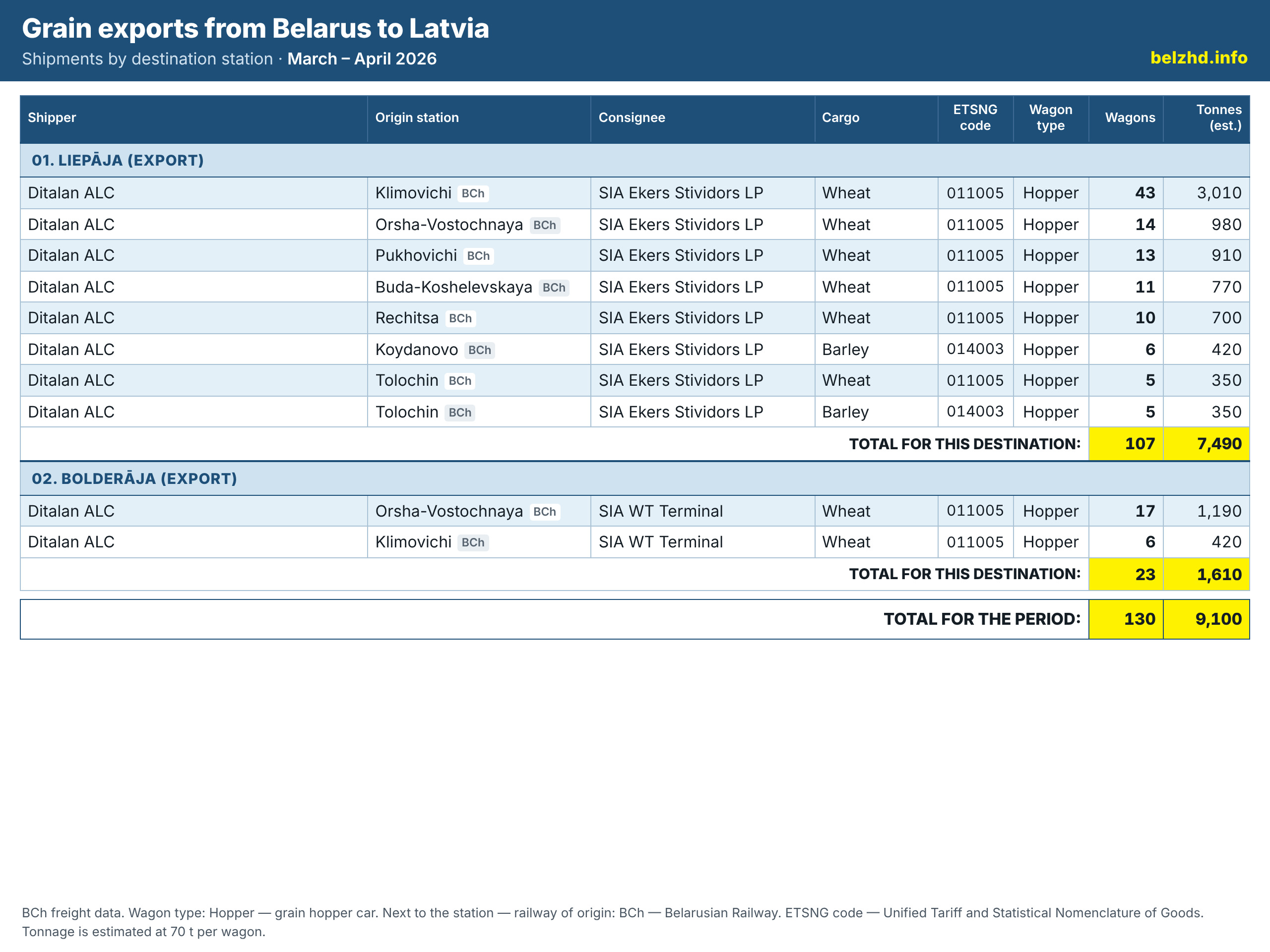
Ditalan is a Minsk-based company. By its own account, it has operated in the agro-industrial market since 2005, producing compound feed and premixes, purchasing vegetable oil and grain, and, since 2019, representing the Latvian trader SIA Agerona in Belarus.
Until 2026, Ditalan’s shipments to Latvia consisted mainly of peas and vegetable oil: peas alone accounted for more than 300 wagons in 2024–2025. Its first wagon of wheat was shipped in late 2025. In March and April 2026, 15 empty grain wagons arrived at Ditalan for loading, sent from Liepāja by Transit Service Agency. However, Ditalan’s grain was received in Latvia not by Transit Service Agency, but by other companies.
From January to April 2026, almost no wheat was brought from Russia into Belarus by rail, yet in April alone Ditalan shipped 105 wagons of grain to Latvia. That means the grain was either Belarusian in origin or arrived by some other means of transport. Among Ditalan’s loading points are Maryina Gorka, home to Pukhovichi station, and Orsha. Both towns have bread-products plants.
In 2021, Belarus banned grain exports. They were later allowed only under one-off licenses from the Ministry of Antitrust Regulation and Trade, with this arrangement renewed every six months. The last extension reported in the media ran from April 14 to October 14, 2025 — meaning most of Ditalan’s shipments took place only after it expired.
The loading point for the grain determines both the Latvian surcharge and the RZD tariff. Latvia applies a higher infrastructure fee to grain shipped from stations in Russia, but the government’s decision makes no mention of Belarus. RZD applies a double tariff on its own section of the route, including for shipments through Belarus, but grain loaded in Belarus doesn’t travel over the RZD network at all. Notably, Ditalan’s first wagons were shipped before either measure took effect: the RZD double tariff has applied since June 1, and the Latvian surcharge since October 13.
Grain from the south shifted to the Baltic
The sharp rise in transit through Latvia came in August–October, following attacks on Russia’s southern ports. Back in July, strikes on vessels and restrictions in the Kerch Strait had already halted grain ports on the Sea of Azov. On August 12, the port of Novorossiysk was attacked: two of the three largest grain terminals there were shut down, terminals that together handle about a third of Russia’s grain exports. According to Reuters calculations, by late September grain terminals in southern Russian ports with a combined capacity of about 53 million tonnes out of 67 million were sitting idle.
Exports pivoted to the Baltic: according to Rusagrotrans estimates, 65% of all Russian grain exports went there in September. According to Reuters and the consulting firm ProZerno, Latvia ranked among the top five destinations for Russian grain exports this season. From September 1 through the end of the year, Russia zeroed out export duties on wheat, barley and corn.
Grain also got priority on the railways: according to Kommersant, since October 1 export grain on the Northwestern route has been moved under the third priority category. From October 28 to November 3, at RZD’s request, a conventional ban was in effect on accepting cargo from Kazakhstan and seven other countries via the Osinovka — Krasnoye and Zakopytye — Zlynka crossings. An exception was made for grain and vegetable oil moving through Osinovka — Krasnoye.
Russian Baltic ports are overloaded. As Delovoy Peterburg reported, in September alone about 48 trains were held up on approaches to Ust-Luga station, and grain shipments, despite their priority status, are arriving with delays of at least three days. Part of the flow has shifted to Latvia.
In August, 159,000 tonnes of grain passed from Russia through Latvia — 56% more than a year earlier. In September, the figure was 347,000 tonnes, and in October, 425,000 tonnes. September and October together accounted for more than two-thirds of Russian transit over the ten-month period, and the January–October total came in 71% higher than for all of 2025. Neither the RZD tariff, doubled since June 1, nor the Latvian infrastructure fee hike for grain from Russian stations, raised on October 13, stopped the flow: October was the record month of the year.
The SRS does not disclose what share of this flow was carried by BCh. The direct crossing from Russia to Latvia, Posin — Zilupe, remains open. Since July 1, 2026, Russia has suspended traffic through the Pytalovo — Karsava crossing, though even before that only about one train a month passed through there.
According to our sources, the Posin — Zilupe crossing currently handles one or two freight trains a day. Yet in October, 425,000 tonnes arrived from Russia — nearly 200 wagons a day, or three to four trains of grain alone. If the crossing handled the same volume in October, it’s unlikely such a flow could have passed through directly. It appears a significant share of this growth is also moving via Belarus.
What’s actually new
In Latvia, the rise in transit is being discussed as a new phenomenon, but neither the flow itself nor the debate around it is new. According to SRS data, about 2.2 million tonnes of grain passed from Russia through Latvia in 2023, and 1.9 million tonnes in 2024. Even then, BCh carried roughly half of that grain. The 3.1-fold increase comes from comparing against January–October 2025, when the flow was in decline: for all of that year, only 652,000 tonnes passed through from Russia.
In January 2024, Latvia’s Ministry of Agriculture warned in an informational report that Russian grain transit threatened Latvian grain exports. Around the same time, Kristaps Amsils, head of Latvia’s largest grain processor, Dobeles dzirnavnieks, urged the Baltic states to agree on banning both imports and transit. In 2024, Latvia banned imports of Russian and Belarusian grain, but not transit.
What’s new in 2026 is something else:
- a spike: in October, 425,000 tonnes of grain passed from Russia through Latvia, compared with an average of about 190,000 tonnes a month in 2023. If the October pace holds through year-end, around 2 million tonnes will arrive from Russia in 2026 — roughly matching 2023–2024 levels;
- suspicion that grain from occupied Ukrainian territories is moving through Latvia: shipments are now being checked;
- Estonia closed its transit route even though Russian grain hardly moved through it anyway; in the Baltics, it mainly travels via Latvia;
- grain from Belarus has appeared, and judging by the government’s decision, the Latvian infrastructure surcharge doesn’t apply to it;
- all of this coincided with the October 3 Saeima elections and farmer protests; a new protest against transit, according to Latvian public broadcaster LSM, has been scheduled for November 7 in Jēkabpils.
The bottleneck is Polotsk
On the Belarusian side, everything hinges on the Polotsk rail hub and the Bigosovo — Indra crossing. According to our sources, acceptance through the Bigosovo — Indra crossing was recently restricted for three days, and the backlog of wagons then had to be worked back into the existing schedule. At Polotsk station, the same sources say, operations were further hampered by bridge repairs near the station’s exit throat. On the Latvian side, in early September, according to the TVNET news portal, about 300 grain-laden wagons bound for the ports were sitting in Daugavpils.
It’s not only grain wagons moving through Polotsk. According to our sources, over roughly three weeks, around 3,000 privately owned tank wagons accumulated bound for Novopolotsk and Naftan. At Naftan, according to Reuters, overhaul work on processing units began in late September, with most of it taking place in October.
The turnaround time for a grain wagon between BCh and Latvian Railway (LDz), according to our sources, is approaching a month. A wagon waits for a train to be formed, sits on the approaches to Polotsk, and waits again before being handed over to LDz via the Bigosovo — Indra crossing. It then sits idle on the Latvian side and during unloading at the port, before returning empty for reloading. For the wagon’s owner, all of this adds up to a single metric: turnaround time.
The scale can be roughly estimated. In October, about 480,000 tonnes of Russian and Belarusian grain passed through Latvia. A grain wagon typically carries 67–73 tonnes. At 70 tonnes per wagon, that’s about 6,900 wagons, or 220 wagons a day. With a 30-day turnaround cycle, more than 6,500 wagons would be in this cycle at any given time. This is a rough estimate based on the entire Latvian flow, not the actual wagon fleet.
The longer the turnaround, the more wagons owners need to move the same volume. Inside Russia itself, as Kommersant reported, the cost of shipping grain in hopper wagons to Baltic ports rose 25% in October, with market participants complaining of denied scheduling requests and wagon downtime.
Every wagon of grain brings BCh transit revenue, so the incentive to take on new volume is clear. But the long turnaround time isn’t paid for by wagon owners alone. BCh pays for it in occupied track capacity at stations, locomotives and crews, while other customers pay through delays to their own cargo. While the grain is in transit, the cargo owner is left waiting for payment, and the freight forwarder, having sold delivery at a fixed rate, loses margin and risks missing deadlines.
Take the cargo or limit acceptance
If traffic grows, and the line capacity of Polotsk, the Bigosovo — Indra crossing, and Latvian ports remains unchanged, BCh will have to choose: either accept cargo and accumulate wagons at stations, or limit acceptance and lose revenue.
That is why tonnes say little about what these shipments cost BCh. Other indicators are more important: the average wagon turnaround time, idle time at Polotsk station, actual acceptance via the Bigosovo — Indra crossing, the number of wagons approaching the Latvian border, and grain wagon idle time during unloading at the port.
Political risk
The route via the Bigosovo — Indra crossing could close for reasons unrelated to railways.
- On September 15, the Latvian government recommended increasing the infrastructure fee for grain from Russian stations by 300%; on September 17, the Saeima urgently adopted amendments to the Railway Law. However, from October 13, the fee increased by only 25% on average. Transit via the Latvian route, according to LSM, costs the shipper 25–30 euros per tonne, while the infrastructure fee surcharge is less than one euro.
- On September 24, the Saeima called on the government to prepare regulations to immediately stop the import of Russian and Belarusian grain, including transit.
- Since September, the SRS has been checking documents for every batch of grain from Russia and Belarus, and the Food and Veterinary Service sends samples to laboratories in France and the UK: they are looking for grain from occupied Ukrainian territories. If found, the operations of a specific carrier may be restricted, up to a transit ban.
- On October 21, Latvia, Ukraine, and the UK signed a memorandum on joint inspections, including in ports and on railways. According to Latvian Television (LTV) on October 29, the analysis results are not yet available, and they will not be publicly disclosed.
- Estonia banned the transit of Russian and Belarusian grain from October 8 — six days after the government’s decision, with no transition period or exceptions.
- On October 9, the leaders of Lithuania, Latvia, and Estonia asked the EU to ban the transit of Russian grain. However, the conclusions of the European Council on October 16 only refer to grain exported from occupied territories of Ukraine.
- Kulbergs says a full ban is currently impossible: grain is not under sanctions, the EU must decide, and lawsuits could cost 200–800 million euros. The Ministry of Transport estimated industry losses from closing this transit at 290 million euros. On October 26, the Latvian Foreign Ministry informed Reuters that there is no ban yet, and the government is preparing it at the EU or Latvian level.
On November 3, the new Latvian Saeima convened, and on November 4, President Edgars Rinkēvičs instructed Kulbergs to form a new government. They will now decide on the transit issue. If a ban is introduced as quickly as in Estonia, grain already en route will remain at the approaches to the border — at BCh stations.
Related materials:
Second Ban in a Month: Cargo from Kazakhstan and Seven Other Countries Barred from Belarus via Krasnoye and Zlynka;
Disappointing results of 2025 in BCh freight operations and foreign economic activity.