To the extent possible,* we present to the public what rightfully belongs to it—various information about the activities of the state association “Belarusian Railway”, created and operating on state, that is, national (public) funds.
However, virtually all information from the Belarusian Railway, like the authorities in general, is now concealed. Even what was recently open and accessible, as in civilized countries, is now classified as “official,” “commercial,” or other secrets to intimidate and enable actual criminal prosecution of citizens for its disclosure. In reality, there is no secret whatsoever, including official or commercial, in what we present today.**
On the contrary, under normal operating conditions, information about logistics chains is useful to logistics operators and freight forwarders in seeking more competitive offers for cargo owners. The Belarusian Railway also benefits from this, as it cannot inherently possess all competencies available in the market. However, the authorities’ fear in attempting to conceal their miscalculations and inefficiency bears no relation to common sense.
Nevertheless, let us return to the topic. We present operational Belarusian Railway statistics on the transport of major export goods (fertilizers, petroleum products, timber cargo, ferrous metals, hereinafter MEG) for five months of 2023 compared with the same period in 2022,*** supplementing previously published information, but in a different breakdown.
Dynamics of major export goods export for five months of 2022–2023:

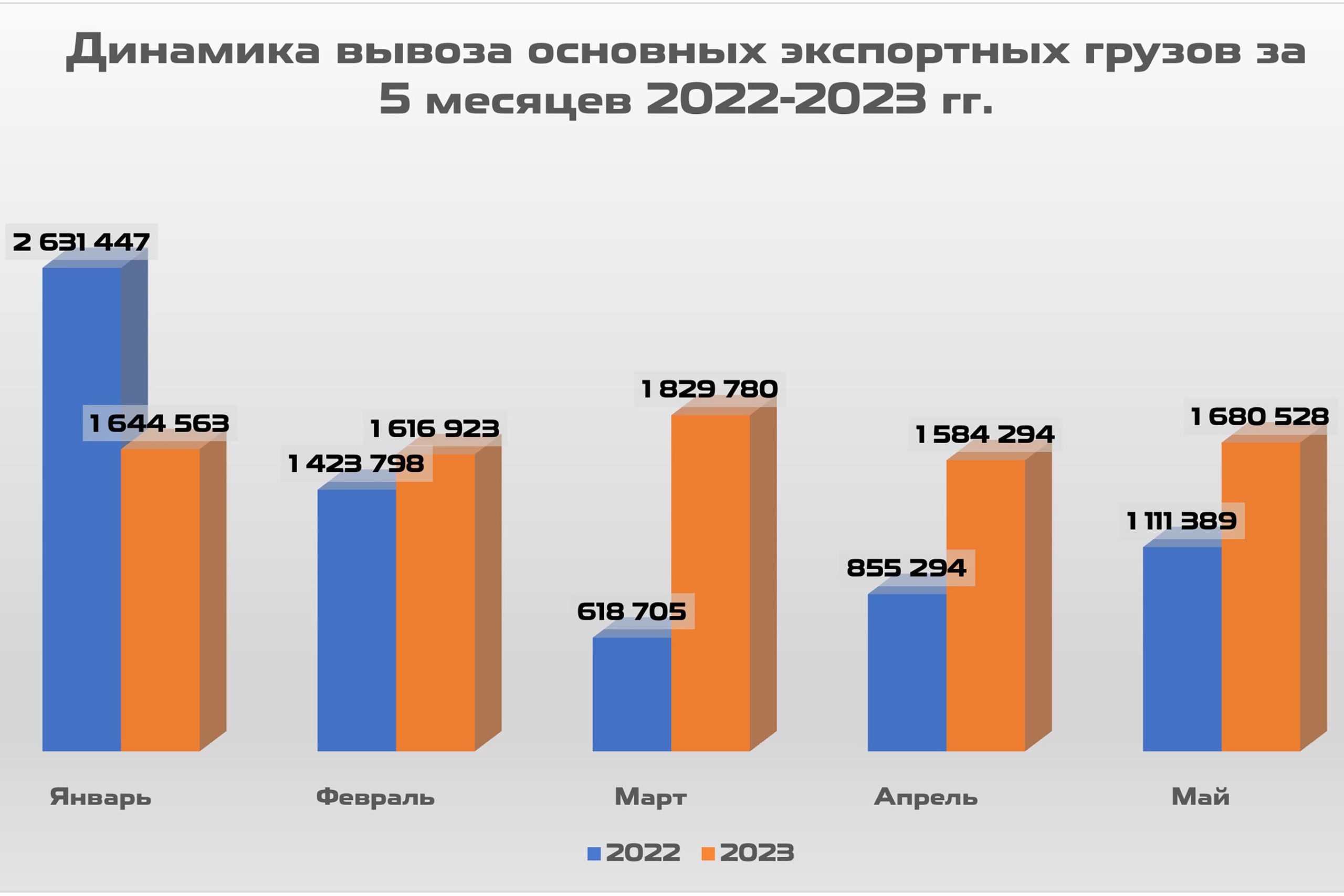
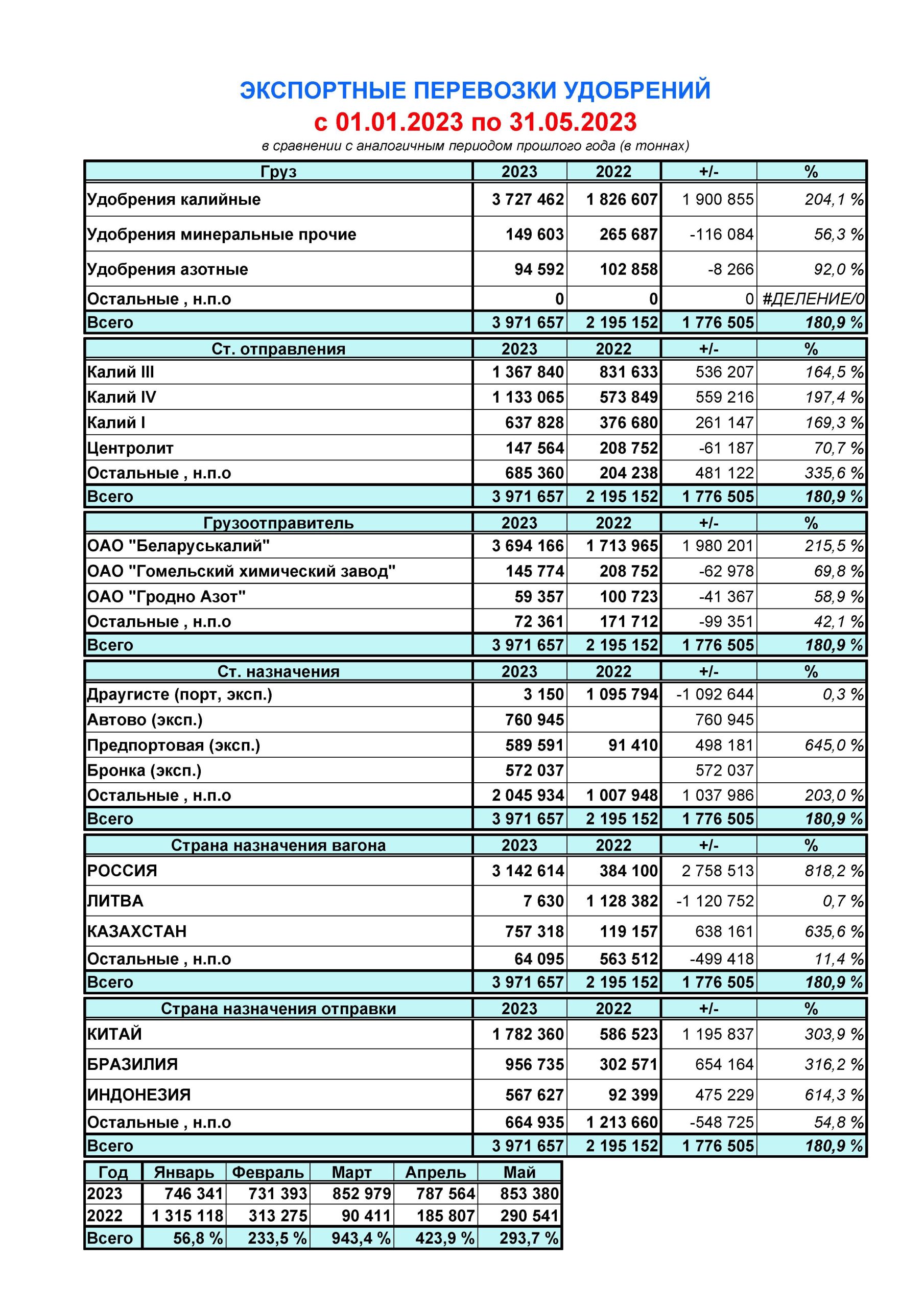
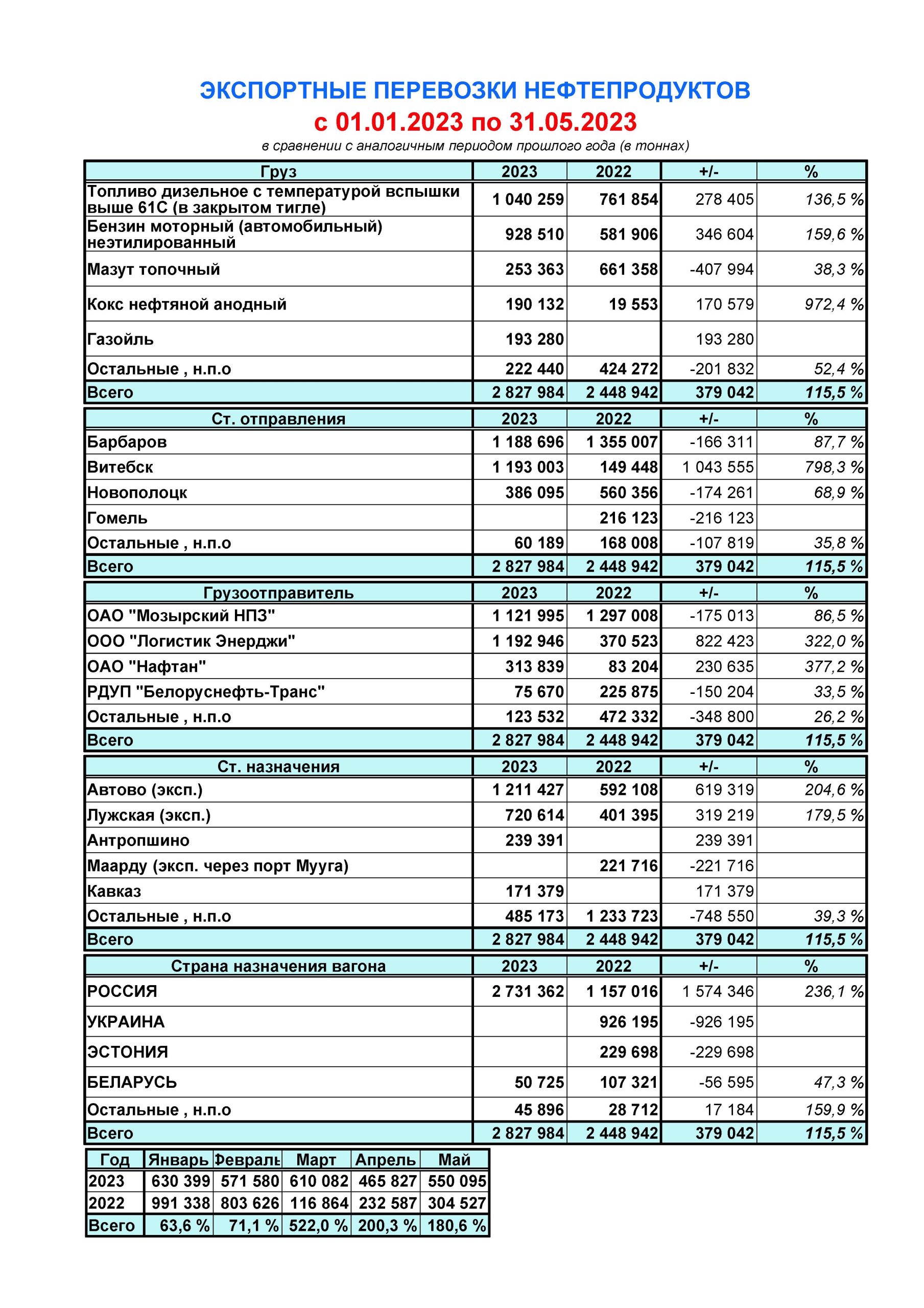
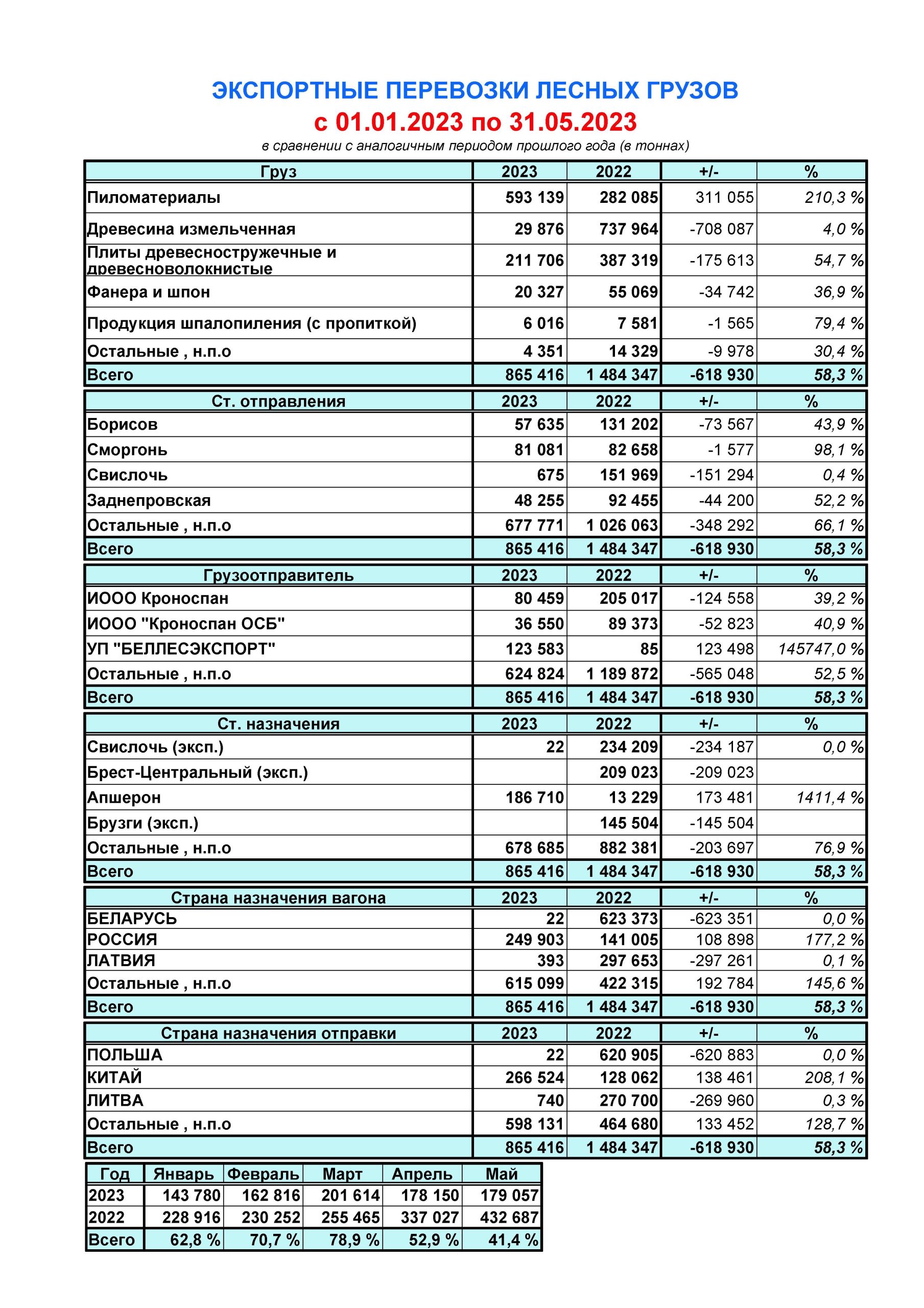
Source data: 1. Export transport of fertilizers; 2. Export transport of petroleum products; 3. Export transport of timber cargo; 4. Export transport of ferrous metals:
The geography of MEG transport as a whole changed radically in 2023 and now follows the general shift to/via Russia, as we have repeatedly written (links below).
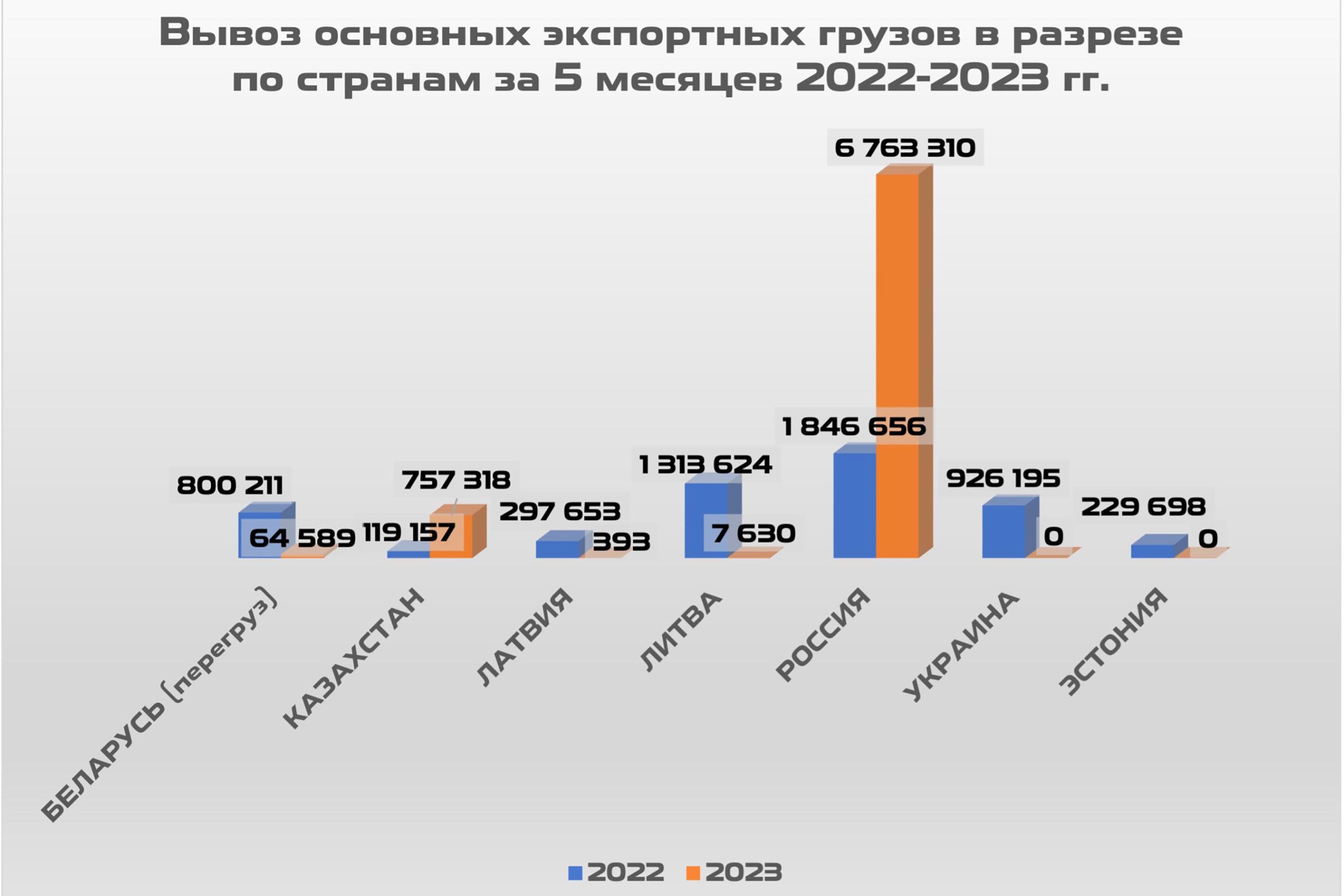
In 2023, export of MEG overall is increasing and totaled 8,356 thousand tonnes, or 125.8%, including to/via Russia—6,763 thousand tonnes, an increase of 3.7 times. At the same time, the share of MEG to/via Russia in total export increased from 27.8% (1,847 thousand tonnes) to 80.9%.
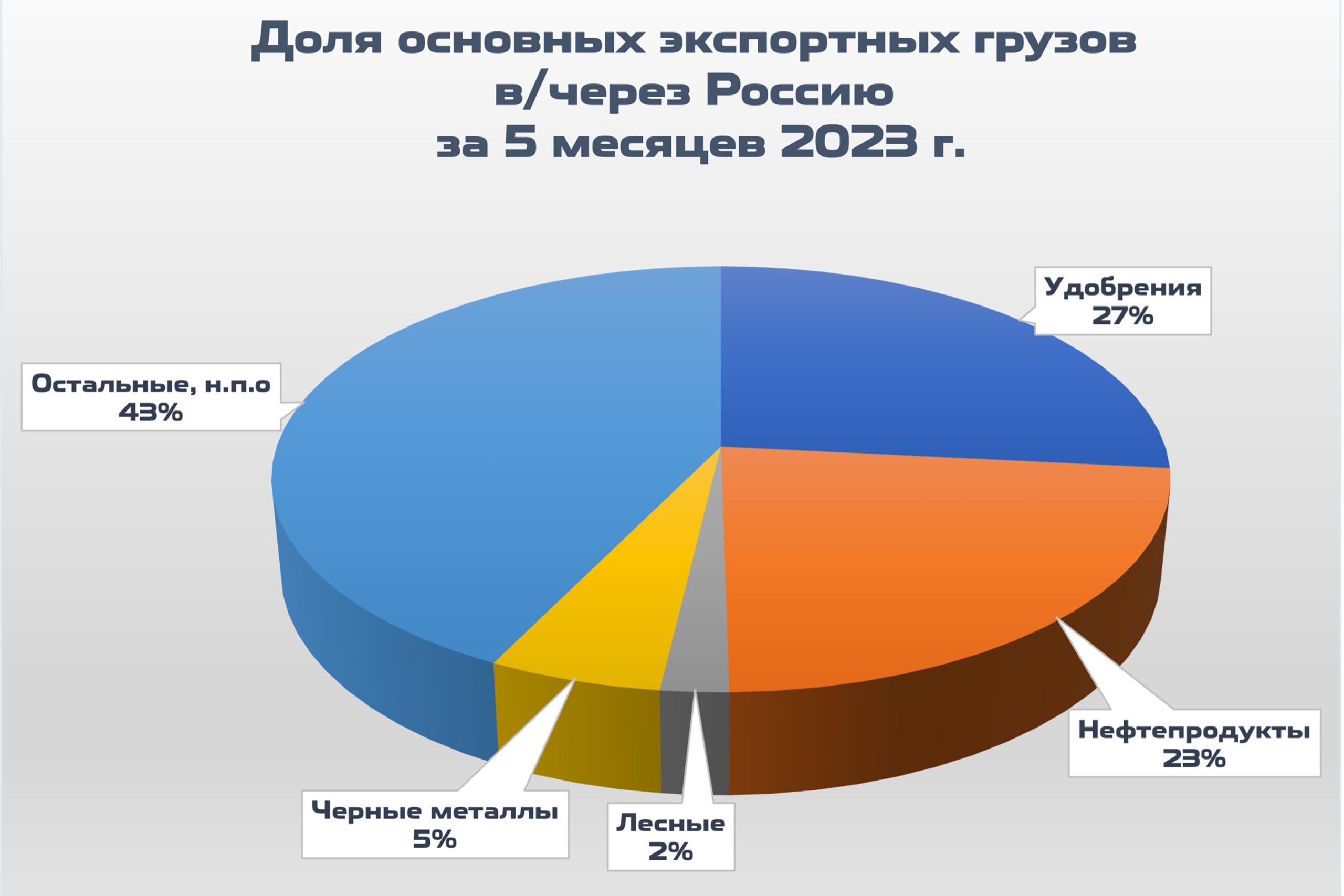
1. Share of major export goods to/via Russia for five months of 2023;
2. Export of major export goods by country for five months of 2022–2023.
Exports of MEG to Ukraine and Estonia have stopped completely, exports to Latvia (0.1% of the 2022 level) and Lithuania (0.6%) are approaching zero, and exports of MEG with transshipment at the Polish border have fallen catastrophically (8.1%). Meanwhile, exports to Kazakhstan, one of the member states of the Eurasian Economic Union (EAEU)****, increased 6.4 times, to 757 thousand tonnes, consisting exclusively of fertilizers. .
Similar trends are observed for individual categories of major export goods.
Fertilizers (potash, mineral, nitrogen). Export growth—180.9%, or 3,972 thousand tonnes. Nearly the entire share of fertilizers exported falls on Russia—79.1% (3,143 thousand tonnes) and partly on Kazakhstan—19.1% (757 thousand tonnes). In 2022, 51.4% of export went to Lithuania. The overall increase in exports in 2023 even exceeds the volume of export to Lithuania in 2022—1,777 thousand tonnes versus 1,128 thousand tonnes.
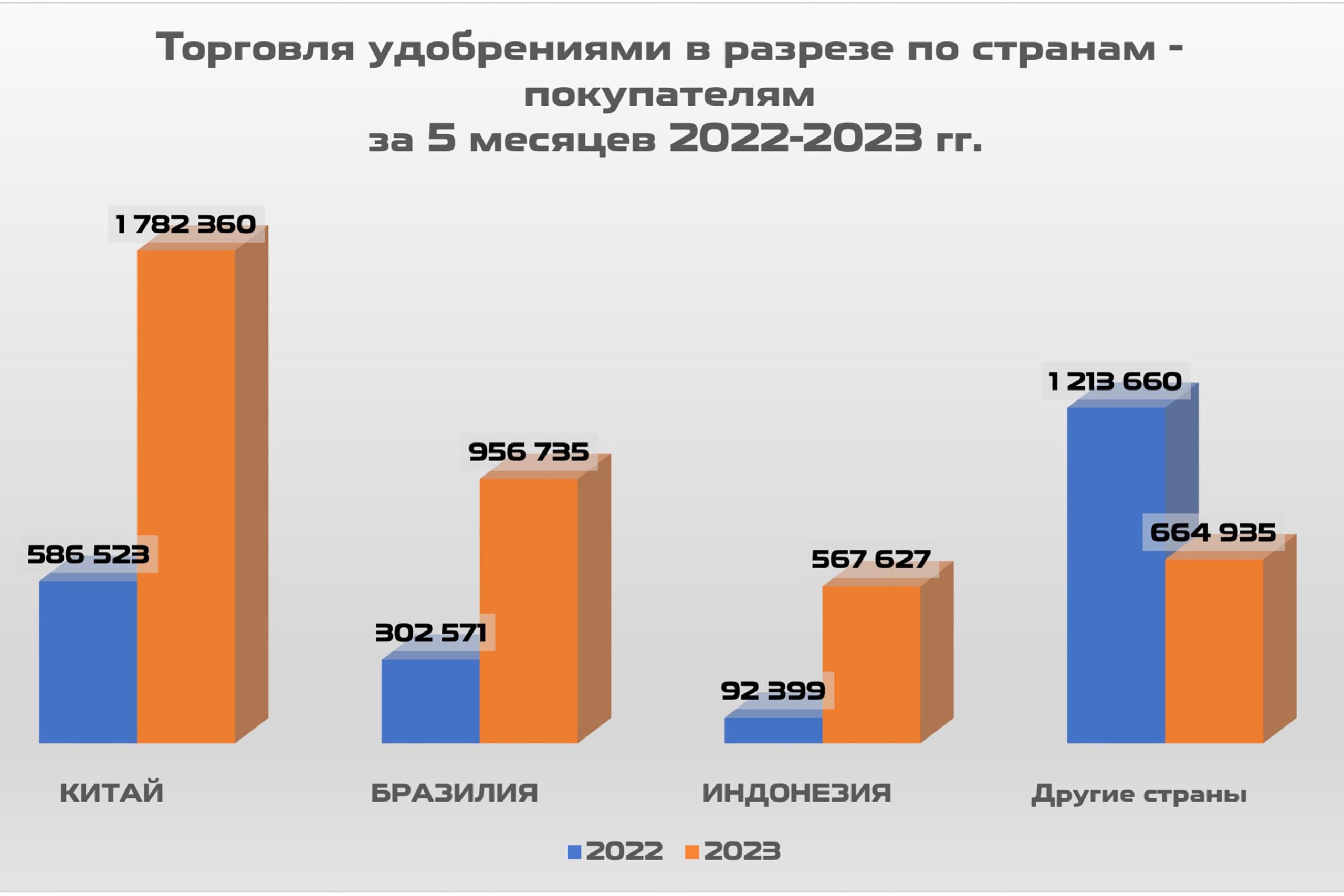
Trade trends are also of interest—a sharp increase in sales to China, Brazil, and Indonesia is occurring while trade with other countries is declining:
- China—growth of 3 times, or 1,782 thousand tonnes. Share in total fertilizer sales—44.9% (versus 26.7% in 2022);
- Brazil—growth of 3.2 times, or 957 thousand tonnes. Share in total fertilizer sales—24.1% (versus 13.8%);
- Indonesia—growth of 6.1 times, or 568 thousand tonnes. Share in total fertilizer sales—14.3% (versus 4.2%);
- Other countries—decline to 54.8%, or 665 thousand tonnes. Share in total fertilizer sales—16.7% (versus 55.3%).
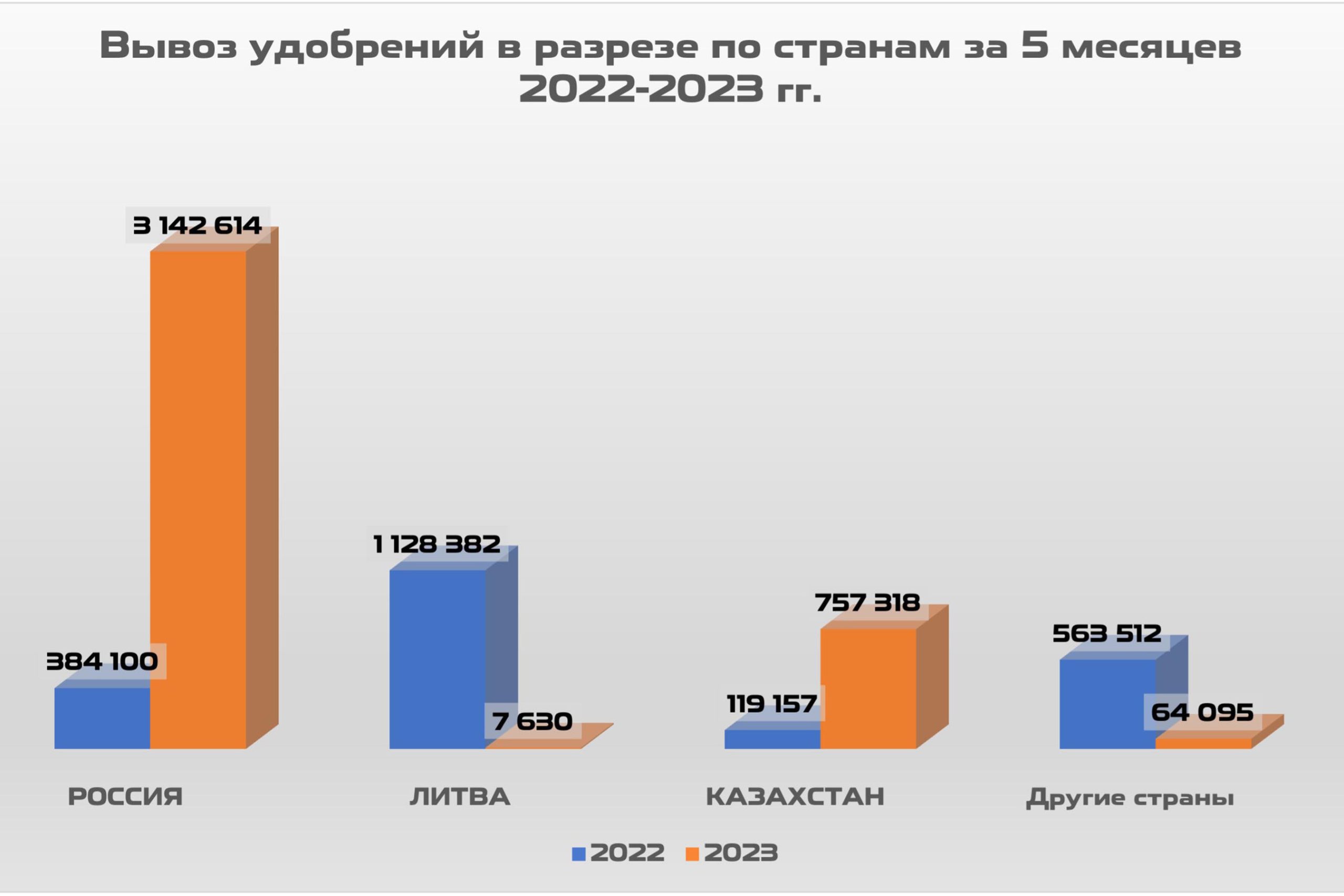
1. Export of fertilizers by country for five months of 2022–2023;
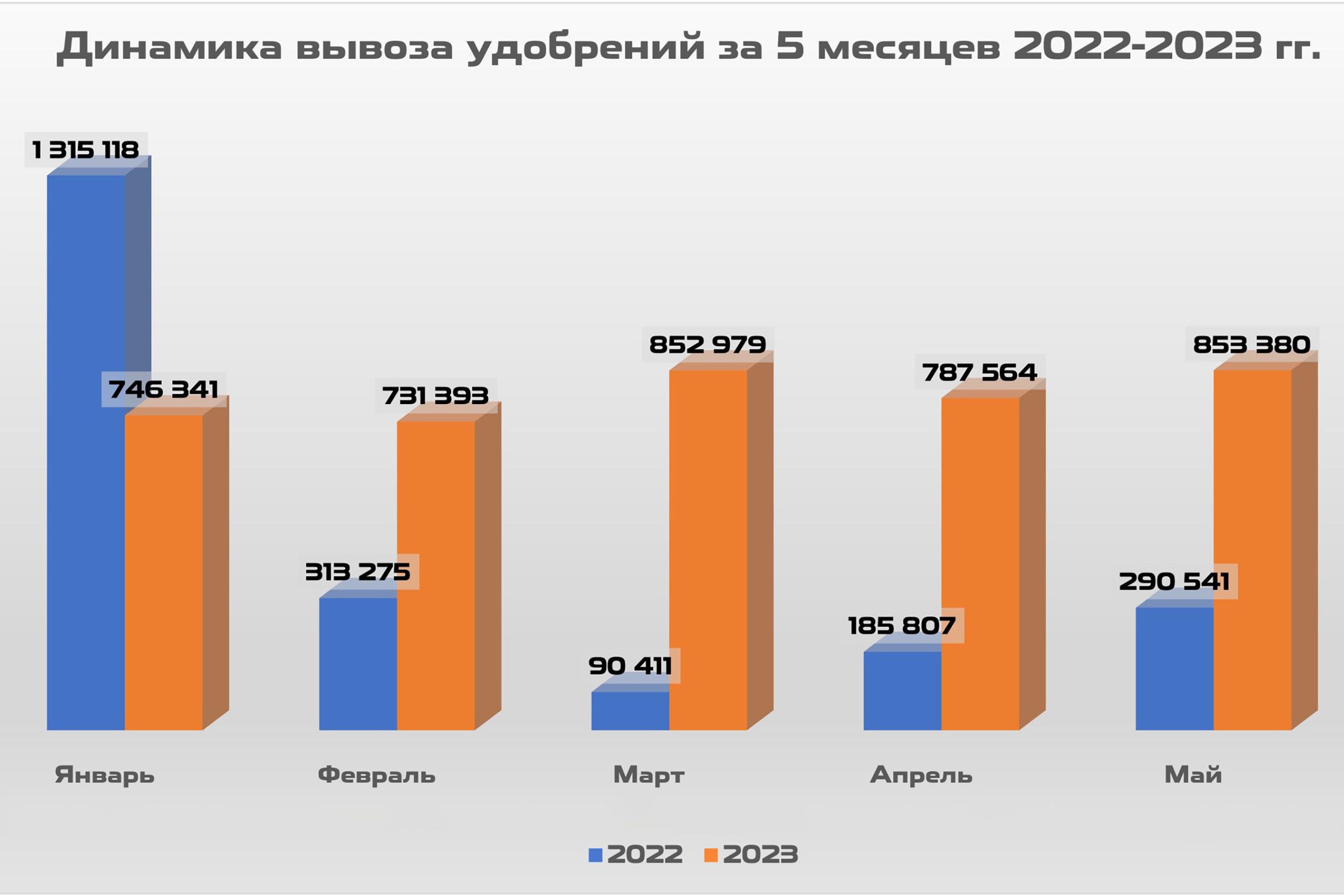
2. Dynamics of fertilizer export for five months of 2022–2023;
3. Fertilizer trade by purchasing country for five months of 2022–2023.
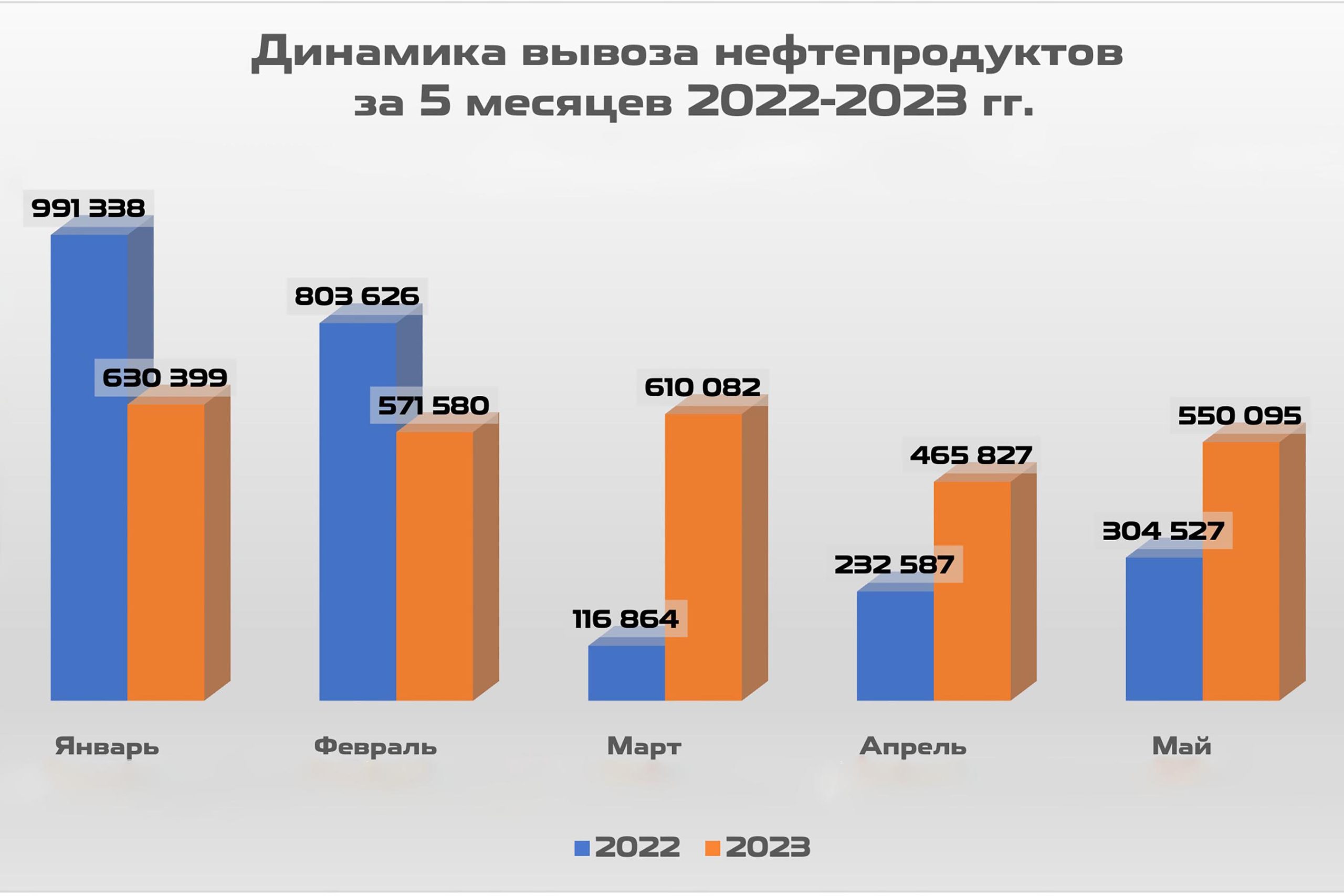
Petroleum products (primarily fuel, gasoline, fuel oil). Export growth—136.5%, or 2,828 thousand tonnes. Nearly the entire share of petroleum products exported falls on Russia—96.6% (2,731 thousand tonnes). Whereas in 2022 this was a share of 47.2% (1,157 thousand tonnes), and 37.8% (926 thousand tonnes) was exported to Ukraine.
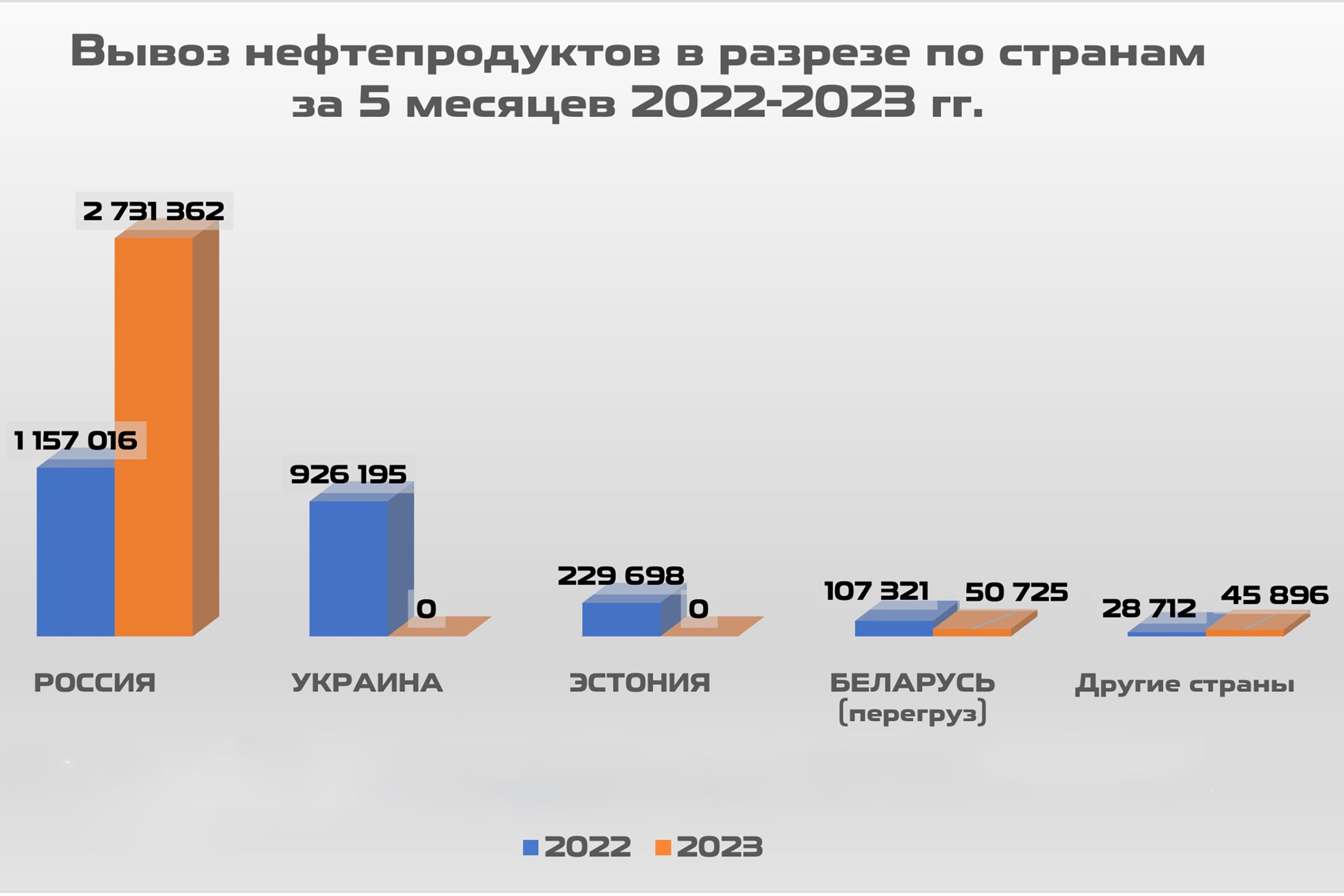
1. Export of petroleum products by country for five months of 2022–2023;
2. Dynamics of petroleum product export for five months of 2022–2023.
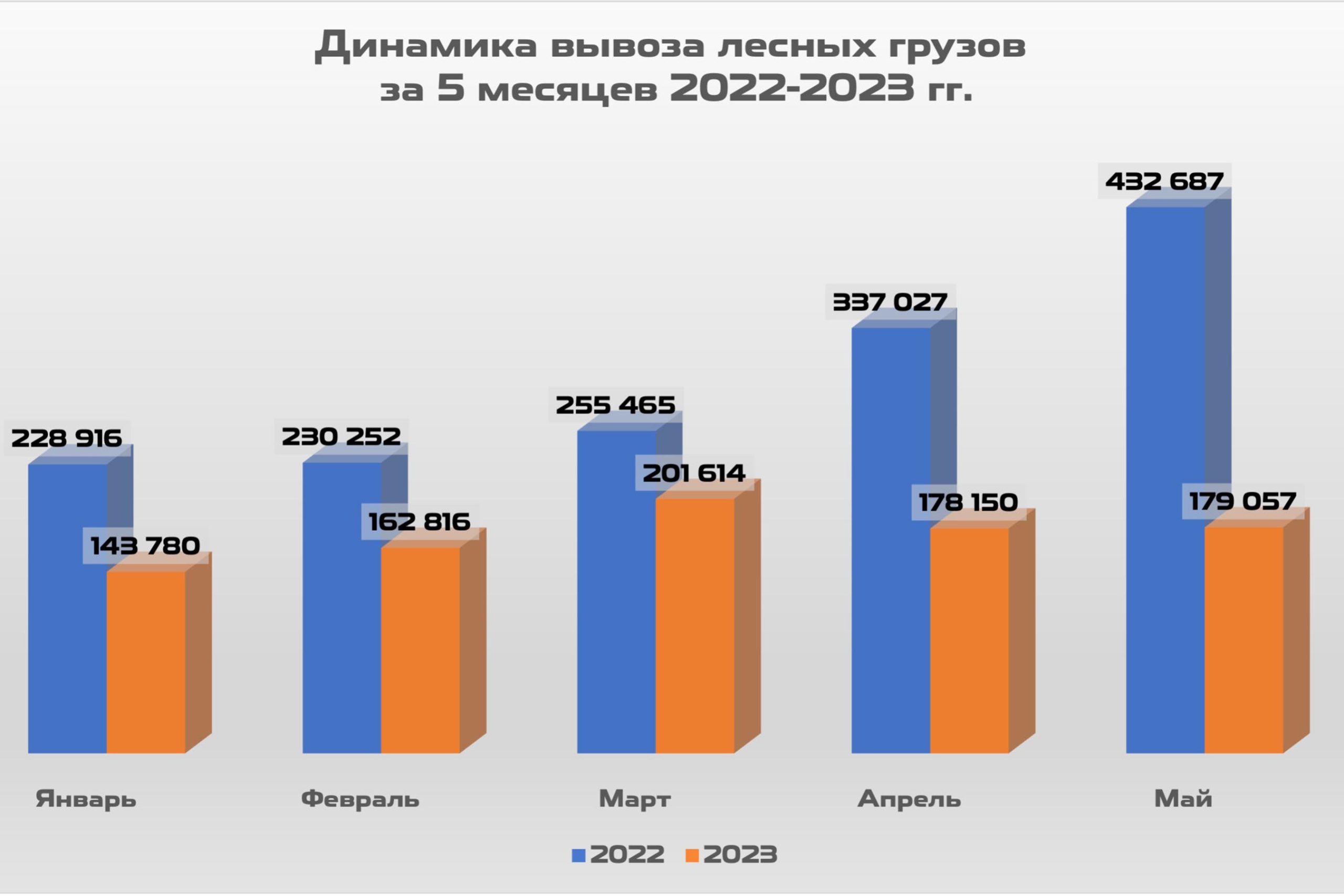
Timber cargo (primarily lumber, chipboard and fiberboard). Here a serious decline in export volumes is noted—58.3%, or 865 thousand tonnes. With export growth to Russia up to 177.2%, or 249 thousand tonnes (the share in total export also increased to 28.9% versus 9.5%), export volume to other countries increased even more—145.6%, or 615 thousand tonnes (share 71.1% versus 28.5%). Here we note separately that in the overall volume of the presented statistics, China stands out as the final destination for timber cargo with deliveries of 267 thousand tonnes.
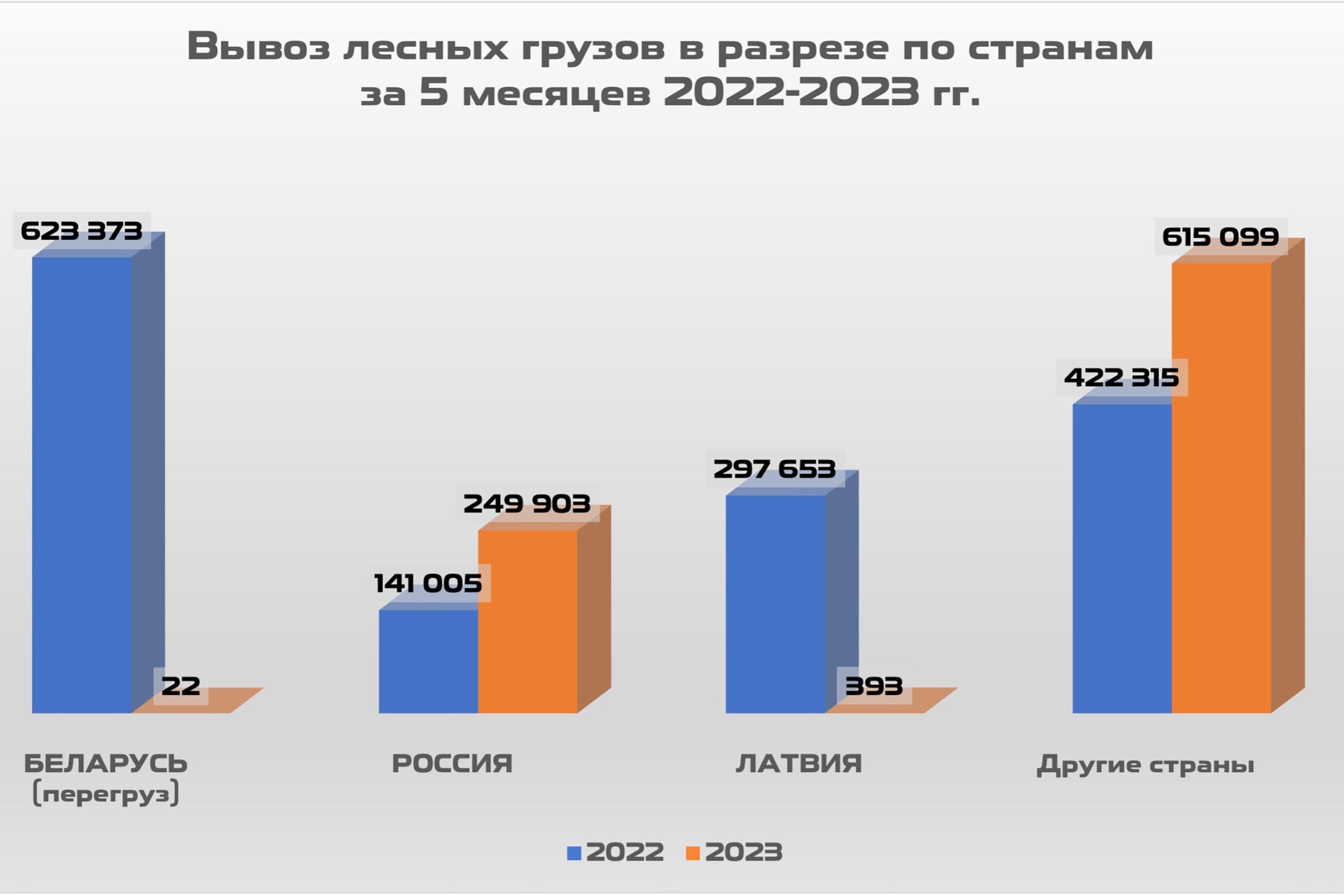
1. Export of timber cargo by country for five months of 2022–2023;
2. Dynamics of timber cargo export for five months of 2022–2023.
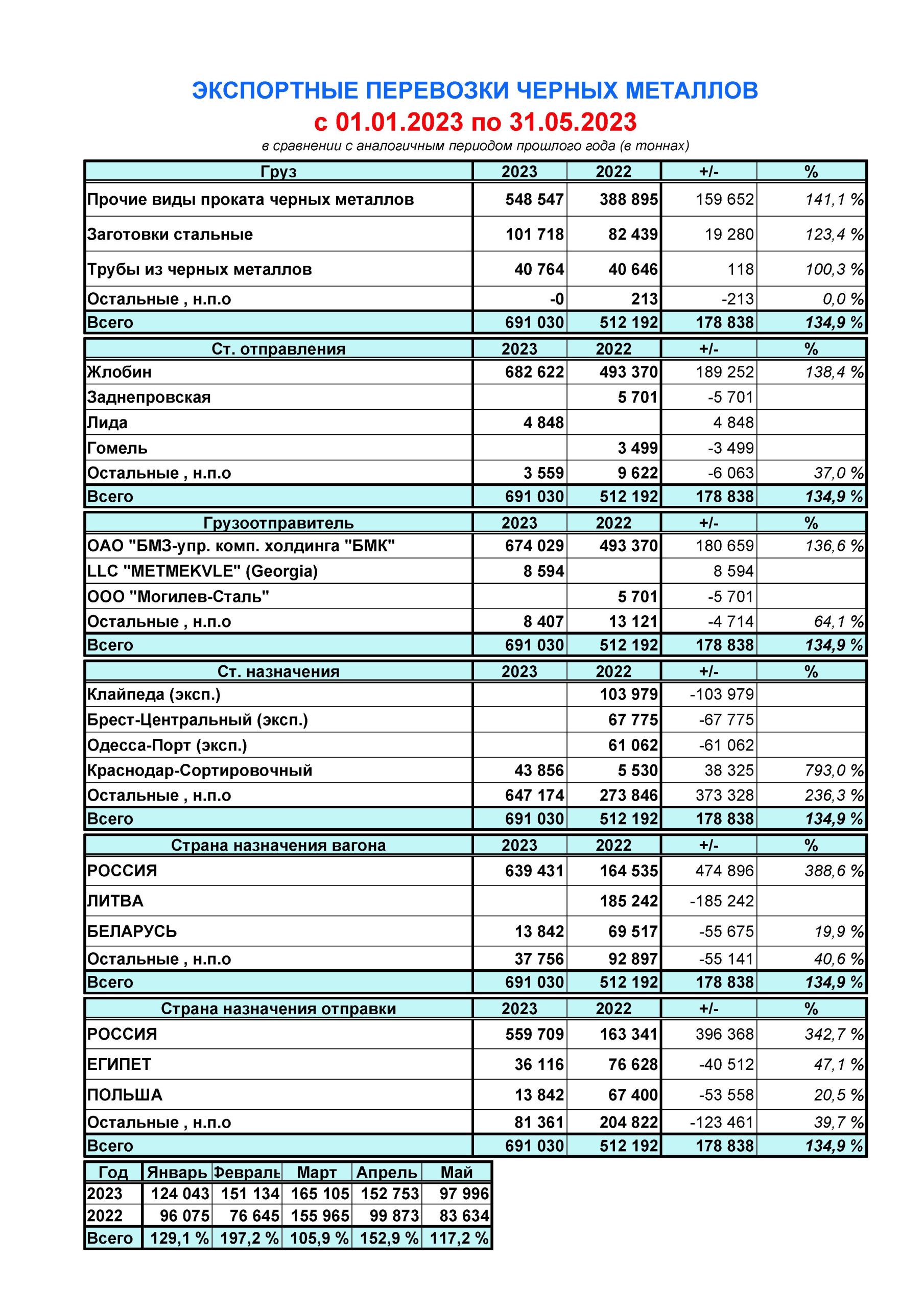
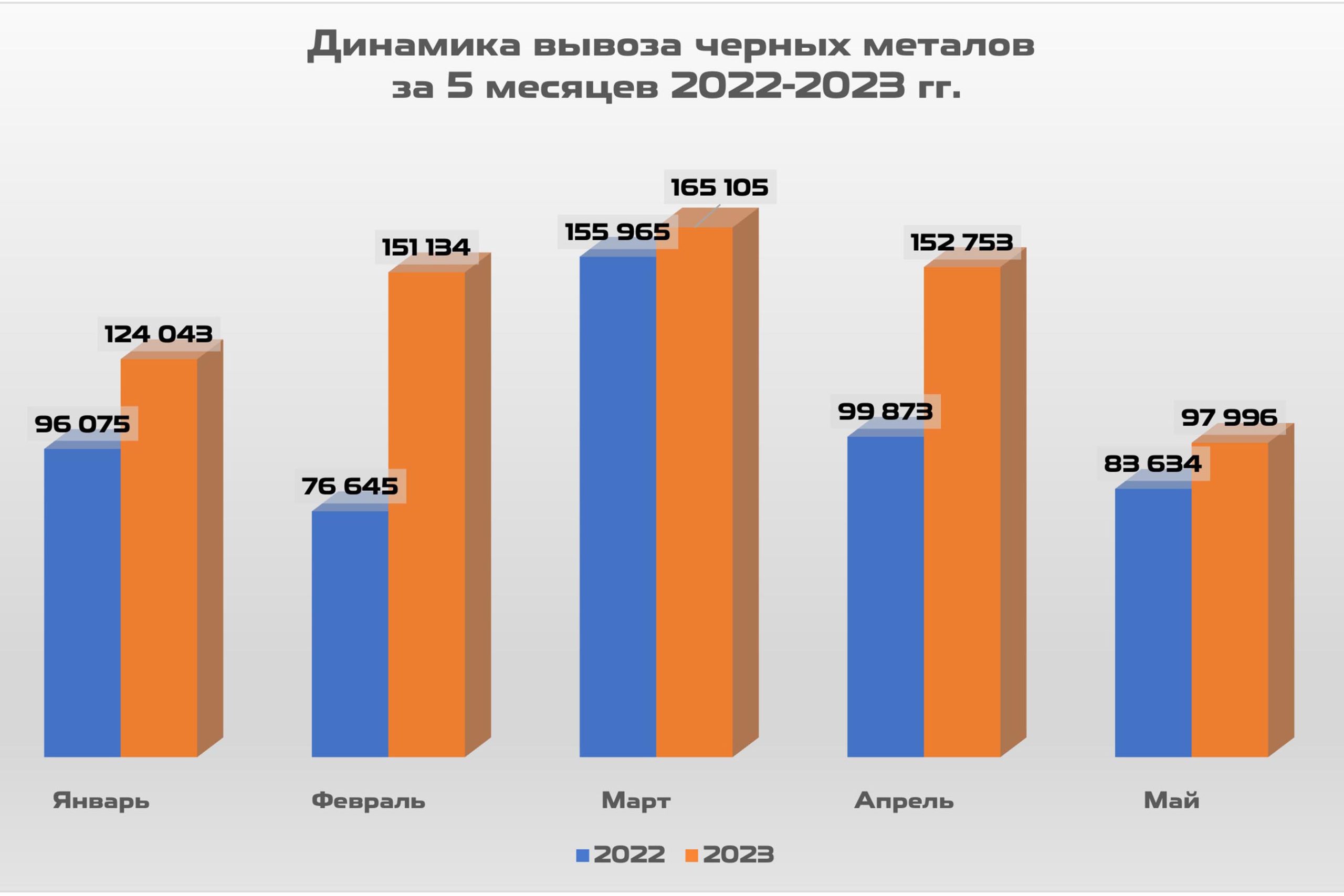
Ferrous metals (primarily various rolled products, steel billets). Export growth—134.9%, or 691 thousand tonnes. Nearly the entire share of ferrous metals exported falls on Russia—92.5% (639 thousand tonnes), with export volume growth of 3.9 times. Whereas in 2022 this was a share of 32.1% (165 thousand tonnes).
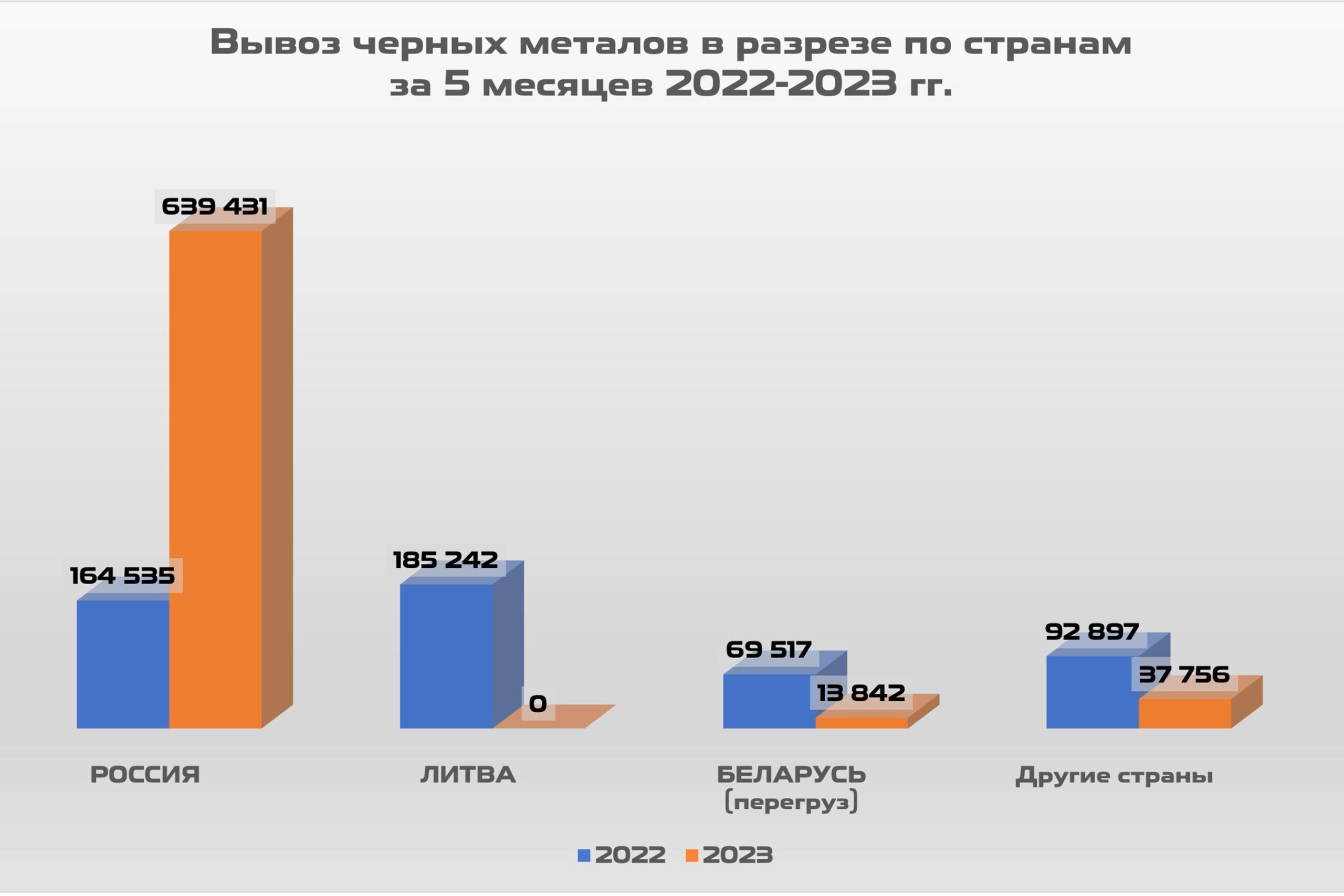
1. Export of ferrous metals by country for five months of 2022–2023;
2. Dynamics of ferrous metal export for five months of 2022–2023.
We hope this information will be useful to specialists in railway and other logistics. As a reminder, since the creation of the independent Republic of Belarus, MEG was transported exclusively via Lithuania, Latvia, Estonia, Ukraine, and Poland as genuinely competitive routes. But now, together with the national product (MEG), the means Belarusians have earned for their own prosperity are also being exported to Russia (all links on this below). Such a “benefit” is advantageous exclusively to the regimes established in Belarus and Russia.
* Not everything can be published right away, as we observe a moratorium to protect our sources. We write about this constantly and, so as not to tire readers with this forced but unchanging phrase under conditions of lawlessness in the country, we place it in a note.
** Official and commercial secrets: under Article 140 of the Civil Code of Belarus, information constitutes an official or commercial secret when it has actual or potential commercial value because it is unknown to third parties.
*** Here and throughout the article, all comparisons are for five months of 2022 and 2023.
**** The Eurasian Economic Union (EAEU) is an international organization for regional economic integration with international legal personality, established in 2014 by the Treaty on the Eurasian Economic Union. Its members are the Republic of Armenia, the Republic of Belarus, the Republic of Kazakhstan, the Kyrgyz Republic, and the Russian Federation. The same countries are members of the Collective Security Treaty Organization (CSTO).
Related materials:
- The Illusory Benefit of New Export Routes for Belarusian Fertilizers
- Realities of Export Routes for Belarus’s Major Export Products
- “Fair Family” Russian-Belarusian Business at the Expense of Belarusian Exporters and Railway Workers
- Belarusian Railway Freight Railcar Turnaround Has Increased Catastrophically
- Global Circumvention Routes for Belarus and Russia Deliveries
- The Belarusian Railway and Russian Railways Are Developing Sanctions Circumvention by All Means