The Belarusian Railway has accelerated the preparation of a backup traffic control scheme in case the main Traffic Control Center (TCC) in Minsk is lost. If the building on Stekolny Lane is destroyed, seriously damaged, or becomes inaccessible for a long time, the railway dispatching staff must continue operations from pre-prepared facilities. Currently, Belarusian Railway is determining which employees to transfer to backup sites and what they will need for work.
We have been monitoring the development of this system since 2022. Belarusian Railway has reactivated the equipment of the backup TCCs, checked the readiness of train dispatchers to work at backup workstations, and then began to put underground communication points in order. Now, the focus is on specific positions, sites, equipment, and documentation required to continue operations outside the main TCC.
The main TCC is located in Minsk at 1 Stekolny Lane. This is where the management of the transportation process at the railway level is concentrated: coordination of train throughput between divisions and train dispatcher sections, regulation of line capacity and processing capacity utilization, coordination of work during technological “windows,” and traffic management during serious disruptions.
The loss of the building will not stop traffic across the entire railway instantly. Station duty officers and line personnel will remain at their workplaces, and undamaged station and line-section signalling and interlocking devices will continue to operate. However, traffic on almost the entire Belarusian Railway network is conducted under train dispatcher control, with train dispatcher workstations concentrated in the main TCC. From there, they monitor the train situation on assigned sections, regulate train throughput, and on sections with centralized traffic control, they control switches and signals at stations. Therefore, if the TCC is lost, the railway will lose not just a data aggregation point, but a significant part of the active dispatching staff and centralized traffic control means. Before switching to backup workstations, traffic will have to be organized using backup operating procedures, with some stations transferred to local control and an inevitable reduction in line capacity.
Difficulties will primarily arise where a single decision affects several sections: when changing the order of train throughput, bringing trains to large junctions, coordinating trains with locomotives and locomotive crews, limiting line capacity, or simultaneous failures on several sections. Without railway-wide coordination, the risk of train delays at approaches to junctions, disruptions in locomotive turnover, accumulation of railcars, and the spread of delays to adjacent sections increases.
Preparation of Backup TCCs After February 2022
The Belarusian Railway returned to preparing backup TCCs shortly after the start of Russia’s full-scale aggression against Ukraine. As early as November 2022, we reported that since March, the railway had been checking the operability of backup centers, reactivating equipment, and assessing the knowledge of train dispatcher personnel. According to the information available at the time, there were six such facilities — one for each division of the Belarusian Railway.
Before 2022, the reserve was largely maintained on paper. Equipment was not used for long periods, training sessions were rare, and some employees only familiarized themselves with backup workstations. After the start of the full-scale war, for the first time in a long time, the reserve began to be prepared for an actual switchover.
The preparation of the reserve took place against the backdrop of a series of attacks in February–March 2022 on the Belarusian Railway’s internal network, the Neman centralized traffic control system, the TCC, and other information and telecommunication systems. These affected the means on which train dispatcher traffic control depends, during a period when the railway was ensuring the passage of Russian troop trains. We provided a chronology of events in the article “Belarusian Railway Seeks Protection in CSTO”.
In 2023, it became known that special communication points were being prepared in protective structures in Lyottsy and Talka. There, line-equipment rooms, communication channels, access to necessary networks, backup power supply, and premises for continuous personnel work were being brought to readiness. According to sources, in Lyottsy, separate restricted access rooms for KGB employees are provided next to the equipment rooms.
In August 2026, we obtained an order issued by Deputy Head of Belarusian Railway Ihar Kazlouski, dated August 6, 2026, No. 10-03-02/111. The document prescribes additional measures to minimize the consequences of “acts of unlawful interference” against transportation process management facilities.
What “act of unlawful interference” means. The order does not define this wording. In transport security, the term refers to an unlawful act or the threat of such an act capable of disrupting the safe and stable operation of a facility. The document does not specify which scenario is being considered in this case.
Kazlouski oversees security, facility protection, and interaction with law enforcement agencies at Belarusian Railway. Before joining the railway, he served in the central apparatus of the KGB of Belarus. We discussed the role of former and current security officials in railway management in a separate article.
The term “backup TCC” is not used in the document. Instead, it refers to the continuation of transportation process management and operational work from another Belarusian Railway facility — a station, a protective structure, or another site. Such a scheme will be required if the main center becomes inaccessible for a prolonged period.

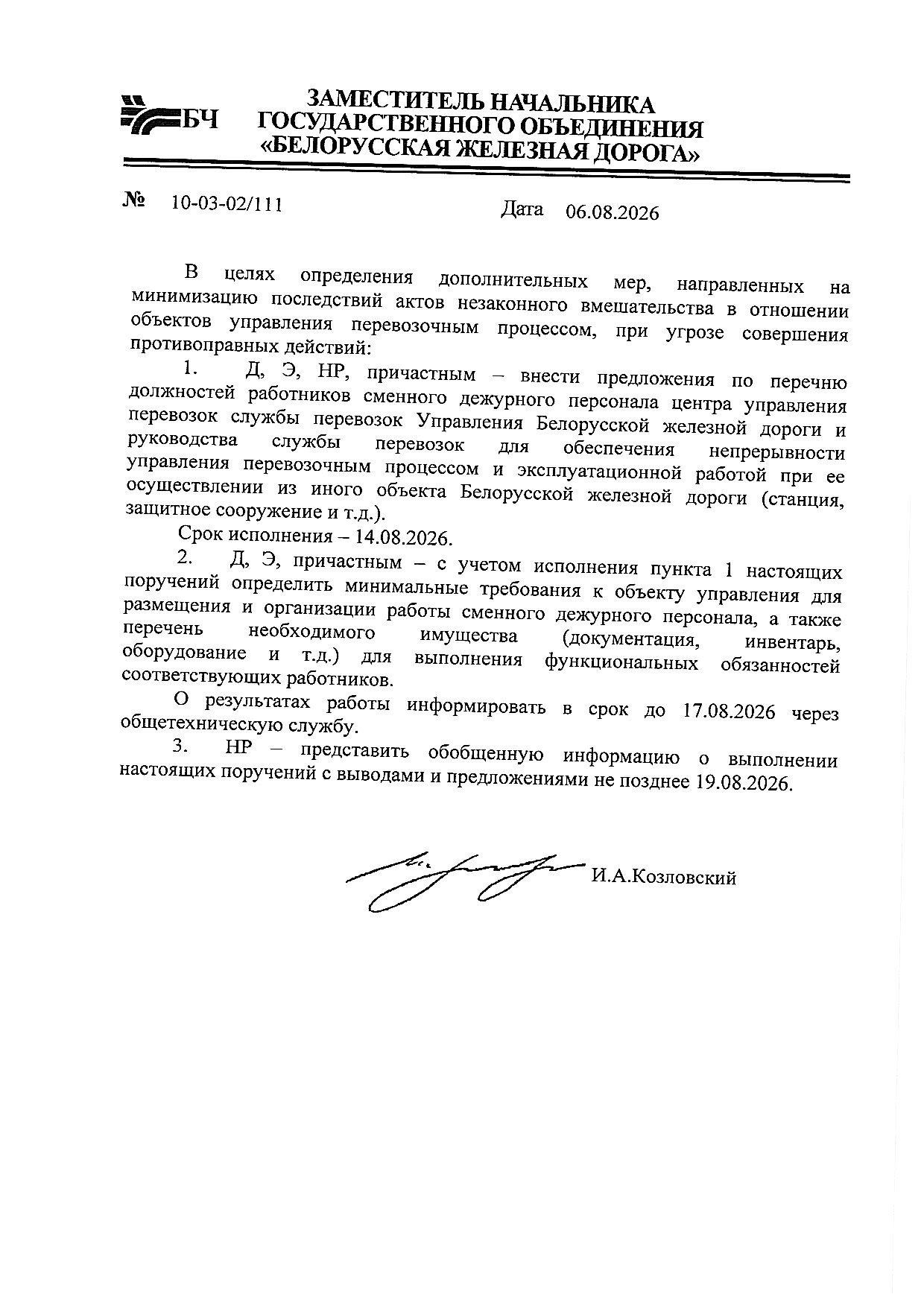
The Transportation Department (D), the Power Supply Department (E), the General Technical Department (NR), and other departments were to determine the list of shift and duty personnel positions at the TCC, as well as representatives of the transportation department management who would continue to work at the reserve facility. They were also instructed to establish minimum requirements for the facility and workstations, the procedure for organizing duty, and a list of necessary documentation, equipment, and property.
Proposals for personnel were to be submitted by August 14, requirements for the facility by August 17, and the summarized result no later than August 19. Between the signing of the order and the last deadline for execution, 13 days remained. A new center cannot be built in that time. This means it was about selecting and retrofitting an existing site or bringing one of the previously created reserve facilities to readiness.
The composition of the executors shows which functions must be preserved when transferring management. The Transportation Department is responsible for operational work and train dispatcher regulation. The power dispatching staff of the power supply department manages the power supply scheme, organizes necessary switching operations, and coordinates restoration work in case of disruptions in the overhead contact system, traction substations, and other facilities. The General Technical Department consolidates proposals and coordinates security and safety issues. It is responsible for infrastructure protection, paramilitary security, and escort of special transportation, including military transportation and transportation of explosive materials.
The order requires determining the list of shift and duty personnel positions for work at the reserve facility. Employees will need operational information about train movements, operational and technological communication with train dispatcher sections, stations, and divisions, working documentation, access to necessary information systems, and stable power supply with a backup power source.
According to our information, Belarusian Railway simultaneously intensified training sessions on manual maintenance of the actual train movement graph (GID). Such training was conducted before, but often formally. Now, train dispatchers more frequently practice working without familiar automated systems.
How the GID is maintained manually. The train dispatcher, based on reports from station duty officers, marks the actual arrival, departure, and passage times of trains at stations on a paper form, and then connects the marks with lines of movement. Such a diagram shows delays, crossings, and overtakes, and the train dispatcher maintains an understanding of the position of trains on their section even without an automated system.
In parallel, Belarusian Railway is tightening restrictions on travel to countries that the authorities classify as “unfriendly” for employees of the transportation department, and especially train dispatcher personnel. In the available documents, this decision is not directly linked to the preparation of backup TCCs. However, the restrictions affected precisely those specialists without whom it is impossible to transfer management to a backup facility.
Where the Backup TCCs Are Located
Reserve facilities were created on a territorial basis — one for each railway division. According to our information, the backup TCC of the Vitebsk division is located at Shumilino station. The backup facility of the Baranovichi division is located near the Kroshyn halt; its main part is located underground.
The exact locations in the Mogilev, Brest, and Gomel divisions have not yet been established. The location of a separate reserve facility for the Minsk division is also unknown. The special communication point in Talka cannot automatically be considered a backup TCC: it is a different class of facility.
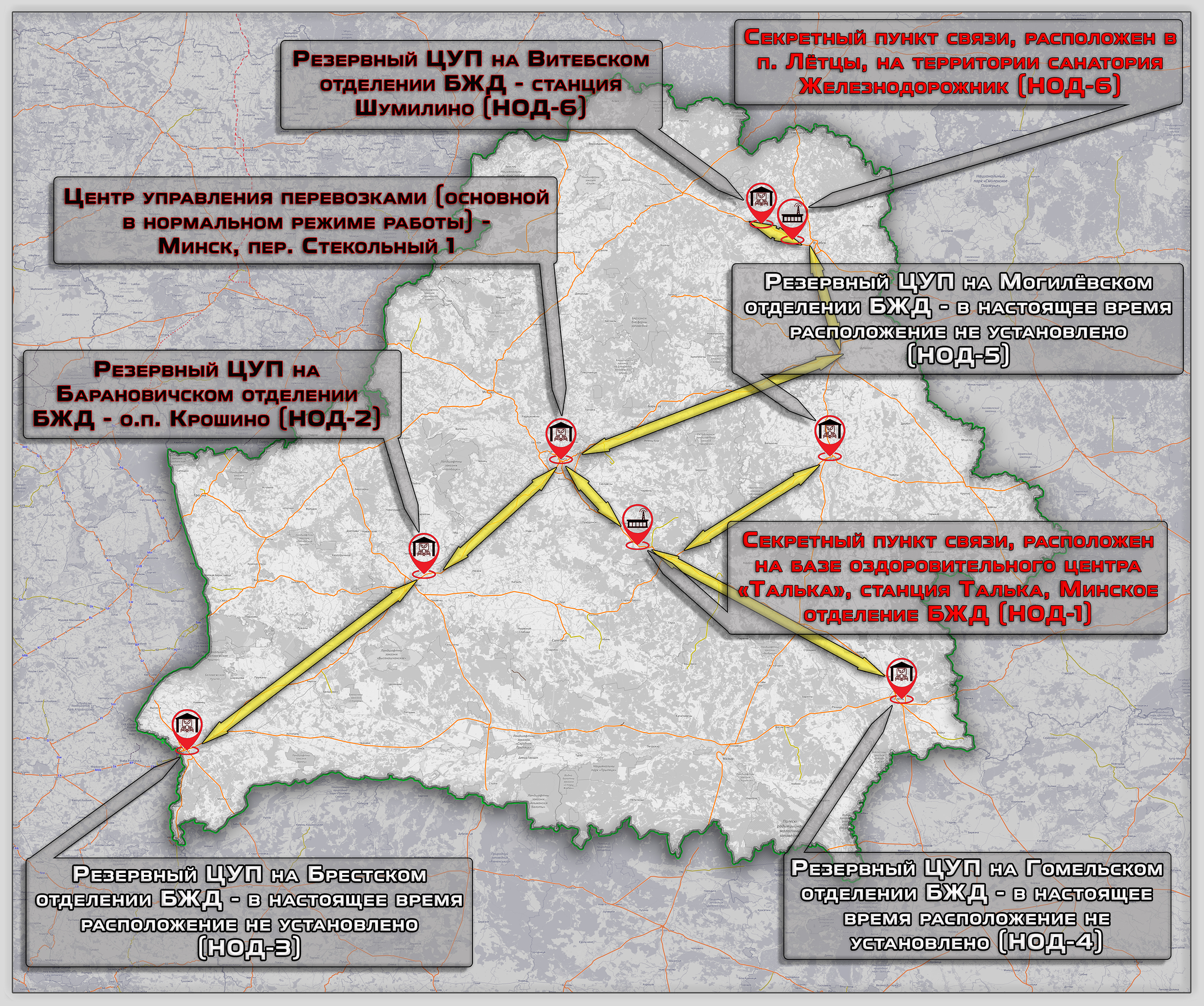
A backup TCC and a communication point are not the same thing. A reserve control point needs train dispatcher workstations, operational information about train positions, operational and technological communication means with train dispatcher sections, stations, and divisions, and the ability to transmit and register train dispatcher orders. A special communication point maintains secure channels and ensures the work of management and individual administrative bodies, but it does not replace a train dispatcher center. However, without stable communication with divisions and train dispatcher sections, a backup TCC will also be unable to operate.
The placement of reserve facilities by divisions indicates territorial redundancy, but the available information does not yet allow for a strict division into railway-wide and divisional levels. It is unknown which points are intended for management within their division, and which facility should take over the railway-wide train dispatcher shift of the main TCC. To perform railway-wide functions, access to operational information across the entire network and stable communication with all six divisions will be required.
The readiness of each of these facilities is currently unknown. We do not know if full-scale training switchovers have been conducted, where backup equipment is stored, or how personnel delivery is organized. Equipped premises alone are not enough: the notification procedure, shift arrival, facility access, and system launch must be worked out in advance.
Military Personnel at the TCC on Stekolny Lane
The main TCC on Stekolny Lane is also used for organizing military transportation. In June 2026, we reported that a group of military representatives is permanently stationed in the building. Its core consists of representatives of the military communications bodies of the Ministry of Defence of Belarus; employees of communication units, classified information protection, and other support structures also work there.
According to sources, the entire eighth floor, approximately 600 sq. m, has been allocated to the military, and the group’s strength is estimated at 20–30 military personnel. Even during the building’s design, premises for employees of the Military Communications Commandant’s Office were provided on the sixth and seventh floors. Now, the military occupies the entire eighth floor — significantly more than originally allocated to them.
The military communications bodies coordinate with Belarusian Railway on plans and conditions for military transportation, allocation and delivery of railcars to loading points, removal of railcars after unloading, as well as the passage of troop trains and military transports across the network. Operational decisions regarding movement remain with the Belarusian Railway’s dispatching staff. The presence of military representatives directly in the TCC reduces coordination time and allows for faster integration of military transportation with the overall timetable. This increases the military-logistic significance of the facility. In the event of its incapacitation, the consequences will affect train movements in general and military transportation in particular.
The destruction of the building is not directly mentioned in internal orders. Formulations such as “acts of unlawful interference” and working “from another facility” are used. However, the preparation of personnel, backup workstations, protective structures, reserve communication, and manual maintenance of the GID is designed for a situation where a quick return to the main TCC is impossible. Physical destruction or serious damage to the center is one of the scenarios in which this scheme will be required.
Belarusian Railway is already preparing for a situation in which the main TCC will be destroyed, seriously damaged, or incapacitated for a long time. Reserve workstations, the composition of duty shifts, and the procedure for transferring management to another facility are currently being determined, while simultaneously intensifying the training of train dispatcher personnel. All these measures are designed for the actual loss of the main control center.
Even with a ready backup TCC, the switchover will not be instantaneous. In the first hours, some information and automated systems may be unavailable, and decisions will have to be made by the reserve shift. The task of the reserve is to maintain railway-wide coordination, communication with divisions and train dispatcher sections, and prevent their prolonged isolated operation.
We do not yet know all the reserve sites, their degree of readiness, the switchover time, or the exact composition of the shifts. But preparations are already underway at a practical level: services are determining personnel, facility requirements, equipment lists, and operating procedures without familiar automated systems.