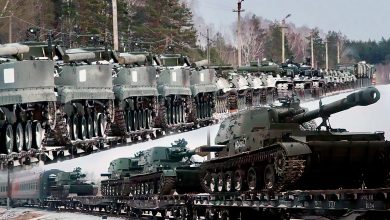
The illegitimate authorities and Belarusian Railway management have ‘mismanaged’ to such an extent that in recent years, their propaganda regarding railway transport has been left with only a few topics for ‘self-promotion.’ These include the growth of passenger transport in general and specific indicators of cargo transport, such as container transport.

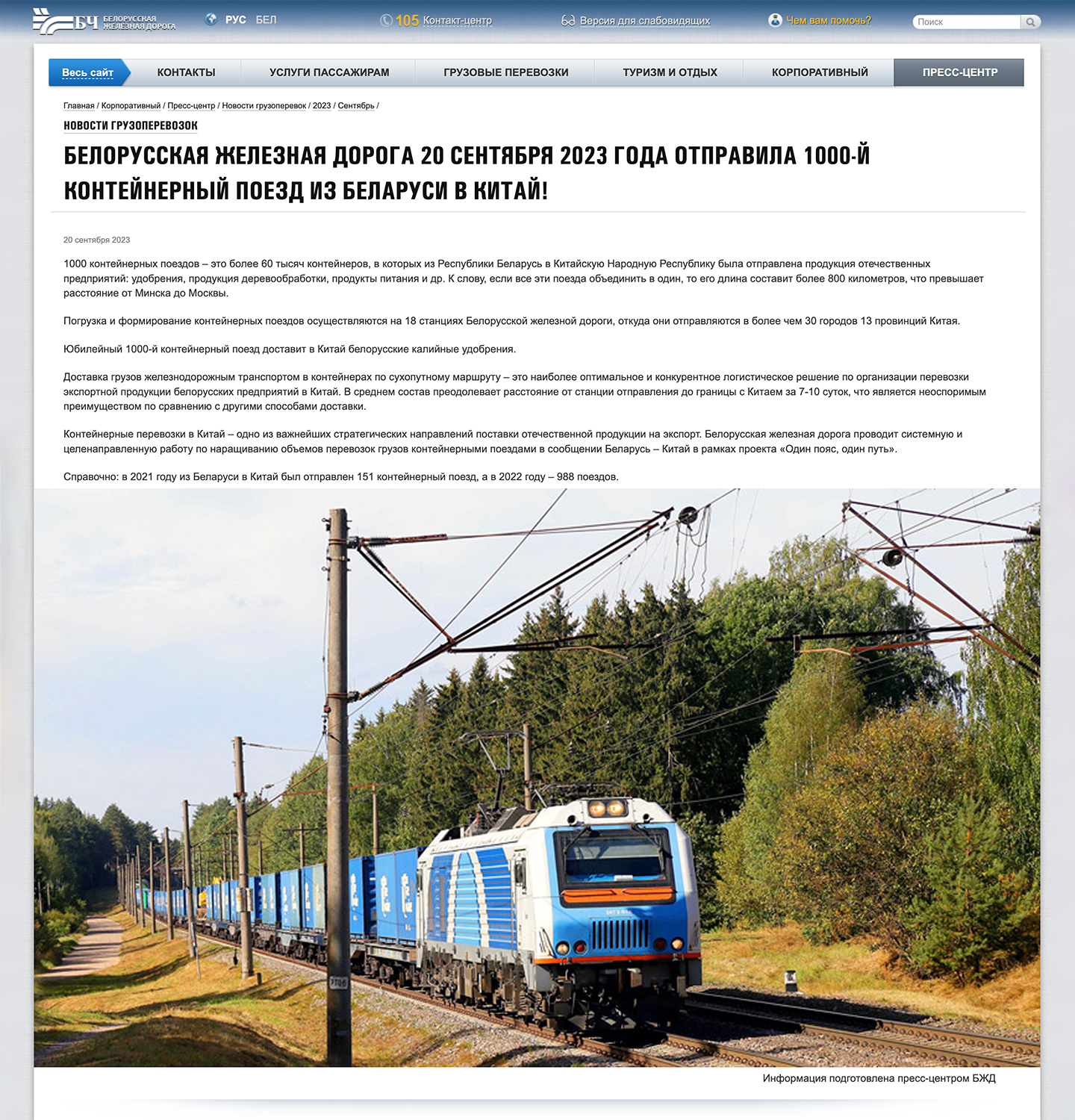
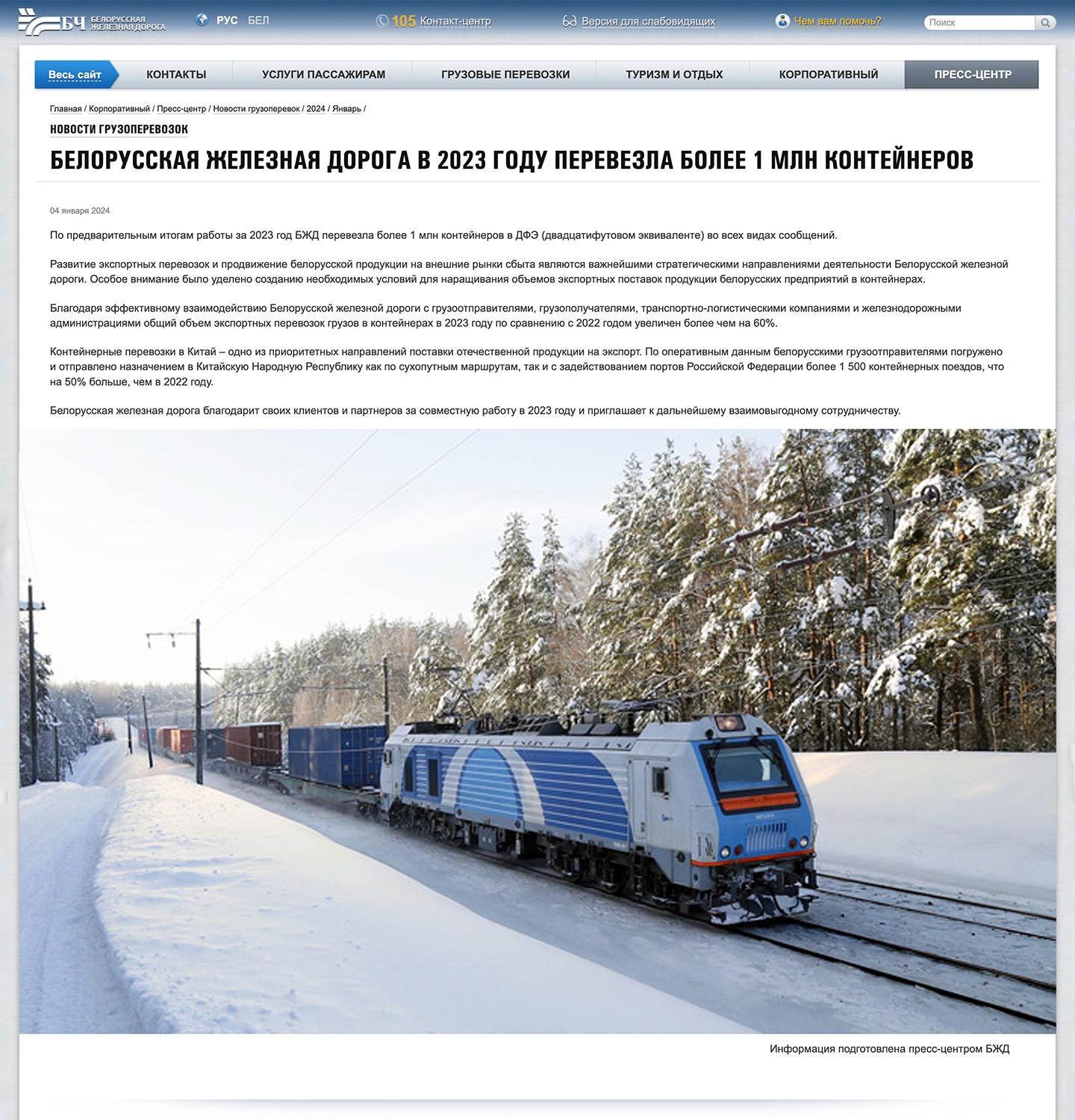
While the reasons for the ‘successes’ in passenger transport, attributed to themselves and cited by various leaders, are quite clear—the impoverishment of Belarusians and the search for a better life in the only easily accessible ‘Muscovy’ (despite internal regional economy-class transport, which accounts for about 80% of total traffic, having steadily declined for many years)—the situation with containerized cargo transport is not so ‘rosy’.
Recently, we reported on Belarusian Railway container transit, and today we will look at container transport for the period 2018–2023 in general and by type of service. We will also supplement the data on transit, specifically for transport between China and Europe.
In total, Belarusian Railway container transport volumes across all types of services grew at a steady and significant pace until 2021. And, as with most freight transport, due to sanctions, container transport began to decline from 2022:
- 2019 – 115% of the previous year (733 thousand TEU*);
- 2020 – 137% (1001 thousand TEU);
- 2021 – 125% (1251 thousand TEU);
- 2022 – 89% (1119 thousand TEU);
- 2023 – 92% (1028 thousand TEU).
By the way, we were not far off in our forecasts for 2023 in August 2023, though we were too ‘optimistic.’ The actual results for all types of services are below our calculations.
It must be said that for Lukashenka’s regime, the sanctions proved to be very painful. Under these conditions, the authorities intensified their efforts, and solely due to their alliance with Russia and its unprecedented expansive economic policy (providing discounts on railway tariffs, port capacities, infrastructure investments – see here), as well as in line with international trends in containerization, export, import, and domestic (local) transport have been constantly growing during the period under review.
Belarusian Railway Export Container Transport:
- 2019 – 126% of the previous year (98 thousand TEU);
- 2020 – 118% (116 thousand TEU);
- 2021 – 111% (129 thousand TEU);
- 2022 – 164% (212 thousand TEU);
- 2023 – 148% (313 thousand TEU).
Belarusian Railway Import Container Transport:
- 2019 – 153% of the previous year (115 thousand TEU);
- 2020 – 118% (136 thousand TEU);
- 2021 – 113% (153 thousand TEU);
- 2022 – 155% (237 thousand TEU);
- 2023 – 144% (341 thousand TEU).
Belarusian Railway Domestic (Local) Container Transport:
- 2019 – 80% of the previous year (16 thousand TEU);
- 2020 – 188% (30 thousand TEU);
- 2021 – 119% (37 thousand TEU);
- 2022 – 105% (39 thousand TEU);
- 2023 – 213% (83 thousand TEU).
However, if we look at the total growth of export, import, and domestic (local) transport over the entire period 2018–2023, the achievements are not as impressive – 137% in six years.
Considering the additionally obtained data on transport between China (PRC) and Europe (EU), let’s revisit transit. For the convenience of readers (all in one article), we will repeat the general figures:
- 2019 – 109% of the previous year (504 thousand TEU),
PRC – EU: 102% (332 thousand TEU), share in transit – 67%; - 2020 – 143% (719 thousand TEU),
PRC – EU: 163% (551 thousand TEU), share in transit – 77%; - 2021 – 129% (932 thousand TEU),
PRC – EU: 134% (736 thousand TEU), share in transit – 79%; - 2022 – 68% (631 thousand TEU),
PRC – EU: 61% (450 thousand TEU), share in transit – 71%; - 2023 – 46% (291 thousand TEU),
PRC – EU: 48% (216 thousand TEU), share in transit – 74%.
As we can see, sanctions seriously affected Chinese transit, which by 2023 reached its lowest value in six years. At the same time, over six years, the share of container transport in the China–Europe service within overall transit fluctuates around 74%. This means that transit trends are directly dependent on transit cargo flows to/from China. This, incidentally, is also true for container transport in general, as before the sanctions 69–75% of all the ‘vaunted’ container traffic was transit. However, in 2023, transit already accounts for only 28% of the total volume.
The shares of export, import, and domestic (local) transport within the total volume have also redistributed, from 12%, 12%, and 3% respectively in 2018 to 30%, 33%, and 8% in 2023.
With such a catastrophic drop in transit, even a slight increase in other components (types of services) already allows propaganda to talk about ‘dynamic development’ and so on. And the authorities continue to lie about the ‘special’ role of Belarusian Railway in the transit of goods from the ‘Celestial Empire.’ China has clearly stopped considering Belarus as a route for its supplies to Europe.
Now, for its land transit to Europe, China has chosen Russia. And Russian propaganda tirelessly reiterates this (Russian Railways in open sources): “in the east, the main partner is China, with whom over 161 million tonnes (+36% compared to 2022) were transported by rail in 2023″**. This trend continues for Russian Railways in 2024, and for some junctions, it is even significantly increasing (from 30 to 50%).
Here, we note that the ‘internal’ forecasts of Belarusian Railway specialists*** for 2024 across all types of services are not encouraging – Belarusian Railway reports on prospects indicate only a nominal, marginal increase (about 1%). This means that specialists actually expect a decline in container transport. And in line with the practice of the servile culture among Belarusian officials, minimal ‘positive’ figures are submitted ‘upwards.’ The only noticeable growth in 2024 is predicted for container trains to China – 106% or 1600 container trains.
By the way, Belarusian Railway’s largest ‘partners’ in Chinese container transit, UTLC ERA***** and PJSC TransContainer*****, have significantly worsened their positions in recent years. UTLC ERA no longer boasts about its successes in Belarus and builds its main business on routes through Russia. And the representative subsidiary TransContainer-West LLC, which was once a leader in container transport in Belarus, according to our sources, ended the 2023 financial year with losses.
Finally, some food for thought: according to statements by Chinese representatives in open sources, over 10 years of the ‘One Belt, One Road’**** initiative, 81 thousand container trains (other estimates – 85 thousand) have been dispatched from China to Europe. Based on the average capacity of such a train and Belarusian transit in both directions (to and from Europe) of 2988 thousand TEU since 2017 (the year Belarus joined the Chinese initiative) – this is about 20% considering the overall trend of flow redistribution in the ‘there and back’ directions.
This is a very impressive volume and promising potential for Belarus, ruined by the illegitimate authorities in recent years.
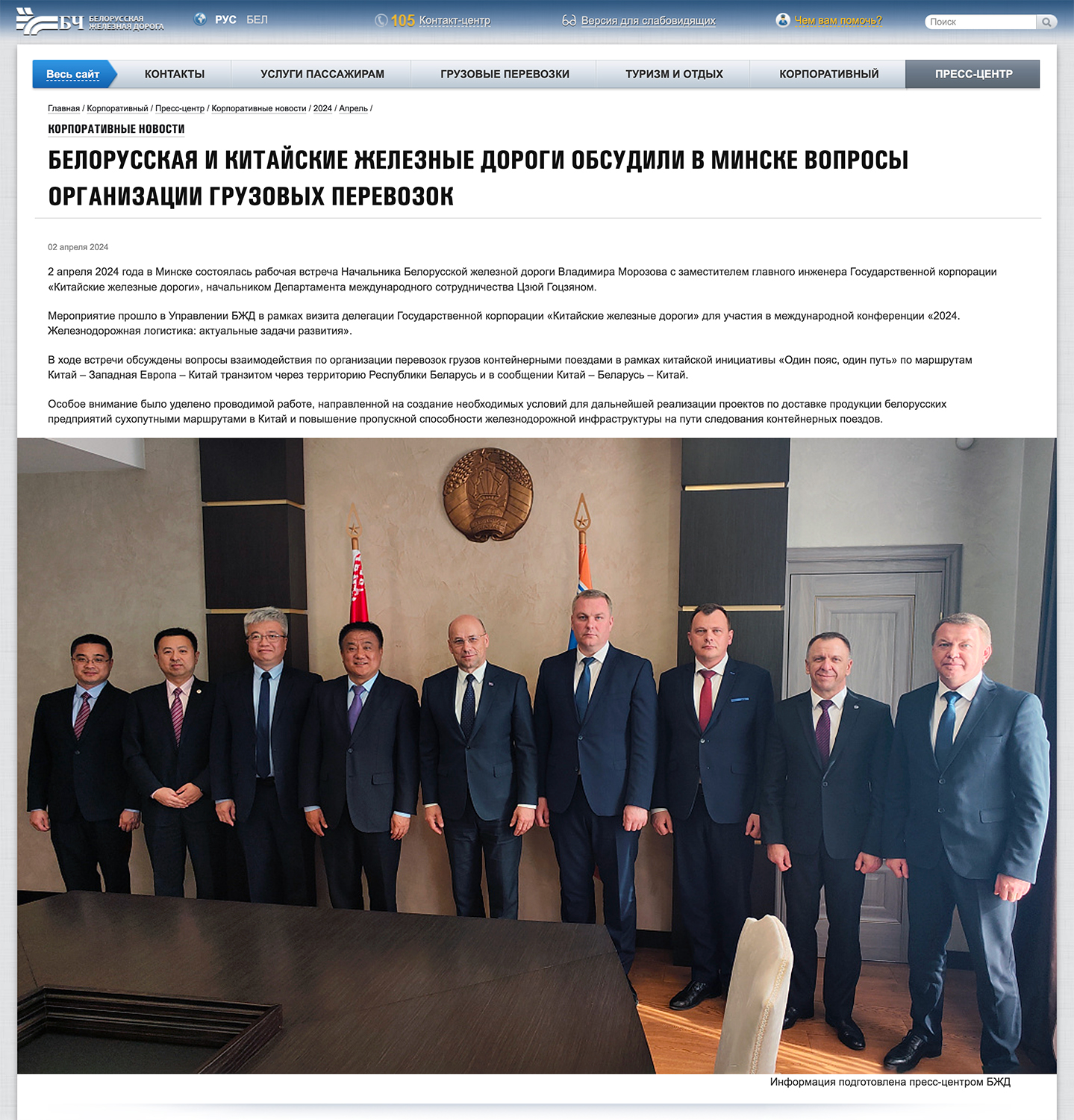
And no matter how hard propaganda and Belarusian Railway try, by announcing ‘successful’ protocol meetings and events with Chinese representatives, the national geopolitical resource (transit potential) has been lost due to the ‘all-knowing president’ and his usurper’s policy, which includes supporting Russian aggression in Ukraine. All further development of the country and Belarusian Railway relies solely on the export of Belarusian national resources.
* Twenty-foot Equivalent Unit (TEU) – a conventional unit of measurement for the quantitative aspect of transport flows, the line capacity of container terminals, or the capacity of cargo vehicles. It is equivalent to the dimensions of an ISO container 20 feet (6.1 m) long.
The Forty-foot Equivalent Unit (FEU), based on the dimensions of a 40-foot container and equal to 2 TEU, is also often used (in particular, for calculating economic freight indices).
** In the article text, quotes are highlighted in italics in an ‘as is’ format without any corrections, including spelling errors.
*** Not everything can be published right away, as we observe a moratorium to protect our sources. We constantly write about this, and to avoid annoying readers with this forced but unchanging phrase under lawlessness in Belarus, we include it in a note.
**** ‘One Belt, One Road’ or the 21st Century Silk Road – China’s global development strategy and long-term policy and investment program connecting Asia with Africa and Europe via land and sea routes to deepen regional integration, develop trade, and stimulate economic growth. It includes a transcontinental corridor connecting China with Southeast Asia, South Asia, Central Asia, Russia, and Europe by land, and the 21st Century Maritime Silk Road, connecting China’s coastal regions with Southeast Asia, South Asia, South Pacific countries, the Middle East, East Africa, and Europe. The program involves the development of logistics and attracting investment in infrastructure development. As part of this initiative, China has signed cooperation agreements with 148 countries, including Belarus (ratified by the Law of the Republic of Belarus of December 8, 2017, ‘On the Ratification of the Agreement between the Government of the Republic of Belarus and the Government of the People’s Republic of China on the Development of International Freight Transport and Cooperation in the Implementation of the Concept of Building the Silk Road Economic Belt’).
***** JSC ‘UTLC ERA’ (Joint stock company ‘United Transport and Logistics Company – Eurasian Rail Alliance’), established by the national railway companies of Russia (Russian Railways), Belarus (Belarusian Railway), and Kazakhstan (KTZ) in November 2014. The purpose of its creation is to develop transit potential and increase transport volumes across the railway network of the participating countries in the China–Europe service. UTLC became a monopolist in container transport on the China–Kazakhstan–Russia–Belarus–Europe routes primarily through administrative, rather than market, decisions.
PJSC ‘TransContainer’ (Public Joint Stock Company TransContainer) – one of the leading railway container operators in Russia, having separated from Russian Railways at the dawn of reforms. It operates the largest fleet of containers and container flatcars across the entire 1520 mm gauge railway network, mostly inherited from Russian Railways.