Introduction
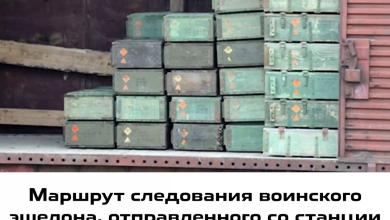
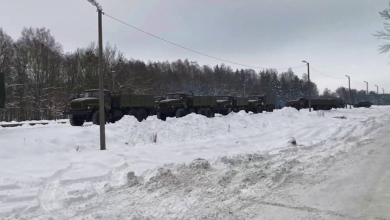
Railway communication between Belarus and Russia continues to be used for the transport of military units, weaponry, ammunition, special equipment, materiel, and products from defense industry enterprises. The Belarusian Railway is involved in both the import of military cargo from the Russian Federation and its dispatch from Belarus to Russian military units, facilities of the Ministry of Defence of the Russian Federation, and defense industry enterprises.
This publication is an integral part and continuation of the belzhd.info series of materials dedicated to military railway transport between Belarus and Russia, supplies of weaponry and ammunition, as well as supplies of products from Belarusian enterprises for the needs of the Russian defense industry. For a full understanding of the dynamics, structure, and nature of the transport under consideration, the material should be viewed in conjunction with previous publications in the series. Previously reviewed topics include:
- Military Transport by Belarusian Railway in Q2–Q3 2025;
- Volumes of Ammunition Import and Export from Belarus in September 2025;
- Resumption of Ammunition Export from Belarusian Arsenals for the Needs of the Russian Armed Forces;
- Import of a Large Batch of Ammunition from Russia to Belarus;
- Export of Belarusian Products for Russian Strategic Facilities and Import of Russian Armed Forces Equipment to Belarus in Q1 2025;
- Railway Export of MZKT Products and Military Cargo to Russia by the End of 2024;
- Supplies of Russian Weaponry to Belarus in Q4 and by the End of 2024;
- Import of Russian Weaponry and Ammunition to Belarus by Railway Transport for 9 Months of 2024;
- Ammunition was Exported by Railway from Belarus to Attacked Arsenals in Russia.
This material examines established military transport between Belarus and Russia in Q4 2025 and January–April 2026. The first part is dedicated to the import of goods from Russia to Belarus, the second to transport in the opposite direction. The export structure separately analyzes supplies of products from JSC “Minsk Wheel Tractor Plant” (MZKT), dispatches of reinforced concrete sleepers and turnout bearers produced by JSC “Spetszhelezobeton,” as well as other military cargo, including explosive materials (EM) cargo.
Separate subsections are dedicated to the results for 2025. They summarize data for all four quarters, distinguishing between return transport of Belarusian units, temporary arrival of Russian military units for exercises, and targeted deliveries of equipment, weaponry, ammunition, and materiel. For inbound transport, the total volume of established transport for 2025 amounted to 764 railcars.
Specifically for the period covered in the article — Q4 2025 and January–April 2026 — 243 railcars of military cargo were imported from the Russian Federation to the Republic of Belarus: 223 railcars in Q4 2025 and 20 railcars in January–April 2026. In the opposite direction, 494 railcars were dispatched from Belarus to Russia. Thus, the export volume more than doubled the inbound import volume.
A significant portion of the export consisted of products from JSC “MZKT,” destined for Russian defense industry enterprises. Another major direction was supplies from JSC “Spetszhelezobeton.” Formally, reinforced concrete sleepers and turnout bearers are civilian products, but the destination stations and recipients indicate their use in supporting the railway infrastructure of Russian military units and Ministry of Defence facilities, including facilities of the 12th Main Directorate of the Russian Ministry of Defence and units of the Strategic Missile Forces.
The transport under consideration shows that railway exchange between the two countries covers not only the movement of weaponry, military equipment, and ammunition. A substantial part consists of supplies of components, fuel, construction and infrastructure materials, as well as products necessary for the technical and logistical support of military facilities.
Note. The material repeatedly mentions ETSNG code 693087 — “Other goods, not listed in the alphabetical index.” It belongs to group 69 and is used for railway transport of goods for which there is no more precise separate entry in the Unified Tariff and Statistical Nomenclature.
In military transport, this code is often used as a generalized designation for equipment, gear, materiel, and mixed consignments. It can be applied by military communications bodies, military units, law enforcement agencies, defense industry and aerospace enterprises, as well as other state organizations transporting non-standard or special cargo.
Code 693087 itself does not allow determining the actual contents of the railcar. It can be used to transport individual samples of military and special equipment, as well as equipment, components, support property, or mixed consignments. The use of a generalized name simultaneously limits the amount of information about the cargo available in the transport data.
According to our documents, Russian and Belarusian military structures regularly register specific types of equipment, weaponry, gear, and other property under code 693087. Therefore, in each case, the content of the transport is determined not by a single code, but by a combination of factors: sender and recipient, type of rolling stock, destination station, train consist, and the profile of the military units or enterprises involved.
Section I. Import of Military Cargo to the Republic of Belarus from the Russian Federation
This section examines established railway transport of military cargo from the Russian Federation to the Republic of Belarus in Q4 2025 and January–April 2026. Results for the entire year 2025 are provided separately.
The recorded transport includes several groups with different purposes. These are the return of Belarusian units after training and firing exercises at Russian training grounds, the temporary arrival of Russian military units to participate in joint exercises, targeted deliveries of weaponry, ammunition, special equipment, and materiel, as well as the supply of Russian military facilities located in Belarus.
Therefore, the total volume of inbound transport should not be directly equated with the amount of weaponry and military equipment transferred to the Belarusian side. Some railcars were used for the temporary movement of units and property, which was subsequently exported back. To assess the actual replenishment of supplies, targeted deliveries to Belarusian arsenals, storage bases, military units, and technical support facilities must be considered separately.
In Q4 2025, the import structure differed significantly from previous periods. In addition to the return of Belarusian units after training in Russia, large targeted shipments of missile weaponry, aviation ammunition, air defense equipment and property, wheeled armored vehicles, special vehicles, spare parts, and cartridges were recorded. The largest single transport was directed to the area of the former Krichev-6 airbase.
In January–April 2026, the nature of transport changed significantly. During this period, only supplies of gas oil to the Russian radio-technical unit “Baranovichi” were established. No transport of weaponry, ammunition, military equipment, or organized troop trains was identified.
1.1. Import of Military Cargo to the Republic of Belarus in Q4 2025
In Q4 2025, 223 railcars with military cargo were imported from the Russian Federation to the Republic of Belarus. Transport was carried out across 12 routes.
The main volume consisted of cargo registered as “Other goods, not listed in the alphabetical index” — 155 railcars. Another 28 railcars were for explosive materials, 15 for special vehicles, 8 for other means of transport, 9 for cargo attendant railcars, 5 for buffer railcars, and 3 for spare parts.
The largest shipments were Kapustin Yar – Krichev I – 61 railcars, Noginsk – Brest-Vostochny – 31 railcars, Kapustin Yar – Osipovichi I – 29 railcars, and Manikhino I – Lososno – 28 railcars. The import structure was dominated by the transport of military and special equipment, air defense property, missile weaponry, aviation ammunition, cartridges, and components.
The recipients included the Military Communications Directorate of the Armed Forces of Belarus, the 336th Rocket Artillery Brigade, the 115th and 1st Anti-Aircraft Missile Regiments, the 1405th Artillery Ammunition Base, the 25th Arsenal of Missile and Artillery Armament, the 2631st Aviation Base for Storage of Missile Armament and Ammunition, the 969th Tank Reserve Base, the 814th Technical Support Center, the 230th Combined Arms Training Ground, as well as the Department of Finance and Logistics of the Ministry of Internal Affairs of Belarus.


Transport was carried out along the following routes.
- Kapustin Yar – Krichev I
From Kapustin Yar station (Privolzhskaya Railway) to Krichev I station (Mogilev Division of Belarusian Railway), 61 railcars were dispatched from military unit No. 15644 (4th State Central Inter-Service Test Range (4th GCP)) to the Military Communications Directorate of the Armed Forces of the Republic of Belarus.
The troop train included:
- 54 flatcars with cargo: “Other goods, not listed in the alphabetical index” (ETSNG code 693087);
- 6 boxcars with cargo: “Other goods, not listed in the alphabetical index” (ETSNG code 693087);
- 1 boxcar with cargo: “Explosive materials” (ETSNG code 693142).
We previously covered the arrival of this train in detail in the area of the former Krichev-6 airbase. The train arrived in late December 2025 — approximately between December 20 and 29. The destination station according to transport documents was Krichev I. After uncoupling the train locomotive, the railcars were moved to the facility’s territory by shunting with a station locomotive.
By this time, the former Krichev-6 airbase had been prepared to receive troop trains. Under the guise of a “logistics center,” an access track, additional track infrastructure, and loading/unloading infrastructure were built at the facility, allowing equipment and property to be unloaded outside public station areas.
According to available information, military equipment was transported on flatcars, gear in boxcars, and cartridges and other ammunition in a separate railcar. As of mid-May 2026, the arrived contingent remained at the facility; no return shipment of equipment and property was recorded.
- Kapustin Yar – Osipovichi I
From Kapustin Yar station (Privolzhskaya Railway) to Osipovichi I station (Mogilev Division of Belarusian Railway), 29 railcars were dispatched from military unit No. 47209 (60th Training Center for Combat Use of Missile Forces and Artillery) to military unit No. 12180 (336th Rocket Artillery Brigade of the Armed Forces of the Republic of Belarus).
The troop train included:
- 25 flatcars with cargo: “Other goods, not listed in the alphabetical index” (ETSNG code 693087);
- 3 boxcars with cargo: “Other goods, not listed in the alphabetical index” (ETSNG code 693087);
- 1 gondola car with cargo: “Explosive materials” (ETSNG code 693142).
The shipment is related to the return of units of the 336th Rocket Artillery Brigade after scheduled combat training activities at the Kapustin Yar training ground. Military unit No. 47209 provides training and practical application for missile forces and artillery units, including live-fire exercises.
Units of the 336th Rocket Artillery Brigade are sent to Kapustin Yar for practical launches and firing from multiple launch rocket systems, as Belarusian training grounds do not allow for full-scale practice of extended-range systems. Transport along the Osipovichi I – Kapustin Yar route and back is recorded periodically.
- Lukovsky – Osipovichi I
From Lukovsky station (North Caucasus Railway) to Osipovichi I station (Mogilev Division of Belarusian Railway), 21 railcars were dispatched from military unit No. 57229 (68th Arsenal of the Main Missile and Artillery Directorate of the Ministry of Defence of the Russian Federation, Mozdok) to military unit No. 42707 (1405th Artillery Ammunition Base of the Ministry of Defence of the Republic of Belarus).
The troop train included:
- 14 gondola cars with cargo: “Explosive materials” (ETSNG code 693142);
- 6 gondola cars with cargo: “Other goods, not listed in the alphabetical index” (ETSNG code 693087);
- 1 boxcar with cargo: “Cargo attendant railcar” (ETSNG code 421161).
The 14 gondola cars, registered as “Explosive materials,” transported missile weaponry, presumably intended for Iskander operational-tactical missile systems. The shipment was formed by the 68th Arsenal of the GRAU of the Ministry of Defence of the Russian Federation in the Mozdok area and was destined for the 1405th Artillery Ammunition Base in Bolshaya Gorozha near Osipovichi, intended for receiving, storing, and issuing missile and artillery armament and ammunition.
Six gondola cars with cargo “Other goods, not listed in the alphabetical index” could have been used for transporting transport packaging, components, and equipment for storing and servicing the delivered items. The exact nomenclature of the cargo is not disclosed in the transport documents.
- Noginsk – Brest-Vostochny
From Noginsk station (Moscow Railway) to Brest-Vostochny station (Brest Division of Belarusian Railway), 31 railcars were dispatched from the Federal State Institution “Joint Strategic Command of the Moscow Military District” to military unit No. 92504 (115th Anti-Aircraft Missile Regiment of the Air Force and Air Defense Forces of the Republic of Belarus).
The troop train included:
- 29 flatcars with cargo: “Other goods, not listed in the alphabetical index” (ETSNG code 693087);
- 1 boxcar with cargo: “Other goods, not listed in the alphabetical index” (ETSNG code 693087);
- 1 boxcar with cargo: “Cargo attendant railcar” (ETSNG code 421161).
The exact sender of the train was not established: the transport documents only indicate the Federal State Institution “Joint Strategic Command of the Moscow Military District.” However, in the Noginsk area, near Makarovo village, military unit No. 58172 – the 1488th Technical Base, known as Noginsk-4, was previously located. The facility was used for storage, maintenance, and equipping of anti-aircraft missile system missiles, initially the S-25 “Berkut” system. Subsequently, the legal entity of the military unit was liquidated, so there is no basis to consider it the direct sender of the train.
The recipient was military unit No. 92504 – the 115th Anti-Aircraft Missile Regiment of the Air Force and Air Defense Forces of the Republic of Belarus, stationed in the Brest region and operating S-300 family systems. Given the recipient’s profile, the departure station, and the missile-technical base located in the Noginsk area, the train was likely related to the transfer of air defense equipment or property.
- Manikhino I – Lososno
From Manikhino I station (Moscow Railway) to Lososno station (Baranovichi Division of Belarusian Railway), 28 railcars were dispatched from the Federal State Institution “Joint Strategic Command of the Moscow Military District” to military unit No. 97097 (1st Anti-Aircraft Missile Regiment of the Air Force and Air Defense Forces of the Republic of Belarus).
The troop train included:
- 26 flatcars with cargo: “Other goods, not listed in the alphabetical index” (ETSNG code 693087);
- 1 boxcar with cargo: “Other goods, not listed in the alphabetical index” (ETSNG code 693087);
- 1 boxcar with cargo: “Cargo attendant railcar” (ETSNG code 421161).
The exact sender of the train was not established: the transport documents only indicate the Federal State Institution “Joint Strategic Command of the Moscow Military District.” However, in the area of Manikhino I station, military unit No. 63002 – the 1494th Missile-Technical Air Defense Base, part of the S-25 Moscow grouping support system, was previously located. In 2012, the unit was disbanded, after which a separate storage department was created on its territory, included in military unit No. 58172 in Makarovo. The facility continued to store decommissioned military equipment and air defense property.
The recipient was military unit No. 97097 – the 1st Anti-Aircraft Missile Regiment of the Air Force and Air Defense Forces of the Republic of Belarus. Given the recipient’s profile, the departure station, and the former air defense equipment storage facility located in the Manikhino area, the train was likely related to the transfer of air defense equipment or property.
- Vozhoy – Stolbtsy
From Vozhoy station (Gorky Railway) to Stolbtsy station (Minsk Division of Belarusian Railway), 18 railcars were dispatched from JSC “Izhevsk Electromechanical Plant ‘Kupol'” to military unit No. 25819 (25th Arsenal of Missile and Artillery Armament).
The shipment included:
- 8 flatcars with cargo: “Means of transport, not listed in the alphabetical index” (ETSNG code 391303);
- 8 flatcars with cargo: “Special vehicles” (ETSNG code 381091);
- 1 boxcar with cargo: “Spare parts for means of transport, not listed in the alphabetical index” (ETSNG code 391426);
- 1 boxcar with cargo: “Cargo attendant railcar” (ETSNG code 421161).
JSC “Izhevsk Electromechanical Plant ‘Kupol'” is part of the Almaz-Antey Air and Space Defense Concern and specializes in the development and production of short-range anti-aircraft missile systems of the Tor family, including the Tor-M2 system. The enterprise also produces autonomous combat modules, simulators, control and testing equipment, and technical support means for its systems.
The recipient was the 25th Arsenal of Missile and Artillery Armament in Novokolosovo, which had previously received supplies of products from the Kupol plant. In Q4 2024, 10 railcars arrived at the arsenal via the same Vozhoy – Stolbtsy route. In one of the previous materials, this shipment was linked to the supply of Tor-M2 system equipment.
The current shipment increased to 18 railcars and included 16 flatcars with special equipment, as well as a boxcar with spare parts. Given the profile of the sender, recipient, and the repeated route, it is likely another batch of Tor-M2 system assets. In addition to combat vehicles, the supply could include transport-loading, repair, control and testing, and other technical support vehicles.
- Penza I – Stolbtsy
From Penza I station (Kuybyshev Railway) to Stolbtsy station (Minsk Division of Belarusian Railway), 3 railcars were dispatched from JSC “Radiozavod” to military unit No. 25819 (25th Arsenal of Missile and Artillery Armament).
The shipment included:
- 2 flatcars with cargo: “Special vehicles” (ETSNG code 381091);
- 1 boxcar with cargo: “Cargo attendant railcar” (ETSNG code 421161).
Penza JSC “Radiozavod” specializes in the development and production of automated control systems for special purposes. The enterprise produces mobile command posts for air defense and artillery units, as well as means for collecting, processing, and transmitting radar information. Notable developments include the Ranzhir family of command posts, designed to control units armed with Tor and Strela-10 systems and Tunguska anti-aircraft gun-missile systems.
Both flatcars with equipment were sent to the 25th Arsenal of Missile and Artillery Armament in Novokolosovo, which received a batch of products from the Izhevsk Electromechanical Plant “Kupol” during the same period. Given the sender’s profile and the parallel supply of Tor family equipment, the railcars could have contained mobile control assets or support vehicles for air defense units.
- Cheboksary – Prudok
From Cheboksary station (Gorky Railway) to Prudok station (Vitebsk Division of Belarusian Railway), 16 railcars were dispatched from JSC “Cheboksary Production Association named after V.I. Chapaev” to military unit No. 94017 (2631st Aviation Base for Storage of Missile Armament and Ammunition of the Ministry of Defence of the Republic of Belarus).
The shipment included:
- 10 boxcars with cargo: “Explosive materials” (ETSNG code 693142);
- 5 empty railway railcars, transported on their own axles and specifically used as buffer railcars for cargo, as well as as buffer railcars or for installation of a control frame when transporting oversized cargo (ETSNG code 421212);
- 1 boxcar with cargo: “Cargo attendant railcar” (ETSNG code 421161).
JSC “Cheboksary Production Association named after V.I. Chapaev” specializes in the production of military pyrotechnics, ammunition, and special-purpose products. A significant part of the enterprise’s nomenclature traditionally consisted of aviation products: incendiary, illuminating, and photo-illuminating aerial bombs, pyrotechnic charges, initiation means, signal, smoke, and tracer products, as well as individual components of aviation ammunition.
The recipient was the 2631st Aviation Base for Storage of Missile Armament and Ammunition, located in the Prudok station area. The facility is intended for receiving, storing, maintaining, and issuing aviation weapons and ammunition.
Given the profile of the sender and recipient, the ten boxcars likely transported a batch of aviation ammunition, military pyrotechnic devices, or components for aviation weapons. The specific type of items is not indicated in the transport documents.
Five buffer railcars were used to ensure the established intervals between railcars with explosive materials, the locomotive, and the cargo attendant railcar. Such a train consist is typical for organized transport of Class 1 dangerous goods.
- Arzamas II – Urechye
From Arzamas II station (Gorky Railway) to Urechye station (Mogilev Division of Belarusian Railway), 8 railcars were dispatched from JSC “Arzamas Machine-Building Plant” to military unit No. 42715 (969th Tank Reserve Base of the Ministry of Defence of the Republic of Belarus).
The shipment included:
- 5 flatcars with cargo: “Special vehicles” (ETSNG code 381091);
- 2 boxcars with cargo: “Spare parts for automobiles, trailers, semi-trailers” (ETSNG code 381299);
- 1 boxcar with cargo: “Cargo attendant railcar” (ETSNG code 421161).
JSC “Arzamas Machine-Building Plant” specializes in the production of wheeled armored vehicles. The core of its military products consists of BTR-80 and BTR-82 family armored personnel carriers, as well as special vehicles based on them. The enterprise produces command and staff, repair and evacuation, sanitary, and other specialized variants of wheeled armored vehicles.
The recipient was the 969th Tank Reserve Base in Urechye — one of the largest storage facilities for armored vehicles of the Armed Forces of Belarus. The base is used for receiving, storing, maintaining, and issuing reserve equipment.
Given the profile of the sender, five flatcars with special vehicles, and two railcars with spare parts, it is likely a supply of five units of wheeled armored vehicles or special vehicles based on them, with a set of spare parts.
- Gornaya – Baranovichi-Tsentralnye
From Gornaya station (North Caucasus Railway) to Baranovichi-Tsentralnye station (Baranovichi Division of Belarusian Railway), 4 railcars were dispatched from the Federal State Institution “Joint Strategic Command of the Central Military District” to military unit No. 33933 (230th Combined Arms Training Ground of the Western Operational Command of the Ground Forces of the Armed Forces of the Republic of Belarus).
The shipment included:
- 3 flatcars with cargo: “Other goods, not listed in the alphabetical index” (ETSNG code 693087);
- 1 boxcar with cargo: “Cargo attendant railcar” (ETSNG code 421161).
The specific Russian military unit is not indicated in the transport documents: the shipment is registered on behalf of the Federal State Institution “Joint Strategic Command of the Central Military District.” The recipient was the 230th Obuz-Lesnovsky Combined Arms Training Ground near Baranovichi.
Three flatcars and an cargo attendant railcar indicate the transport of a small group of military equipment, gear, or equipment with accompanying personnel.
- Shuvakish – Borisov
From Shuvakish station (Sverdlovsk Railway) to Borisov station (Minsk Division of Belarusian Railway), 2 railcars were dispatched from military unit No. 42716 (1311th Central Tank Reserve Base of the Russian Armed Forces) to military unit No. 32377 (814th Technical Support Center of the Ministry of Defence of the Republic of Belarus).
The shipment included:
- 1 flatcar with cargo: “Other goods, not listed in the alphabetical index” (ETSNG code 693087);
- 1 boxcar with cargo: “Cargo attendant railcar” (ETSNG code 421161).
The sender was the 1311th Central Tank Reserve Base, located in the Sverdlovsk region. Facilities of this profile are intended for storing, maintaining, and issuing reserve armored vehicles.
The recipient was the 814th Technical Support Center in Borisov. The center performs tasks related to the maintenance, repair, and provision of military equipment.
Given the profile of the sender and recipient, the flatcar likely transported a unit of armored vehicles, a special vehicle on a tracked chassis, or equipment for its maintenance and repair.
- Barnaul – Mogilev II
From Barnaul station (West Siberian Railway) to Mogilev II station (Mogilev Division of Belarusian Railway), 2 boxcars with cargo: “Explosive materials” (ETSNG code 693142) were dispatched from JSC “Barnaul Cartridge Plant” to the Department of Finance and Logistics of the Ministry of Internal Affairs of the Republic of Belarus.
The Barnaul Cartridge Plant produces cartridges for rifled, smoothbore, and short-barreled weapons. The enterprise’s open nomenclature includes, in particular, cartridges of calibers 5.45×39 mm, 5.56×45 mm, 7.62×39 mm, 7.62×51 mm, and 7.62×54R, as well as pistol cartridges.
The recipient was the Department of Finance and Logistics of the Ministry of Internal Affairs of Belarus, responsible for the material and technical support of internal affairs bodies and internal troops. Given the sender’s profile and the cargo being registered as explosive materials in two boxcars, it is most likely a batch of small arms ammunition for Ministry of Internal Affairs units.
1.2. 2025 Results
In 2025, 764 railcars involved in military transport and delivery of military cargo were imported from the Russian Federation to the Republic of Belarus.
By period, the volume was distributed as follows:
January–March accounted for 6.9% of the annual volume, April–September for 63.9%, and Q4 for 29.2%.
However, the total figure should not be equated with the volume of weaponry and equipment transferred to the Belarusian side. It includes the return of Belarusian Armed Forces units after training at Russian training grounds, the temporary arrival of Russian units for exercises, supplies of weaponry and ammunition, delivery of special equipment, and supply of the Russian military facility in Belarus.
Q1
In Q1, 53 railcars were imported. From Luostari station to Ozerishche station, 32 flatcars with equipment of the 200th Separate Guards Motor Rifle Brigade of the Russian Armed Forces arrived. Another five flatcars and one boxcar were used to deliver T-34 tanks from the 22nd Central Tank Reserve Base to the Military Academy of the Republic of Belarus. Both transports were related to the preparation of a military parade in Minsk.
The remaining 15 tank cars delivered gas oil from Solvychegodsk station to the Russian radio-technical unit “Baranovichi,” which operates the 70M6 “Volga” radar station. No supplies of weaponry or explosive materials cargo were recorded in January–March.
Q2–Q3
The largest volume occurred in April–September — 488 railcars. The main part was formed by transport related to combat training and joint exercises, rather than the transfer of new equipment or weaponry.
In late September, two trains of the 120th Separate Guards Mechanized Brigade returned to Belarus after training at the 333rd Combat Training Center of the Russian Armed Forces. Their total consist was 69 railcars: 62 flatcars with equipment and seven boxcars with gear. In April, 71 railcars were exported to Russia; the number of flatcars with equipment upon return did not change.
Another 158 railcars accounted for the return of Air Force and Air Defense units, as well as rocket artillery, from the Ashuluk and Kapustin Yar training grounds:
- 15th Anti-Aircraft Missile Brigade — 49 railcars;
- 49th Radio-Technical Brigade — 28 railcars;
- 120th Anti-Aircraft Missile Brigade — 41 railcars;
- 336th Rocket Artillery Brigade — 40 railcars.
These trains returned equipment, gear, transport-packaging containers, and missile weaponry used during live-fire exercises.
Thus, the return of Belarusian units after training in Russia amounted to 227 railcars.
In August, six Russian troop trains arrived in Belarus to participate in the joint strategic exercises “Zapad-2025” and CSTO exercises “Interaction-2025,” “Search-2025,” and “Echelon-2025.” Their total consist was 184 railcars, including 145 railcars within “Zapad-2025” and 39 railcars within the CSTO exercises. After the completion of the events, the trains were sent back to the Russian Federation with the same consist as they arrived.
In total, the return of Belarusian units and the temporary arrival of Russian units formed 411 out of 488 railcars imported in Q2–Q3. Targeted deliveries of weaponry and ammunition accounted for another 77 railcars.
The main volume of such supplies arrived in September. Three batches were dispatched from the 93rd Arsenal of the GRAU of the Ministry of Defence of the Russian Federation in Kuzhenkino:
- 20 railcars to the 391st Artillery Ammunition Base in Bobr, including 14 railcars with explosive materials;
- 20 railcars to the 1393rd Artillery Ammunition Depot at Tsentrolit station, including 19 railcars with explosive materials;
- 18 railcars to the 3611th Artillery Ammunition Depot in Zaslonovo, including 12 railcars with explosive materials.
Another 11 railcars arrived from the 2161st Central Base of the Ministry of Defence of the Russian Federation in Butylitsy to the 1405th Artillery Ammunition Base near Osipovichi. The shipment included five boxcars with explosive materials, five buffer gondola cars, and one cargo attendant railcar.
In total, the four September shipments amounted to 69 railcars, including 50 railcars with explosive materials, 15 buffer railcars, and four cargo attendant railcars. The 58 railcars and 45 railcars with explosive materials mentioned in the September material cover three shipments from Kuzhenkino station; taking into account the Butylitsy – Osipovichi I route, the total for the entire month is 69 and 50 railcars, respectively.
Additionally, in Q2–Q3, the Barnaul Cartridge Plant sent eight railcars to Belarus. Five boxcars with cartridges and one buffer railcar arrived at Cherveno station for JSC “Kidma Tek,” and another two boxcars with cartridges arrived at Mogilev II station for the Department of Finance and Logistics of the Ministry of Internal Affairs of the Republic of Belarus.
Q4
In Q4, 223 railcars were imported to Belarus. Unlike April–September, the basis of transport was not temporary movements within large exercises, but targeted shipments to Belarusian military facilities.
An exception was 29 railcars with returning units of the 336th Rocket Artillery Brigade after planned training at the Kapustin Yar training ground.
The largest shipment of Q4 — 61 railcars along the Kapustin Yar – Krichev I route — arrived in the area of the former Krichev-6 airbase. As of mid-May 2026, no return transport of the delivered equipment and property was recorded.
Another 59 railcars arrived from Noginsk and Manikhino I stations for the 115th and 1st Anti-Aircraft Missile Regiments of the Air Force and Air Defense Forces of the Republic of Belarus. Other transport included missile weaponry, presumably intended for Iskander operational-tactical missile systems, Tor-M2 system equipment and property, air defense unit control assets, wheeled armored vehicles, aviation ammunition, special vehicles, spare parts, and cartridges.
Transport of Explosive Materials (EM) Cargo
In total, in 2025, 96 railcars registered as “Explosive materials” passed in the inbound direction:
— Q1 — 0 railcars;
— Q2–Q3 — 68 railcars;
— Q4 — 28 railcars.
Of the 68 railcars recorded in Q2–Q3, six returned as part of Belarusian units after firing exercises at the Ashuluk and Kapustin Yar training grounds: four with the 15th Anti-Aircraft Missile Brigade, one with the 120th Anti-Aircraft Missile Brigade, and one with the 336th Rocket Artillery Brigade.
Another five railcars with explosive materials arrived with Russian units for the “Zapad-2025” exercises and were exported back after their completion. Targeted deliveries include 57 railcars with explosive materials: 50 railcars that arrived in September at Belarusian ammunition bases and depots, and seven railcars with cartridges from the Barnaul Cartridge Plant.
In Q4, of the 28 railcars with explosive materials, one was part of the 336th Rocket Artillery Brigade returning from Kapustin Yar. Another arrived as part of a train to the Krichev-6 facility.
The remaining 26 railcars were related to separate supplies:
- 14 gondola cars with missile weaponry to the 1405th Artillery Ammunition Base;
- 10 boxcars of products from the Cheboksary Production Association named after V.I. Chapaev to the 2631st Aviation Base for Storage of Missile Armament and Ammunition;
- two boxcars with cartridges from the Barnaul Cartridge Plant for the Department of Finance and Logistics of the Ministry of Internal Affairs of the Republic of Belarus.
Thus, confirmed targeted deliveries of weaponry and ammunition in 2025 include at least 83 railcars with explosive materials: 57 in Q2–Q3 and 26 in Q4. Seven railcars returned with Belarusian units after firing exercises, five temporarily arrived with Russian units for exercises. Another railcar with explosive materials was delivered to the Krichev-6 facility.
Throughout the year, the nature of imports changed. In Q1, transport was related to parade preparations and supplying the Russian radio-technical unit. In Q2–Q3, the main volume was formed by the return of Belarusian units, the arrival of Russian units for exercises, and the September replenishment of Belarusian arsenals. In Q4, targeted deliveries to air defense units, artillery and aviation storage bases, arsenals, and technical support centers predominated.
The final 764 railcars characterize the total volume of inbound military transport, but not the volume of weaponry transferred to Belarus. To assess the actual replenishment of supplies, returning Belarusian trains and Russian trains that arrived for a limited period must be excluded from the total figure. The main volume of identified targeted deliveries of missile weaponry, ammunition, and special equipment occurred in September–December 2025.
1.3. Import of Military Cargo to the Republic of Belarus in January–April 2026
In January–April 2026, we identified only one group of railway shipments of military cargo from the Russian Federation to the Republic of Belarus — supplies of gas oil to the Russian radio-technical unit “Baranovichi.” The total import volume amounted to 20 tank cars. No other shipments of weaponry, ammunition, military equipment, or property were identified during this period.

From Solvychegodsk station (Northern Railway) to Baranovichi-Tsentralnye station (Baranovichi Division of Belarusian Railway), 20 tank cars with cargo: “Gas oil” were dispatched from the Federal State Institution “Joint Strategic Command of the Northern Fleet” to military unit No. 03522.
By month, transport was distributed as follows:
- January — 5 railcars;
- February — 10 railcars;
- March — 5 railcars;
- April — no shipments recorded.
Military unit No. 03522 services the separate radio-technical unit “Baranovichi” with the 70M6 “Volga” radar station, located in the Gantsevichi area. The facility is part of the Russian missile attack warning system and maintains continuous combat duty.
Gas oil could be used for backup diesel generator sets, boiler facilities, special and auxiliary equipment of the facility. For a stationary radio-technical unit, having its own supply of liquid fuel is necessary in case of interruptions in external power supply and for the operation of autonomous engineering systems.
The shipment from Solvychegodsk station, despite the presence of oil refineries in Belarus, is likely related to the centralized supply system for Russian military facilities. The sender was a Northern Fleet structure, and the recipient was a Russian military unit stationed in Belarus. In such a scheme, fuel can be purchased and distributed through the Ministry of Defence of the Russian Federation from a designated loading point or oil depot, regardless of the availability of similar products in the Belarusian market.
Section II. Export of Military Cargo from the Republic of Belarus to the Russian Federation
This section examines established railway transport of military cargo from the Republic of Belarus to the Russian Federation in Q4 2025 and January–April 2026. Results for 2025 are provided separately, including industrial supplies, ammunition exports, dispatch of military equipment and weaponry for repair and storage, as well as transport of Belarusian and Russian military units.
Unlike the inbound direction, where return trains and temporary arrival of Russian units for exercises constituted a significant share, exports from Belarus were more related to targeted deliveries. The main flow was formed by special wheeled chassis and towed equipment from MZKT, reinforced concrete products for the track infrastructure of Russian military facilities, as well as ammunition, equipment, and property destined for military units, arsenals, training grounds, and defense industry enterprises.
However, the total export volume should not be fully equated with the irrevocable transfer of weaponry and materiel to the Russian side. The recorded transport also includes temporary movements of Belarusian units to Russian training grounds and the return of Russian units after combat training activities in Belarus. Furthermore, in January–April 2026, a separate group of goods traveled through Russian port infrastructure to a third country, not to a Russian end-user.
In total, 494 railcars were dispatched from Belarus to Russia in Q4 2025 and January–April 2026. Of these, 275 railcars accounted for Q4 2025, and another 219 for the first four months of 2026.
2.1. Export of Military Cargo from the Republic of Belarus in Q4 2025
In Q4 2025, 275 railcars with military cargo and products destined for Russian military and defense industry structures were exported from the Republic of Belarus to the Russian Federation.
By main groups, the volume was distributed as follows:
- products from JSC “Minsk Wheel Tractor Plant” — 53 railcars;
- products from JSC “Spetszhelezobeton” — 101 gondola cars;
- other military cargo — 121 railcars.
The largest group was other military transport — 44% of the quarterly volume. These were represented by two large shipments of ammunition from Belarusian arsenals and one troop train of the 336th Rocket Artillery Brigade, dispatched to the Kapustin Yar training ground. Supplies from JSC “Spetszhelezobeton” accounted for 36.7%, and products from JSC “MZKT” for 19.3%.
The export structure in Q4 differed from transport in spring and summer 2025. In April–September, a significant part of the flow was formed by exercises, combat training, and unit movements. In October–December, targeted deliveries of products from Belarusian enterprises and ammunition exports became primary. An exception was the train of the 336th Rocket Artillery Brigade, related to another cycle of training at the Kapustin Yar training ground.
MZKT supplies were primarily directed to enterprises manufacturing anti-aircraft missile systems, artillery and missile systems, radar equipment, and special vehicles. Unlike civilian automotive exports, these involved special wheeled chassis, tractors, trailers, and semi-trailers used as transport bases for mounting weapons, radar equipment, command posts, and auxiliary equipment.
JSC “Spetszhelezobeton” supplied sleepers and turnout bearers to 15 destinations. Formally, these products belong to civilian nomenclature, but their recipients included the Plesetsk Cosmodrome, Railway Troops units, arsenals, logistics support units, Navy facilities, and other structures of the Ministry of Defence of the Russian Federation. Therefore, these shipments are related to the provision of railway infrastructure for military facilities, including internal station tracks, access lines, and turnout infrastructure.
Other military cargo included 92 railcars with ammunition and escort, dispatched from facilities in Bobr and at Tsentrolit station, as well as 29 railcars with equipment and property of the 336th Rocket Artillery Brigade. Unlike ammunition supplies, the latter shipment was a temporary relocation of the unit for training, with a subsequent return to Belarus.
Thus, exports in Q4 2025 combined three flows with different purposes: industrial cooperation between Belarusian enterprises and the Russian military-industrial complex, material support for military railway infrastructure, and direct military transportation of weapons, ammunition, and units. This distinction must be considered in further analysis, as the same indicator in railcars can reflect both the actual supply of products and the temporary movement of equipment as part of combat training.
2.1.1. Product Supplies JSC “Minsk Wheel Tractor Plant”
In Q4 2025, 53 railcars with products from JSC “Minsk Wheel Tractor Plant” were dispatched from Shabany station of the Minsk Division of the Belarusian Railway to the Russian Federation. Shipments were made to eight destinations for enterprises of the Russian military-industrial complex.
By cargo nomenclature, the volume was distributed as follows:
- 32 flatcars with cargo: “Trucks, not elsewhere specified” (ETSNG code 381072);
- 12 flatcars with cargo: “Automobile trailers” (ETSNG code 381231);
- 1 flatcar with cargo: “Transport means, not elsewhere specified” (ETSNG code 391303);
- 8 boxcars with cargo: “Railway railcars, transported on their own axles, not elsewhere specified” (ETSNG code 421034) – as buffer railcars.
The bulk of the supplies consisted of special wheeled chassis and towed equipment, used by Russian enterprises as basic transport vehicles for mounting missile, anti-aircraft, radar, command, and auxiliary equipment. The largest recipients were JSC “NPO Obukhovsky Plant” and JSC “Shumerlinsky Plant of Specialized Vehicles” — 10 railcars each, JSC “KBP named after Academician A.G. Shipunov” — 9 railcars, and JSC “FNPC “Titan-Barrikady”” — 8 railcars. These four destinations accounted for 37 railcars, or 69.8% of MZKT’s quarterly supply volume.
Specific models of transported equipment were not indicated in the railway documents. However, the specialization of the recipient enterprises and the established industrial cooperation make it possible to determine the main families of chassis, tractors, and semi-trailers supplied to them for further equipment installation. Such information characterizes the typical nomenclature of supplies but does not allow determining the model of each item in a specific shipment without additional documents.
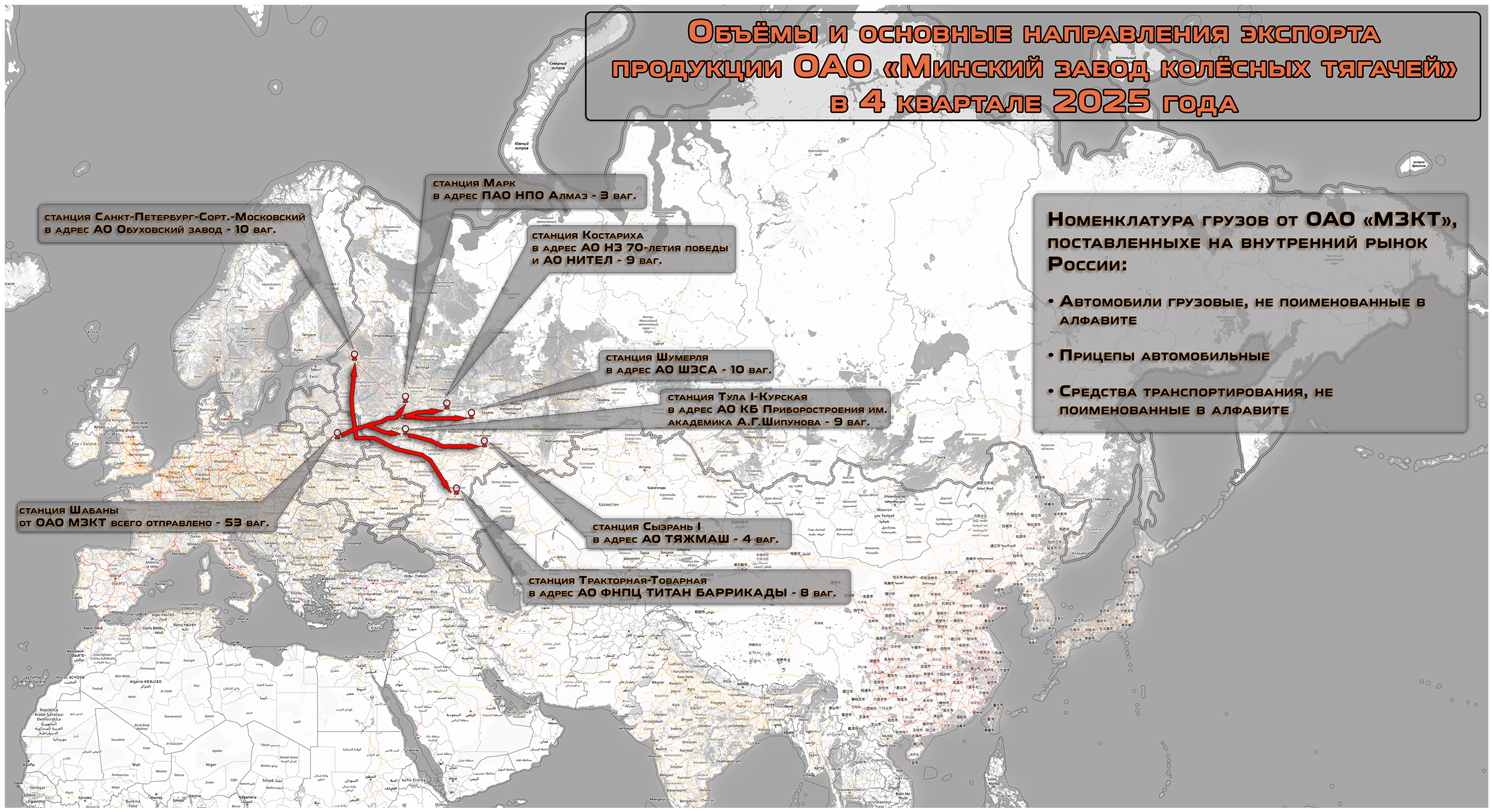
Shipments were carried out in the following directions.
- Shabany — St. Petersburg-Sortirovochny-Moskovsky
From Shabany station (Minsk Division of the Belarusian Railway) to St. Petersburg-Sortirovochny-Moskovsky station (Oktyabrskaya Railway), 10 flatcars with cargo: “Trucks, not elsewhere specified” (ETSNG code 381072) were dispatched from JSC “Minsk Wheel Tractor Plant” to JSC “NPO Obukhovsky Plant”.
JSC “NPO Obukhovsky Plant” is part of the Almaz-Antey Air and Space Defence Concern and is engaged in the development and production of ground-based anti-aircraft missile systems, radar equipment, launchers, transporter-loaders, and other air and missile defense equipment.
In industrial cooperation with MZKT, the enterprise primarily uses special wheeled chassis of the MZKT-543 family, including MZKT-543A and MZKT-543M modifications. In addition, certain types of heavy multi-axle chassis used in air defense and missile defense equipment are supplied to the enterprise.
- Shabany — Shumerlya
From Shabany station (Minsk Division of the Belarusian Railway) to Shumerlya station (Gorky Railway), 10 railcars were dispatched from JSC “Minsk Wheel Tractor Plant” to JSC “Shumerlinsky Plant of Specialized Vehicles”.
The shipment included:
- 7 flatcars with cargo: “Trucks, not elsewhere specified” (ETSNG code 381072);
- 3 boxcars with cargo: “Railway railcars, transported on their own axles, not elsewhere specified” (ETSNG code 421034).
JSC “Shumerlinsky Plant of Specialized Vehicles” produces van bodies, command and staff vehicles, repair vehicles, technical vehicles, and other special vehicles. The enterprise performs equipment installation on high-mobility automotive chassis and produces mobile complexes for various purposes.
The main type of MZKT product supplied to the enterprise is the MZKT-7930 special wheeled chassis. They are used as a base for accommodating large-sized bodies, control equipment, communication equipment, repair equipment, and other special systems.
- Shabany — Kostarikha
From Shabany station (Minsk Division of the Belarusian Railway) to Kostarikha station (Gorky Railway), 6 flatcars with cargo: “Automobile trailers” (ETSNG code 381231) were dispatched from JSC “Minsk Wheel Tractor Plant” to JSC “Nizhny Novgorod Television Plant named after V.I. Lenin”.
JSC “NITEL” specializes in the development and production of duty and combat mode radar stations, air target detection systems, and other radio-technical equipment for air defense systems.
To accommodate individual elements of radar systems, the enterprise receives MZKT-938 family semi-trailers, including MZKT-938B and MZKT-938N modifications. They can be used for mounting hardware cabins, antenna devices, power sources, and auxiliary equipment.
- Shabany — Tula I-Kurskaya
From Shabany station (Minsk Division of the Belarusian Railway) to Tula I-Kurskaya station (Moscow Railway), 9 railcars were dispatched from JSC “Minsk Wheel Tractor Plant” to JSC “Instrument Design Bureau named after Academician A.G. Shipunov”.
The shipment included:
- 6 flatcars with cargo: “Trucks, not elsewhere specified” (ETSNG code 381072);
- 3 boxcars with cargo: “Railway railcars, transported on their own axles, not elsewhere specified” (ETSNG code 421034).
JSC “KBP named after Academician A.G. Shipunov” develops and produces high-precision missile, artillery, and anti-aircraft weapons, including mobile combat systems, control systems, reconnaissance, and guidance systems.
The main type of MZKT chassis used by the enterprise is the MZKT-7930. Its payload capacity, cross-country capability, and layout allow for the placement of launch, radar, command, and auxiliary equipment.
- Shabany — Traktornaya-Tovarnaya
From Shabany station (Minsk Division of the Belarusian Railway) to Traktornaya-Tovarnaya station (Privolzhskaya Railway), 8 railcars were dispatched from JSC “Minsk Wheel Tractor Plant” to JSC “Federal Research and Production Center “Titan-Barrikady””.
The shipment included:
- 6 flatcars with cargo: “Trucks, not elsewhere specified” (ETSNG code 381072);
- 2 boxcars with cargo: “Railway railcars, transported on their own axles, not elsewhere specified” (ETSNG code 421034).
JSC “FNPC “Titan-Barrikady”” specializes in the development and production of ground equipment for missile systems. The enterprise produces self-propelled launchers, transporter-loaders, combat control and support vehicles for the Strategic Missile Forces, Ground Forces, and Navy.
The main MZKT products used by the enterprise are heavy multi-axle chassis MZKT-79221 and special wheeled chassis MZKT-7930. In addition, vehicles based on the MAZ-543 and MZKT-543 families remain in operation.
- Shabany — Syzran I
From Shabany station (Minsk Division of the Belarusian Railway) to Syzran I station (Kuybyshev Railway), 4 flatcars with cargo: “Automobile trailers” (ETSNG code 381231) were dispatched from JSC “Minsk Wheel Tractor Plant” to JSC “TYAZHMASH”.
JSC “TYAZHMASH” produces heavy machinery and special equipment. The enterprise participates in the manufacture of transport and transshipment systems, as well as equipment designed for handling large and heavy products.
In cooperation with MZKT, the enterprise uses MZKT-74106 tractor units and MZKT-938 family semi-trailers.
- Shabany — Mark
From Shabany station (Minsk Division of the Belarusian Railway) to Mark station (Moscow Railway), 3 flatcars with cargo: “Trucks, not elsewhere specified” (ETSNG code 381072) were dispatched from JSC “Minsk Wheel Tractor Plant” to PJSC “Scientific and Production Association ‘Almaz’ named after Academician A.A. Raspletin”.
PJSC “NPO “Almaz”” is the lead developer of anti-aircraft missile systems and automated air defense control systems. The enterprise is engaged in the creation of command posts, radar equipment, control equipment, and other elements of air and missile defense systems.
The main type of MZKT special wheeled chassis used in cooperation with the enterprise is the MZKT-7930. Control systems, radar, and auxiliary equipment can be placed on its base.
- Shabany — Kostarikha
From Shabany station (Minsk Division of the Belarusian Railway) to Kostarikha station (Gorky Railway), 3 flatcars were dispatched from JSC “Minsk Wheel Tractor Plant” to JSC “Nizhny Novgorod Plant of the 70th Anniversary of Victory”.
The shipment included:
- 2 flatcars with cargo: “Automobile trailers” (ETSNG code 381231);
- 1 flatcar with cargo: “Transport means, not elsewhere specified” (ETSNG code 391303).
JSC “Nizhny Novgorod Plant of the 70th Anniversary of Victory” is part of the Almaz-Antey Air and Space Defence Concern and produces radar equipment, command posts, and equipment for anti-aircraft missile systems.
The nomenclature of MZKT equipment used by the enterprise includes special wheeled chassis of the MZKT-543 and MZKT-7930 families, MZKT-7415 tractor units, MZKT-9988 and MZKT-938 family semi-trailers.
Thus, MZKT supplies in Q4 2025 were concentrated on enterprises producing air defense systems, missile and artillery systems, radar equipment, and special vehicles.
The MZKT-7930 chassis remained the most common base in cooperation with Russian enterprises. For individual recipients, supplies of heavy MZKT-79221 chassis, MZKT-543 family vehicles, MZKT-7415 and MZKT-74106 tractor units, as well as MZKT-938 and MZKT-9988 semi-trailers were also characteristic.
2.1.2. Product Supplies JSC “Spetszhelezobeton”
In Q4 2025, 101 gondola cars with products from JSC “Spetszhelezobeton” were dispatched from Sitnitsa station of the Baranovichi Division of the Belarusian Railway to the Russian Federation. All shipments were registered with cargo: “Reinforced concrete sleepers and turnout bearers” (ETSNG code 254159).
Shipments were made to 15 destinations. The largest were supplies to Plesetskaya station — 44 gondola cars, Torzhok — 12, Kotovo — 8, Yedrovo and Rybinsk-Tovarny — 6 gondola cars each. These five destinations accounted for 76 railcars, or 75.2% of the quarterly volume.
Formally, reinforced concrete sleepers and turnout bearers belong to civilian products and are supplied, among others, to units of JSC “Russian Railways” and commercial organizations. However, a significant part of the identified shipments went directly to Russian military units, arsenals, training grounds, logistics support units, Railway Troops units, Strategic Missile Forces facilities, the 12th Main Directorate of the Ministry of Defence of Russia, the Navy, and organizations servicing military and space infrastructure.
Turnout bearers are used in station throats, yards, on access and internal tracks of facilities where railcars are received, sorted, shunted, and delivered to loading and unloading points. Therefore, supplies of such products may be associated not only with routine track maintenance but also with the reconstruction of station track layouts, restoration of access lines, and expansion of loading and unloading infrastructure at military facilities.

Shipments were carried out in the following directions.
- Sitnitsa — Plesetskaya
From Sitnitsa station (Baranovichi Division of the Belarusian Railway) to Plesetskaya station (Northern Railway), 44 gondola cars with cargo: “Reinforced concrete sleepers and turnout bearers” (ETSNG code 254159) were dispatched from JSC “Spetszhelezobeton” to military unit No. 13991.
Military unit No. 13991 ensures the operation of the First State Test Cosmodrome of the Ministry of Defence of the Russian Federation in the closed administrative-territorial formation Mirny. The Plesetsk Cosmodrome has an extensive railway network used for delivering rocket and space technology, fuel components, equipment, building materials, and other cargo directly to technical and launch complexes.
In Q1 2025, 23 gondola cars were dispatched in the same direction, and another one in Q2–Q3. Thus, the total established volume of supplies to Plesetskaya station for 2025 amounted to 68 gondola cars. This is the largest single destination for JSC “Spetszhelezobeton” products to Russian military facilities during the year.
Given the volume of the batch, the products could be used not only for local repairs but also for a larger stage of reconstruction of the internal or access railway tracks of the cosmodrome.
- Sitnitsa — Torzhok
From Sitnitsa station (Baranovichi Division of the Belarusian Railway) to Torzhok station (Oktyabrskaya Railway), 12 gondola cars with cargo: “Reinforced concrete sleepers and turnout bearers” (ETSNG code 254159) were dispatched from JSC “Spetszhelezobeton” to military unit No. 42753.
Military unit No. 42753 belongs to the Railway Troops of the Ministry of Defence of the Russian Federation. Units of this branch of service perform construction, restoration, technical cover, and operation of railway lines and facilities used in the interests of the Russian Armed Forces. In Q2–Q3 2025, another 6 gondola cars were sent to Torzhok station for the same unit.
The total volume of supplies for April–December amounted to 18 gondola cars. The purpose of the cargo directly corresponds to the recipient’s profile: sleepers and turnout bearers could be used both at the unit’s stationary facilities and during work on other sections of the military railway infrastructure.
- Sitnitsa — Kotovo
From Sitnitsa station (Baranovichi Division of the Belarusian Railway) to Kotovo station (Oktyabrskaya Railway), 8 gondola cars with cargo: “Reinforced concrete sleepers and turnout bearers” (ETSNG code 254159) were dispatched from JSC “Spetszhelezobeton” to military unit No. 55443-NL.
Military unit No. 55443-NL is the 13th arsenal of the Main Missile and Artillery Directorate of the Ministry of Defence of the Russian Federation. The facility is intended for storing missile and artillery weapons and ammunition.
Arsenals of this profile have access tracks, station yards, loading and unloading areas, and internal lines to storage facilities. Therefore, the supply could be intended for the repair or reconstruction of track infrastructure used for receiving, storing, and dispatching weapons and ammunition.
- Sitnitsa — Yedrovo
From Sitnitsa station (Baranovichi Division of the Belarusian Railway) to Yedrovo station (Oktyabrskaya Railway), 6 gondola cars with cargo: “Reinforced concrete sleepers and turnout bearers” (ETSNG code 254159) were dispatched from JSC “Spetszhelezobeton” to military unit No. 14245.
Military unit No. 14245 is the command of the 7th Guards Rezhitsa Red Banner Missile Division of the Strategic Missile Forces, stationed in the closed administrative-territorial formation Ozerny, Tver region. Yedrovo station serves railway tracks connected to the division’s facilities.
The supply of sleepers and turnout bearers could be used for the repair of the access and internal railway infrastructure of the formation. Given the recipient’s affiliation with the Strategic Missile Forces, this shipment relates to the provision of infrastructure for a strategic missile facility.
- Sitnitsa — Rybinsk-Tovarny
From Sitnitsa station (Baranovichi Division of the Belarusian Railway) to Rybinsk-Tovarny station (Northern Railway), 6 gondola cars with cargo: “Reinforced concrete sleepers and turnout bearers” (ETSNG code 254159) were dispatched from JSC “Spetszhelezobeton” to military unit No. 54169-SG.
Military unit No. 54169-SG is located in the Rybinsk area and is associated with the storage and distribution of fuels and lubricants. The supply of reinforced concrete sleepers and turnout bearers could be intended for the repair of access and internal railway tracks, ensuring the reception of tank cars, shunting of train consists, and delivery of railcars to fuel storage and dispensing facilities.
- Sitnitsa — Mekenzievye Gory
From Sitnitsa station (Baranovichi Division of the Belarusian Railway) to Mekenzievye Gory station (Crimean Railway), 5 gondola cars with cargo: “Reinforced concrete sleepers and turnout bearers” (ETSNG code 254159) were dispatched from JSC “Spetszhelezobeton” to military unit No. 63876.
Military unit No. 63876 is the 758th logistics support center of the Black Sea Fleet. The center provides warehouse, transport, technical, and rear infrastructure for the fleet in the Sevastopol area. In Q1 2025, another 6 gondola cars were dispatched in the same direction.
The total volume for 2025 amounted to 11 gondola cars. The products could be intended for the repair of access tracks to warehouse facilities, storage bases, and other logistics support facilities of the Black Sea Fleet.
- Sitnitsa — Bolshaya Izhora
From Sitnitsa station (Baranovichi Division of the Belarusian Railway) to Bolshaya Izhora station (Oktyabrskaya Railway), 4 gondola cars with cargo: “Reinforced concrete sleepers and turnout bearers” (ETSNG code 254159) were dispatched from JSC “Spetszhelezobeton” to military unit No. 55443-25.
Military unit No. 55443-25 is associated with the 15th arsenal of the Navy, located in the Bolshaya Izhora area of the Leningrad region. The facility is intended for storing and ensuring the operation of weapons and other material assets of the Navy.
Reinforced concrete sleepers and turnout bearers could be used for the repair of access and internal railway tracks, ensuring the reception of railcars, shunting of train consists, and delivery of cargo to the warehouse and loading/unloading infrastructure of the arsenal.
- Sitnitsa — Kuzhenkino
From Sitnitsa station (Baranovichi Division of the Belarusian Railway) to Kuzhenkino station (Oktyabrskaya Railway), 4 gondola cars with cargo: “Reinforced concrete sleepers and turnout bearers” (ETSNG code 254159) were dispatched from JSC “Spetszhelezobeton” to military unit No. 54149-TD.
Military unit No. 54149-TD is associated with the arsenal infrastructure of the Main Missile and Artillery Directorate of the Ministry of Defence of the Russian Federation and is part of the 1060th logistics support center system. The facility is used for storing artillery, missile, and small arms ammunition in the interests of Ground Forces and Aerospace Forces formations.
The dispatched reinforced concrete products could be intended for the repair of access and internal railway tracks of the arsenal, ensuring the reception of railcars with ammunition and other material assets, their shunting, and delivery to storage and loading/unloading facilities.
- Sitnitsa — Selikhin
From Sitnitsa station (Baranovichi Division of the Belarusian Railway) to Selikhin station (Far Eastern Railway), 3 gondola cars with cargo: “Reinforced concrete sleepers and turnout bearers” (ETSNG code 254159) were dispatched from JSC “Spetszhelezobeton” to military unit No. 52015.
Military unit No. 52015 is the 1201st facility of the 12th Main Directorate of the Ministry of Defence of the Russian Federation. Facilities of this profile are intended for receiving, storing, servicing, and preparing nuclear weapons.
- Sitnitsa — Korfovskaya
From Sitnitsa station (Baranovichi Division of the Belarusian Railway) to Korfovskaya station (Far Eastern Railway), 2 gondola cars with cargo: “Reinforced concrete sleepers and turnout bearers” (ETSNG code 254159) were dispatched from JSC “Spetszhelezobeton” to military unit No. 25625.
Military unit No. 25625 is located in the area of Korfovsky settlement, Khabarovsk Krai, approximately 25 km from Khabarovsk, and belongs to the system of the 12th Main Directorate of the Ministry of Defence of the Russian Federation. The 12th Main Directorate of the Ministry of Defence of the Russian Federation is responsible for the storage, maintenance, transportation, and operational support of nuclear munitions.
The dispatched reinforced concrete products could be intended for the repair of access and internal railway tracks of the facility, ensuring the reception of railcars, shunting of train consists, and delivery of cargo to the technical, storage, and support infrastructure.
- Sitnitsa — Bogdanovich
From Sitnitsa station (Baranovichi Division of the Belarusian Railway) to Bogdanovich station (Sverdlovsk Railway), 2 gondola cars with cargo: “Reinforced concrete sleepers and turnout bearers” (ETSNG code 254159) were dispatched from JSC “Spetszhelezobeton” to military unit No. 58661-21.
Military unit No. 58661-21 is a storage depot for material and technical means of the food service, located in the city of Bogdanovich, Sverdlovsk region. The unit is part of the structure of military unit No. 58661 and belongs to the system of the 1062nd logistics support center.
The dispatched reinforced concrete products could be intended for the repair of access and internal railway tracks of the storage facility, ensuring the reception of railcars, shunting of train consists, and delivery of cargo to storage locations and loading/unloading infrastructure.
- Sitnitsa — Obolsunovo
From Sitnitsa station (Baranovichi Division of the Belarusian Railway) to Obolsunovo station (Northern Railway), 2 gondola cars with cargo: “Reinforced concrete sleepers and turnout bearers” (ETSNG code 254159) were dispatched from JSC “Spetszhelezobeton” to FKU “Joint Strategic Command”, military unit No. 34048.
Military unit No. 34048 is the command of the 54th Guards Missile Division of the Strategic Missile Forces, stationed in Teykovo, Ivanovo region. The formation operates mobile ground-based missile systems “Topol-M” and “Yars”. Support facilities for the division are located in the Obolsunovo area.
The supply relates to the provision of railway infrastructure for the Strategic Missile Forces formation and could be used for the repair of access tracks for the division’s logistics or technical support units.
- Sitnitsa — Betonnaya
From Sitnitsa station (Baranovichi Division of the Belarusian Railway) to Betonnaya station (Privolzhskaya Railway), 1 gondola car with cargo: “Reinforced concrete sleepers and turnout bearers” (ETSNG code 254159) was dispatched from JSC “Spetszhelezobeton” to military unit No. 51473.
Military unit No. 51473 is the 37th separate railway brigade of the Ministry of Defence of the Russian Federation. The supply directly corresponds to the profile of the unit, which performs construction, restoration, and technical cover of railway facilities.
- Sitnitsa — Sechuga
From Sitnitsa station (Baranovichi Division of the Belarusian Railway) to Sechuga station (Gorky Railway), 1 gondola car with cargo: “Reinforced concrete sleepers and turnout bearers” (ETSNG code 254159) was dispatched from JSC “Spetszhelezobeton” to JSC “Center for Operation of Ground Space Infrastructure Facilities”.
JSC “TsENKI” ensures the operation of ground infrastructure for cosmodromes and other facilities of the rocket and space industry. The specific facility for which the batch was intended is not specified in the shipping documents.
Given the recipient’s profile, the products could be used for the repair of internal or access tracks of the ground space infrastructure facility.
- Sitnitsa — Kedrovka
From Sitnitsa station (Baranovichi Division of the Belarusian Railway) to Kedrovka station (Sverdlovsk Railway), 1 gondola car with cargo: “Reinforced concrete sleepers and turnout bearers” (ETSNG code 254159) was dispatched from JSC “Spetszhelezobeton” to military unit No. 58661-BB.
Military unit No. 58661-BB is an arsenal for complex storage of missiles, ammunition, and explosives of the Main Missile and Artillery Directorate of the Ministry of Defence of the Russian Federation, located in the Kedrovka area. The facility has a developed network of access and internal railway tracks serving the warehouse and loading/unloading infrastructure.
The dispatched reinforced concrete products could be intended for the repair of individual sections of the arsenal’s track infrastructure, ensuring the reception of railcars, shunting of train consists, and delivery of cargo to storage areas.
Overall, Q4 supplies were distributed among several groups of facilities. At least 52 gondola cars were sent to Strategic Missile Forces and space infrastructure facilities, including Plesetsk, Yedrovo, Obolsunovo, and the facility serviced by JSC “TsENKI”. Another at least 22 gondola cars were delivered to arsenals and storage facilities, 13 to Railway Troops units, and 10 to Navy structures and its logistics support.
This structure shows that JSC “Spetszhelezobeton” products were primarily used at facilities with developed internal track infrastructure, where railway transport is necessary for the regular delivery of heavy, dangerous, and oversized cargo. These include missile divisions, cosmodromes, arsenals, storage bases, and fleet facilities.
Compared to Q2–Q3, when 12 gondola cars were sent to the military segment, the volume in Q4 increased more than eightfold to 101 gondola cars. This growth is likely due to the completion of annual contracts and the next stage of work on the repair and reconstruction of the railway infrastructure of Russian military facilities.
2.1.3. Other Military Shipments
In Q4 2025, 121 railcars were classified as other military cargo. This group included two large shipments of ammunition from Belarusian artillery bases and depots, totaling 92 railcars, as well as a troop train of the 336th Rocket Artillery Brigade, sent to the Kapustin Yar training ground for combat training activities.
The nature of these shipments differed significantly. Dispatches from Bobr and Tsentrolit stations represented the actual export of ammunition to Russian arsenals. The shipment of the 336th Rocket Artillery Brigade, in contrast, was a temporary relocation of the unit with equipment and property to a Russian training ground, with a subsequent return to Belarus.
In the overall structure of the subsection, 87 boxcars were loaded with explosives, and another 5 boxcars were intended for escorts. The transportation of equipment and property of the 336th Rocket Artillery Brigade accounted for 29 railcars.
The export of ammunition in Q4 continued the shipments that began in September 2025. In October–December, dispatches continued in two directions — Bobr — Kuzhenkino and Tsentrolit — Neya. The recipients remained the 93rd and 100th arsenals of the Main Missile and Artillery Directorate of the Ministry of Defence of the Russian Federation.
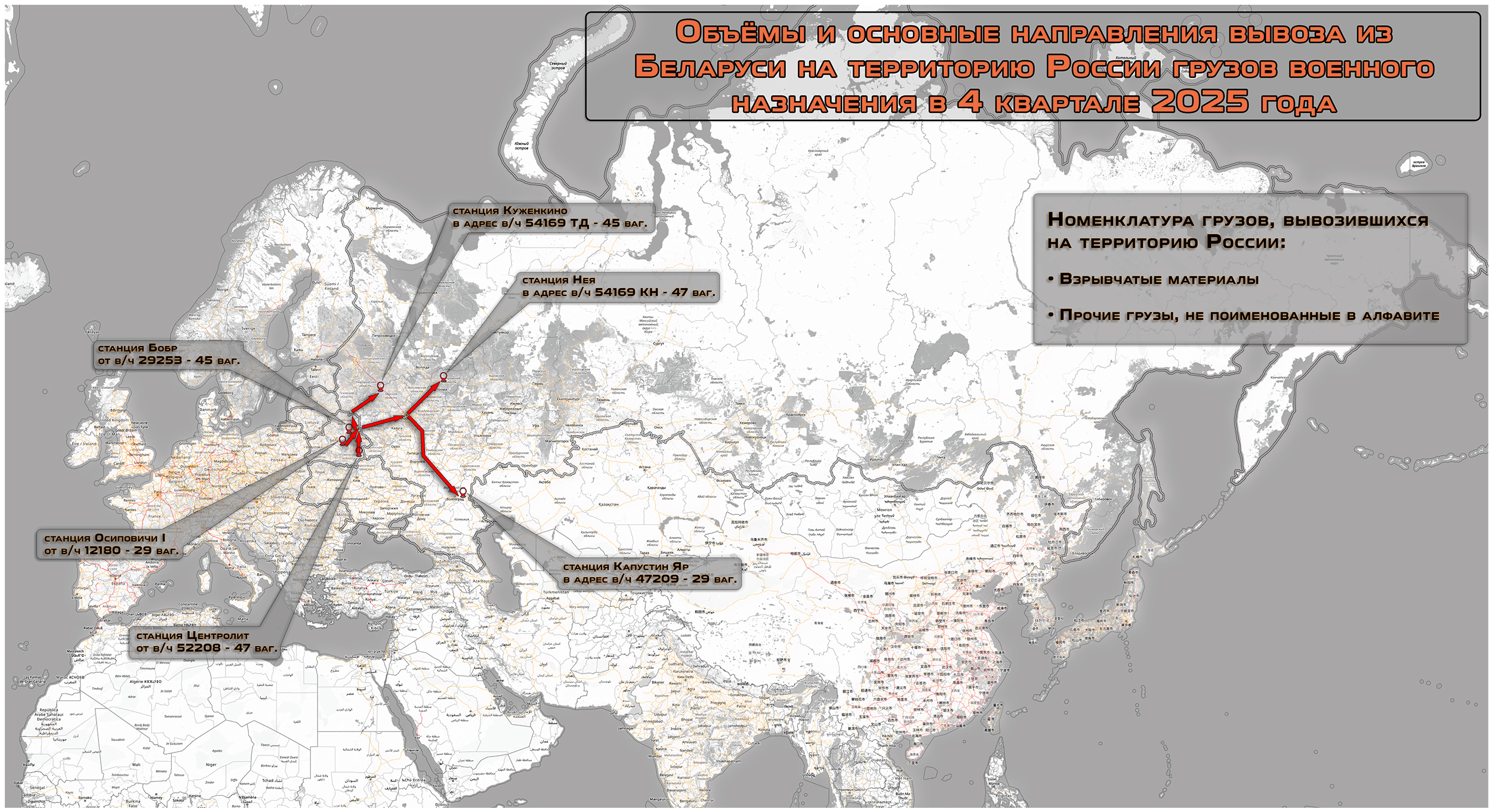
Shipments were carried out in the following directions.
- Bobr — Kuzhenkino
From Bobr station (Minsk Division of the Belarusian Railway) to Kuzhenkino station (Oktyabrskaya Railway), 45 boxcars were dispatched from military unit No. 29253 — the 391st Artillery Ammunition Base of the Ministry of Defence of the Republic of Belarus — to military unit No. 54169-TD — the 93rd Arsenal of the Main Missile and Artillery Directorate of the Ministry of Defence of the Russian Federation.
The shipment included:
- 42 boxcars with cargo: “Explosive materials” (ETSNG code 693142);
- 3 boxcars with cargo: “Railcar for cargo attendants” (ETSNG code 421161)
The 391st Artillery Ammunition Base is located in the Bobr station area and is intended for receiving, storing, servicing, and issuing missile and artillery weapons and ammunition. The recipient was the 93rd Arsenal of the Main Missile and Artillery Directorate of the Ministry of Defence of the Russian Federation in the Kuzhenkino station area.
The exact nomenclature of exported ammunition is not disclosed in the shipping documents. According to available data, the batches included 122-mm and 152-mm artillery rounds, as well as ammunition for multiple launch rocket systems.
- Tsentrolit — Neya
From Tsentrolit station (Gomel Division of the Belarusian Railway) to Neya station (Northern Railway), 47 boxcars were dispatched from military unit No. 52208 — the 1393rd Artillery Ammunition Depot of the Ministry of Defence of the Republic of Belarus — to military unit No. 54169-KN — the 100th Arsenal of the Main Missile and Artillery Directorate of the Ministry of Defence of the Russian Federation.
The shipment included:
- 45 boxcars with cargo: “Explosive materials” (ETSNG code 693142);
- 2 boxcars with cargo: “Railcar for cargo attendants” (ETSNG code 421161).
The 1393rd Artillery Ammunition Depot is located in the area of Tsentrolit and Pribor stations near Gomel. The recipient was the 100th Arsenal of the Main Missile and Artillery Directorate of the Ministry of Defence of the Russian Federation, serviced by Neya station.
In total, 92 railcars were exported from Bobr and Tsentrolit stations in Q4, including 87 boxcars with ammunition and 5 railcars for cargo attendants.
- Osipovichi I — Kapustin Yar
From Osipovichi I station (Mogilev Division of the Belarusian Railway) to Kapustin Yar station (Privolzhskaya Railway), 29 railcars were dispatched from military unit No. 12180 — the 336th Rocket Artillery Brigade of the Armed Forces of the Republic of Belarus — to military unit No. 47209 — the 60th Training Center for Combat Application of Missile Troops and Artillery.
The troop train consist included:
- 25 flatcars with cargo: “Other cargo, not elsewhere specified” (ETSNG code 693087);
- 3 boxcars with cargo: “Other cargo, not elsewhere specified” (ETSNG code 693087);
- 1 gondola car with cargo: “Other cargo, not elsewhere specified” (ETSNG code 693087).
The dispatch was related to the next training cycle for units of the 336th Rocket Artillery Brigade at the Kapustin Yar training ground. Standard equipment was transported on flatcars, and gear and property in boxcars.
The deployment of Belarusian units to Kapustin Yar is associated with the need to conduct practical launches and firing from extended-range systems. Shipments of the 336th Rocket Artillery Brigade along the Osipovichi I — Kapustin Yar route and back are recorded periodically.
At the end of December 2025, the unit returned to Belarus by a train consist of the same total composition — 29 railcars. During the return shipment, the consist included 25 flatcars and 3 boxcars with cargo registered under ETSNG code 693087, as well as 1 gondola car with explosive materials cargo. The designation of the cargo as explosive materials confirms the transportation of missile weapons.
Thus, this shipment was not a supply of weapons to the Russian side: equipment and most of the property returned to their permanent deployment point after training was completed.
Overall, the main volume of other military shipments in Q4 accounted for the actual export of ammunition — 92 railcars, or 76% of the subsection’s volume. Another 29 railcars were related to the temporary redeployment of units of the 336th Rocket Artillery Brigade to the Kapustin Yar training ground.
All identified batches of ammunition were sent not directly to combat areas, but to centralized arsenals of the Main Missile and Artillery Directorate of the Ministry of Defence of the Russian Federation. This scheme likely allowed for accounting, verification, and sorting of received ammunition before its further distribution.
2.2. 2025 Results
In 2025, 1,154 railcars involved in military transport and military product supplies were dispatched from the Republic of Belarus to the Russian Federation.
By period, the volume of established shipments was distributed as follows:
January–March accounted for 15.8% of the annual volume, April–September for 60.4%, and October–December for 23.8%.
The overall figure combines shipments of various purposes. It includes supplies of products from Belarusian enterprises to the Russian military-industrial complex, export of ammunition from Belarusian storage facilities, transfer of military equipment to the Russian side, dispatch of weapons for repair, temporary deployment of Belarusian units to Russian training grounds, and the return of Russian Armed Forces units after exercises in Belarus.
Therefore, the final 1,154 railcars cannot be equated to the volume of weapons, equipment, and material assets irrevocably transferred to the Russian side. A significant part of the annual figure accounts for temporary and return shipments, within which equipment and property returned to their permanent deployment point or remained the property of the original owner after training, repair, or exercises.
Q1
In Q1 2025, exports amounted to 182 railcars and were entirely represented by supplies of products from Belarusian enterprises:
- JSC “Minsk Wheel Tractor Plant” — 93 railcars;
- JSC “Spetszhelezobeton” — 89 gondola cars.
In January–March, no organized troop trains, export of ammunition from Belarusian arsenals, or dispatches of weapons for repair were identified.
MZKT products were primarily sent to enterprises of the Russian military-industrial complex manufacturing missile, anti-aircraft, radar, and other military-purpose systems. Sleepers and turnout bearers produced by JSC “Spetszhelezobeton” were supplied to Russian military units, arsenals, training grounds, Strategic Missile Forces facilities, the 12th Main Directorate of the Ministry of Defence of the Russian Federation, the Navy, and other structures with their own track infrastructure.
Q2–Q3
The largest volume of established shipments occurred in April–September — 697 railcars.
Industrial supplies amounted to 147 railcars:
- JSC “MZKT” products — 135 railcars;
- JSC “Spetszhelezobeton” products — 12 gondola cars.
The remaining 550 railcars accounted for other military shipments:
- export of ammunition from Belarusian artillery bases and depots — 76 railcars;
- transfer of equipment from the 814th Technical Support Center to the 1311th Central Tank Reserve Base — 32 railcars;
- dispatch of equipment from the 377th Anti-Aircraft Missile Regiment to the 1019th Military Repair Plant — 33 railcars;
- deployment of the 120th Separate Guards Mechanized Brigade to the 333rd Combat Training Center — 71 railcars;
- deployment of Air Force and Air Defense units, as well as rocket artillery, to the Ashuluk and Kapustin Yar training grounds — 154 railcars;
- return of Russian units after the “Zapad-2025” exercises and CSTO exercises — 184 railcars.
The main volume of the period was associated not with industrial supplies, but with organized movements of units and equipment. Temporary deployment of Belarusian units for training and the return of Russian units after exercises accounted for 409 railcars.
Q4
In Q4 2025, 275 railcars were dispatched from Belarus:
- JSC “MZKT” products — 53 railcars;
- JSC “Spetszhelezobeton” products — 101 gondola cars;
- ammunition and railcars for cargo attendants — 92 railcars;
- equipment and property of the 336th Rocket Artillery Brigade — 29 railcars.
Unlike Q2–Q3, no mass return of Russian units after major joint exercises was recorded in October–December. The main components of the export were targeted supplies of products from Belarusian enterprises and the continuation of ammunition dispatches from Belarusian storage facilities.
The only organized training train was the dispatch of units of the 336th Rocket Artillery Brigade to the Kapustin Yar training ground. After training was completed, equipment and most of the property returned to Belarus.
Supplies of JSC “MZKT” products
In 2025, JSC “Minsk Wheel Tractor Plant” dispatched 281 railcars of products by railway:
- Q1 — 93 railcars;
- Q2–Q3 — 135 railcars;
- Q4 — 53 railcars.
MZKT products accounted for 24.4% of the total established annual export.
Supplies were primarily made to Russian enterprises manufacturing ground-based missile systems, air and missile defense systems, radar equipment, artillery systems, and special vehicles.
The bulk of the shipments consisted of special wheeled chassis, tractors, trailers, and semi-trailers used as transport bases for mounting launchers, radar equipment, command posts, transporter-loaders, and other military equipment.
Compared to 2024, when the volume of railway dispatches from the enterprise amounted to 306 railcars, the figure decreased by 25 railcars, or 8.2%. At the same time, supplies maintained a strong orientation towards enterprises of the Russian military-industrial complex, and the circle of main recipients did not significantly change.
Supplies of JSC “Spetszhelezobeton” products
In 2025, JSC “Spetszhelezobeton” dispatched 202 gondola cars with reinforced concrete sleepers and turnout bearers to identified military and related facilities:
- Q1 — 89 gondola cars;
- Q2–Q3 — 12 gondola cars;
- Q4 — 101 gondola cars.
These shipments accounted for 17.5% of the total annual export volume.
Compared to 2024, when 149 gondola cars were sent to military and related facilities, the volume increased by 53 railcars, or 35.6%.
The largest single destination was the Plesetsk Cosmodrome, which received 68 gondola cars during the year: 23 in Q1, one in Q2–Q3, and 44 in Q4.
The dynamics of supplies were uneven. After 89 gondola cars in Q1, the volume decreased to 12 in Q2–Q3, and then increased to 101 gondola cars in Q4. Such a distribution could be related to the phasing of infrastructure works and the schedules for executing individual contracts, but shipping documents do not allow for establishing the specific reasons for the concentration of dispatches at the beginning and end of the year.
Products were sent to facilities with their own track infrastructure: cosmodromes, Strategic Missile Forces formations, arsenals, storage bases, Railway Troops units, Navy facilities, and enterprises of the military-industrial complex. Reinforced concrete sleepers and turnout bearers could be used for the repair and reconstruction of station yards, access lines, and internal tracks of military facilities.
Ammunition and explosive materials cargo
The export of ammunition from Belarusian artillery bases and depots resumed in September 2025 and continued until the end of December.
In Q1, no ammunition shipments from Belarus to Russia were identified.
In September, 76 railcars were dispatched from facilities in Bobr, Tsentrolit, Bronnaya Gora, and Dobrush, including 70 boxcars with “Explosive materials” cargo and 6 railcars for cargo attendants.
In Q4, shipments continued. Another 92 railcars were dispatched from Bobr and Tsentrolit stations to Russian arsenals, including 87 boxcars with “Explosive materials” cargo and 5 railcars for cargo attendants.
Thus, 168 railcars were exported directly from Belarusian ammunition bases and depots in 2025, including:
- 157 boxcars with “Explosive materials” cargo;
- 11 railcars for cargo attendants.
Ammunition was dispatched from four Belarusian facilities:
- 391st Artillery Ammunition Base (Bobr);
- 1393rd Artillery Ammunition Depot (Tsentrolit and Pribor stations);
- 46th Missile and Ammunition Arsenal (Bronnaya Gora);
- 43rd Missile and Ammunition Arsenal (Dobrush).
The recipients were:
- 93rd Arsenal of the Main Missile and Artillery Directorate of the Ministry of Defence of the Russian Federation (Kuzhenkino);
- 100th Arsenal of the Main Missile and Artillery Directorate of the Ministry of Defence of the Russian Federation (Neya);
- 13th Arsenal of the Main Missile and Artillery Directorate of the Ministry of Defence of the Russian Federation (Kotovo);
- 68th Arsenal of the Main Missile and Artillery Directorate of the Ministry of Defence of the Russian Federation (Lukovsky station).
The largest destinations were:
- Bobr–Kuzhenkino — 67 railcars in September–December, including 62 railcars with ammunition and 5 railcars for cargo attendants;
- Tsentrolit–Neya — 68 railcars in September–December, including 65 railcars with ammunition and 3 railcars for cargo attendants.
In total, only these two routes accounted for 135 railcars, of which 127 were loaded with ammunition.
In September, shipments were also made in the following directions:
- Bronnaya Gora–Neya — 15 railcars, including 14 railcars with ammunition and 1 railcar for cargo attendants;
- Dobrush–Kotovo — 11 railcars, including 10 railcars with ammunition and 1 railcar for cargo attendants;
- Dobrush–Lukovsky — 7 railcars, including 6 railcars with ammunition and 1 railcar for cargo attendants.
The exact nomenclature of transported items is not disclosed in shipping documents. According to available data, the shipments included 122-mm and 152-mm artillery rounds, as well as ammunition for multiple rocket launcher systems.
All identified shipments were directed to centralized arsenals of the Main Missile and Artillery Directorate of the Ministry of Defence of the Russian Federation, where ammunition is received, stored, accounted for, and further distributed.
Simultaneously, throughout September, counter-deliveries of weapons and ammunition from the Russian Federation to Belarusian arsenals and storage bases were recorded. Thus, the export of part of Belarusian stockpiles occurred in parallel with the arrival in Belarus of Russian weapons and ammunition of different nomenclature.
Not every railcar documented as carrying explosive materials and sent from Belarus to Russia was a delivery of ammunition to the Russian side.
In Q2–Q3, six gondola cars with explosive materials cargo passed as part of trains of Belarusian units heading to the Ashuluk and Kapustin Yar ranges:
- three — as part of the 15th Anti-Aircraft Missile Brigade;
- two — as part of the 120th Anti-Aircraft Missile Brigade;
- one — as part of the 336th Rocket Artillery Brigade.
These railcars transported missile armament items necessary for conducting live-fire exercises during combat training. After completing training, the units returned to their permanent deployment locations in Belarus along with their equipment and remaining property.
In addition, five more railcars with explosive materials cargo left the territory of Belarus as part of Russian troop trains after the completion of the Zapad-2025 exercise: two railcars traveled with units of the 2nd Guards Motorized Rifle Division and three with units of the 4th Guards Tank Division. These cargoes had previously been brought into Belarus by Russian units and were not related to the export of Belarusian stockpiles.
Thus, in total in 2025, 179 railcars related to the transport of explosive materials cargo passed in the direction of the Russian Federation, of which:
- 168 railcars constituted ammunition shipments from Belarusian storage facilities (including 157 railcars with cargo “Explosive Materials” and 11 railcars for cargo attendants);
- 6 railcars were part of trains of Belarusian units heading to Russian ranges;
- 5 railcars returned as part of Russian units after the completion of joint exercises.
Other Military Transport
In addition to industrial deliveries and ammunition export, in 2025 equipment was transported for storage and maintenance, as well as organized movements of units.
In April–September, 32 railcars with equipment from the 814th Technical Support Center were sent to the 1311th Central Tank Reserve Base. Another 33 railcars with equipment from the 377th Anti-Aircraft Missile Regiment passed to the 1019th Military Repair Plant.
The following were sent for training to Russian training centers and ranges:
- 120th Separate Guards Mechanized Brigade — 71 railcars;
- 15th Anti-Aircraft Missile Brigade — 46 railcars;
- 49th Radio-Technical Brigade — 28 railcars;
- 120th Anti-Aircraft Missile Brigade — 40 railcars;
- 336th Rocket Artillery Brigade — 40 railcars in Q2–Q3 and another 29 railcars in Q4.
After completing activities, the equipment and most of the property of Belarusian units returned to Belarus.
A separate group consisted of 184 railcars of Russian units that left Belarus after the Zapad-2025 exercises and CSTO exercises. These transports represented the return of previously imported equipment and property, not deliveries from the Belarusian side.
Overall Export Structure
By main categories, the annual volume was distributed as follows:
- MZKT products — 281 railcars;
- Spetszhelezobeton products — 202 gondola cars;
- other military transport — 671 railcars.
The 671 railcars of other transport included:
- ammunition export and railcars for cargo attendants — 168 railcars;
- transfer of equipment for storage — 32 railcars;
- dispatch of equipment for maintenance — 33 railcars;
- deployment of Belarusian units for training — 254 railcars;
- return of Russian units after exercises — 184 railcars.
Throughout the year, the export structure changed noticeably. In Q1, it consisted entirely of products from Belarusian enterprises. In Q2–Q3, the main part was formed by transport of units and equipment related to combat training, exercises, maintenance, and equipment transfer. Starting in September, large-scale ammunition export from Belarusian storage facilities was added. In Q4, the share of industrial and warehouse shipments increased again — primarily Spetszhelezobeton products, ammunition, and MZKT special wheeled chassis.
The total of 1,154 railcars characterizes the overall volume of identified outgoing military transport, but not the volume of weapons and equipment transferred to the Russian side. To assess actual exports, it is necessary to separate industrial deliveries and material stockpile exports from training, maintenance, and return transport.
2.3. Export of Military Cargo from the Republic of Belarus in January–April 2026
In January–April 2026, 219 railcars with military cargo and products supplied in the interests of Russian military and defense-industrial structures were dispatched from the Republic of Belarus in the direction of the Russian Federation.
By main categories, transport was distributed as follows:
- Minsk Wheel Tractor Plant products — 126 railcars;
- Spetszhelezobeton products — 76 gondola cars;
- other military cargo — 17 railcars.
By month, the volume of shipments was:
- January — 81 railcars;
- February — 62 railcars;
- March — 53 railcars;
- April — 23 railcars.
The main volume of transport fell on industrial products from Belarusian enterprises. Deliveries from the Minsk Wheel Tractor Plant accounted for 57.5% of total exports, while another 34.7% consisted of reinforced concrete sleepers and turnout bearers produced by Spetszhelezobeton. The share of other military cargo did not exceed 7.8%.
Compared to Q4 2025, the transport structure changed noticeably. If in October–December a significant part of exports consisted of ammunition from Belarusian artillery bases and warehouses, as well as transport of units of the 336th Rocket Artillery Brigade, in January–April 2026 such transport was not recorded. The flow was again formed primarily by deliveries of products from Belarusian enterprises maintaining stable production cooperation with the Russian defense-industrial complex and structures of the Ministry of Defence of the Russian Federation.
At the same time, the nature of other military transport changed. Instead of movements between Belarusian and Russian military facilities, in the period under review only one group of shipments was identified, documented to the Russian port of Bronka for further export to a third country. Thus, other military cargo was no longer associated with direct supply to Russian military units or conduct of combat training activities.
Compared to the same period in 2025, there were also no mass transports due to training of Belarusian units at Russian ranges, transfer of equipment for maintenance and storage, or movement of Russian units within joint exercises. This indicates a return of railway transport to a more stable structure in which targeted deliveries of products from enterprises of the Belarusian defense-industrial complex and infrastructure materials for facilities of the Ministry of Defence of the Russian Federation predominate.
In the period under review, the largest export category remained products of the Minsk Wheel Tractor Plant, supplied to enterprises producing missile armament, air defense systems, radar equipment, and special vehicles. Second place was occupied by deliveries from Spetszhelezobeton, intended for facilities of the Strategic Missile Forces, Railway Troops, naval and space-rocket infrastructure, as well as other Russian military facilities with their own railway infrastructure.
Thus, in the first four months of 2026, railway exports from Belarus were characterized by the predominance of industrial cooperation and infrastructure support over actual military transport. Unlike the second half of 2025, signs of large-scale movement of units, ammunition export from Belarusian arsenals, and other major organized military operations were not identified in the period under review.
2.3.1. Product Deliveries Minsk Wheel Tractor Plant
In January–April 2026, 126 railcars with products from the Minsk Wheel Tractor Plant were dispatched from Shabany station of the Minsk Division of the Belarusian Railway in the direction of the Russian Federation. Transport was carried out in 11 directions to enterprises of the Russian defense-industrial and space-rocket complexes.
By cargo nomenclature, transport was distributed as follows:
- 95 flatcars with cargo “Trucks, not listed in the alphabetical index” — ETSNG code 381072;
- 14 flatcars with cargo “Automobile trailers” — ETSNG code 381231;
- 3 flatcars with cargo “Transport means, not listed in the alphabetical index” — ETSNG code 391303;
- 14 boxcars with cargo “Railway cars transported on their own axles, not listed in the alphabetical index” — ETSNG code 421034, used as buffer railcars.
The basis of transport consisted of special automotive equipment: 95 flatcars carried trucks not separately specified in the ETSNG classifier. Another 17 flatcars carried automobile trailers and other transport means. The actual contents and purpose of 14 boxcars are not established from available shipping data.
The largest recipients were Obukhov Plant — 37 railcars, Motovilikha Plants — 26, FNPC Titan-Barrikady — 25, and NITEL — 12 railcars. These four directions accounted for 100 railcars, or 79.4% of the identified volume of MZKT deliveries.

Transport was carried out in the following directions.
- Shabany–St. Petersburg-Sortirovochny-Moskovsky
From Shabany station (Minsk Division of the Belarusian Railway) to St. Petersburg-Sortirovochny-Moskovsky station (Oktyabrskaya Railway) from the Minsk Wheel Tractor Plant to Obukhov Plant, 37 flatcars with cargo “Trucks, not listed in the alphabetical index” — ETSNG code 381072 — were dispatched.
Obukhov Plant is part of the Almaz-Antey Air and Space Defence Corporation and participates in the production of ground-based systems for anti-aircraft missile systems, launchers and transport-loading vehicles, radar and other air and missile defense equipment.
In production cooperation with MZKT, the enterprise uses wheeled chassis of the MZKT-543 family, including MZKT-543A and MZKT-543M. In addition, MZKT performed technical diagnostics and repair-restoration work on MZKT-792911 chassis operated in the interests of Obukhov Plant.
In January–April 2026, Obukhov Plant became the largest recipient of MZKT products. Compared to Q4 2025, the volume of shipments in this direction increased from 10 to 37 flatcars. Given the enterprise’s specialization, the transport could be related to the delivery of special wheeled chassis for subsequent installation of ground-based systems for air and missile defense complexes.
- Shabany–Perm I
From Shabany station (Minsk Division of the Belarusian Railway) to Perm I station (Sverdlovsk Railway) from the Minsk Wheel Tractor Plant to Motovilikha Plants, 26 flatcars with cargo “Trucks, not listed in the alphabetical index” — ETSNG code 381072 — were dispatched.
Motovilikha Plants specializes in the production of artillery systems, multiple rocket launcher systems, combat and transport-loading vehicles, as well as other special equipment for missile forces and artillery.
All 26 railcars were flatcars with automotive equipment. Given the recipient’s specialization, the transported items could be intended for subsequent installation of armament, transport-loading, or auxiliary equipment for artillery and rocket complexes.
- Shabany–Traktornaya-Tovarnaya
From Shabany station (Minsk Division of the Belarusian Railway) to Traktornaya-Tovarnaya station (Privolzhskaya Railway) from the Minsk Wheel Tractor Plant to FNPC Titan-Barrikady, 25 railcars were dispatched, including:
- 17 flatcars with cargo “Trucks, not listed in the alphabetical index” — ETSNG code 381072;
- 8 boxcars with cargo “Railway cars transported on their own axles, not listed in the alphabetical index” — ETSNG code 421034.
FNPC Titan-Barrikady specializes in the development and production of ground-based equipment for missile complexes. The enterprise produces self-propelled launchers, transport-transshipment units, combat control and support vehicles for missile complexes of various purposes.
In production cooperation with MZKT, the enterprise uses heavy multi-axle chassis MZKT-79221, special wheeled chassis MZKT-7930, as well as vehicles of the MAZ-543 and MZKT-543 families. MZKT also performs service maintenance and technical supervision work on these types of chassis.
Compared to Q4 2025, the volume of transport in this direction increased from 8 to 25 railcars.
- Shabany–Kostarikha: NITEL
From Shabany station (Minsk Division of the Belarusian Railway) to Kostarikha station (Gorky Railway) from the Minsk Wheel Tractor Plant to Nizhny Novgorod Television Plant named after V.I. Lenin, 12 flatcars with cargo “Automobile trailers” — ETSNG code 381231 — were dispatched.
NITEL specializes in the development and production of radar stations, airborne target detection systems, and other radio-technical equipment for air defense systems.
In production cooperation with MZKT, the enterprise uses automobile semi-trailers of the MZKT-938 family, including modifications MZKT-938B and MZKT-938N.
In Q4 2025, 6 flatcars with trailer equipment were sent to NITEL, and in January–April 2026 — 12. Given the cargo name and established cooperation, the transport could include another batch of semi-trailers of the MZKT-938 family, intended for placement of equipment cabins, antenna devices, power sources, or other equipment for radar complexes.
- Shabany–Shumerlya
From Shabany station (Minsk Division of the Belarusian Railway) to Shumerlya station (Gorky Railway) from the Minsk Wheel Tractor Plant to Shumerlya Specialized Automobile Plant, 9 railcars were dispatched, including:
- 6 flatcars with cargo “Trucks, not listed in the alphabetical index” — ETSNG code 381072;
- 3 boxcars with cargo “Railway cars transported on their own axles, not listed in the alphabetical index” — ETSNG code 421034.
Shumerlya Specialized Automobile Plant produces van bodies, command-staff, repair, technical, and other special vehicles, performing equipment installation on high-mobility automotive chassis.
The main type of MZKT product used by the enterprise is special wheeled chassis MZKT-7930. Chassis of this family can serve as a base for placing large-sized bodies, communications and control equipment, repair equipment, and other special systems.
- Shabany–Syzran I
From Shabany station (Minsk Division of the Belarusian Railway) to Syzran I station (Kuybyshev Railway) from the Minsk Wheel Tractor Plant to TYAZHMASH, 5 flatcars were dispatched, including:
- 3 flatcars with cargo “Transport means, not listed in the alphabetical index” — ETSNG code 391303;
- 2 flatcars with cargo “Automobile trailers” — ETSNG code 381231.
TYAZHMASH produces heavy machinery and special equipment, including transport and transshipment systems for working with heavy and oversized items.
In production cooperation with MZKT, the enterprise uses MZKT-74106 tractor units and automobile semi-trailers of the MZKT-938 family.
- Shabany–Kostarikha: Nizhny Novgorod Plant 70th Anniversary of Victory
From Shabany station (Minsk Division of the Belarusian Railway) to Kostarikha station (Gorky Railway) from the Minsk Wheel Tractor Plant to Nizhny Novgorod Plant 70th Anniversary of Victory, 3 flatcars with cargo “Trucks, not listed in the alphabetical index” — ETSNG code 381072 — were dispatched.
Nizhny Novgorod Plant 70th Anniversary of Victory is part of the Almaz-Antey Air and Space Defence Corporation and produces radar systems, command posts, and equipment for anti-aircraft missile systems.
The nomenclature of MZKT products used by the enterprise includes chassis of the MZKT-543 and MZKT-7930 families, MZKT-7415 tractor units, MZKT-9988 semi-trailers, and MZKT-938 family. MZKT also performed technical maintenance and restoration work on this equipment.
Unlike Q4 2025, when trailers and other transport means were received by the enterprise, in the period under review the shipment consisted of three flatcars with automotive equipment. Given the plant’s profile, the transported chassis could be intended for placement of radar, command, or auxiliary equipment. The exact model of items was not established.
- Shabany–Krasnodar II
From Shabany station (Minsk Division of the Belarusian Railway) to Krasnodar II station (North Caucasus Railway) from the Minsk Wheel Tractor Plant to Krasnodar Instrument Plant Kaskad, 3 railcars were dispatched, including:
- 2 flatcars with cargo “Trucks, not listed in the alphabetical index” — ETSNG code 381072;
- 1 boxcar with cargo “Railway cars transported on their own axles, not listed in the alphabetical index” — ETSNG code 421034.
Krasnodar Instrument Plant Kaskad specializes in the production, upgrade, and maintenance of special-purpose communications complexes, communications node equipment, mobile command posts, and other information transmission systems.
The enterprise cooperates with MZKT in technical inspection and repair-restoration work on MZKT-7930 chassis.
- Shabany–Mark
From Shabany station (Minsk Division of the Belarusian Railway) to Mark station (Moscow Railway) from the Minsk Wheel Tractor Plant to NPO Almaz named after Academician A.A. Raspletin, 2 flatcars with cargo “Trucks, not listed in the alphabetical index” — ETSNG code 381072 — were dispatched.
NPO Almaz is a developer of anti-aircraft missile systems and automated air defense control systems. The enterprise is engaged in creating command posts, radar systems, control equipment, and other elements of air and missile defense systems.
In production cooperation with the enterprise, special wheeled chassis MZKT-7930 are used. MZKT also performed technical diagnostics and restoration work on them.
- Shabany–Fili
From Shabany station (Minsk Division of the Belarusian Railway) to Fili station (Moscow Railway) from the Minsk Wheel Tractor Plant to State Space Research and Production Center named after M.V. Khrunichev, 2 railcars were dispatched, including:
- 1 flatcar with cargo “Trucks, not listed in the alphabetical index” — ETSNG code 381072;
- 1 boxcar with cargo “Railway cars transported on their own axles, not listed in the alphabetical index” — ETSNG code 421034.
State Space Research and Production Center named after M.V. Khrunichev is an enterprise of the Russian space-rocket industry and is engaged in the development and production of launch vehicles, spacecraft, and ground-based equipment for space-rocket complexes.
The exact type of MZKT automotive equipment sent to the enterprise is not established from available data. Given the recipient’s profile, it could be intended for placement of transport, technological, or auxiliary equipment for ground-based space-rocket infrastructure.
- Shabany–Tula I-Kurskaya
From Shabany station (Minsk Division of the Belarusian Railway) to Tula I-Kurskaya station (Moscow Railway) from the Minsk Wheel Tractor Plant to Design Bureau of Instrument Engineering named after Academician A.G. Shipunov, 2 railcars were dispatched, including:
- 1 flatcar with cargo “Trucks, not listed in the alphabetical index” — ETSNG code 381072;
- 1 boxcar with cargo “Railway cars transported on their own axles, not listed in the alphabetical index” — ETSNG code 421034.
Design Bureau of Instrument Engineering named after Academician A.G. Shipunov develops and produces high-precision missile, artillery, and anti-aircraft armament, including mobile combat complexes, reconnaissance, control, and guidance systems.
In production cooperation with MZKT, the enterprise uses special wheeled chassis MZKT-7930. Their characteristics allow placement of launcher, radar, command, and auxiliary equipment.
Overall, in January–April 2026, deliveries of MZKT products maintained their focus on enterprises of the Russian defense-industrial complex producing air and missile defense systems, missile and artillery armament, radar equipment, communications systems, and special vehicles.
The absolute volume of transport was 126 railcars versus 53 railcars in Q4 2025. However, these indicators cover periods of different duration and do not in themselves indicate comparable growth in transport intensity. More indicative is a comparison with Q1 2025: then 93 railcars were dispatched, or an average of 31 railcars per month, whereas in January–April 2026 the average monthly volume was 31.5 railcars.
Thus, the overall intensity of railway deliveries of MZKT products remained virtually unchanged. At the same time, there was a noticeable redistribution of volumes among recipient enterprises: transport to Obukhov Plant and Titan-Barrikady center increased significantly, and a large batch of automotive equipment was sent to Motovilikha Plants.
The most common automotive base in the established cooperation between MZKT and Russian enterprises remained the special wheeled chassis MZKT-7930. For individual recipients, heavy chassis MZKT-79221, vehicles of the MZKT-543 family, MZKT-7415 and MZKT-74106 tractor units, as well as trailer equipment of the MZKT-938 and MZKT-9988 families are also characteristic.
2.3.2. Product Deliveries Spetszhelezobeton
In January–March 2026, 76 gondola cars with products from Spetszhelezobeton were dispatched from Sitnitsa station of the Baranovichi Division of the Belarusian Railway in the direction of the Russian Federation. In April, deliveries from the enterprise to Russian military and related facilities were not recorded.
All transport was documented with cargo: “Reinforced concrete sleepers and turnout bearers” (ETSNG code 254159).
Shipments were carried out in 16 directions. The largest were deliveries to Darasun station — 17 gondola cars, Patrikeyevo — 8, Kadala — 7, Uzhur and Perevoz — 6 gondola cars each. These five directions accounted for 44 gondola cars, or 57.9% of the delivery volume for the period under review.
Formally, reinforced concrete sleepers and turnout bearers are civilian products and are widely used on public and non-public railways. At the same time, the shipments under review went directly to military units, arsenals, storage bases, Strategic Missile Forces facilities, military ranges, Navy units, and a military shipbuilding enterprise.
Turnout bearers are used in station throats, yards, sidings, and internal tracks of facilities where train reception, breaking up, and shunting operations are performed, as well as delivery of railcars to loading and unloading sites. Therefore, deliveries of such products may be related both to routine maintenance of track infrastructure and to reconstruction of station track layouts, restoration of sidings, and expansion of loading-unloading infrastructure at military facilities.
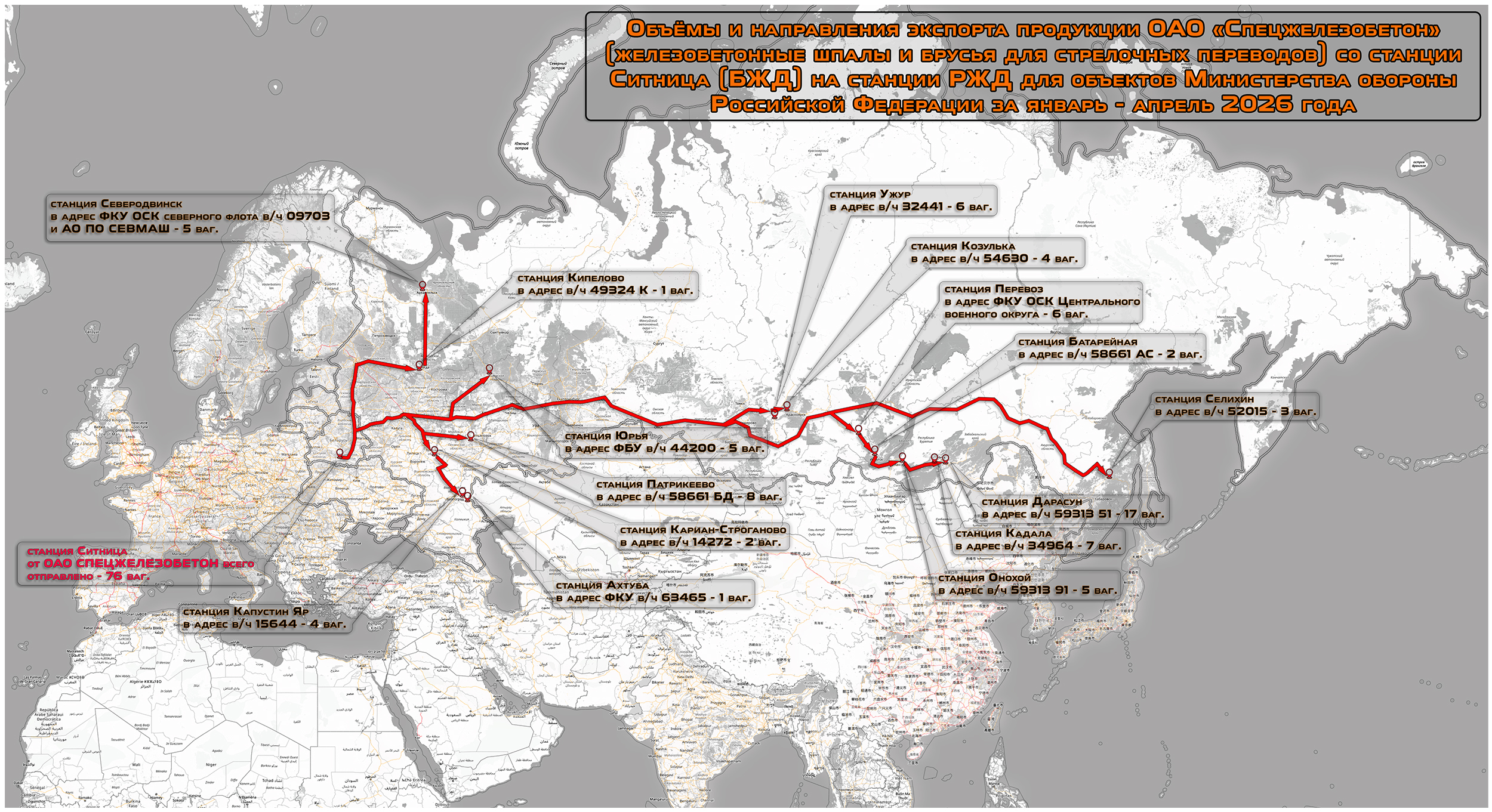
Transport was carried out in the following directions.
- Sitnitsa–Darasun
From Sitnitsa station (Baranovichi Division of the Belarusian Railway) to Darasun station (Trans-Baikal Railway) from Spetszhelezobeton to military unit No. 59313-51, 17 gondola cars with cargo: “Reinforced concrete sleepers and turnout bearers” (ETSNG code 254159) were dispatched.
Military unit No. 59313-51 is located in the Karymsky District of Trans-Baikal Territory and, according to available information, belongs to storage-profile facilities. The unit has a non-public railway track approximately 4.5 km long.
The delivery to Darasun was the largest batch of Spetszhelezobeton products in the period under review. Given the shipment volume, the reinforced concrete sleepers and turnout bearers could be intended for maintenance or reconstruction of the siding and individual sections of the facility’s internal track infrastructure.
- Sitnitsa–Patrikeyevo
From Sitnitsa station (Baranovichi Division of the Belarusian Railway) to Patrikeyevo station (Kuybyshev Railway) from Spetszhelezobeton to military unit No. 58661-BD, 8 gondola cars with cargo: “Reinforced concrete sleepers and turnout bearers” (ETSNG code 254159) were dispatched.
Military unit No. 58661-BD — 12th Arsenal for Storage of Aviation Weapons, part of the logistics system of the Armed Forces of Russia. The facility is intended for storage of aviation armament and ammunition. In Q1 2025, another 6 gondola cars were dispatched in the same direction.
Thus, the total identified volume of deliveries to Patrikeyevo station since the beginning of 2025 was 14 gondola cars. The products could be used for maintenance of sidings and internal tracks of the arsenal, ensuring reception and dispatch of railcars with armament, ammunition, and other material resources.
- Sitnitsa–Kadala
From Sitnitsa station (Baranovichi Division of the Belarusian Railway) to Kadala station (Trans-Baikal Railway) from Spetszhelezobeton to military unit No. 34964, 7 gondola cars with cargo: “Reinforced concrete sleepers and turnout bearers” (ETSNG code 254159) were dispatched.
Military unit No. 34964 belongs to the Railway Troops of the Ministry of Defence of the Russian Federation and is deployed in the Chita area. Units of this branch of service perform construction, restoration, technical protection, and operation of railway lines and facilities in the interests of the Armed Forces of Russia. In Q1 2025, one gondola car was sent to this same unit.
The total identified volume of deliveries in the Sitnitsa–Kadala direction since the beginning of 2025 was 8 gondola cars. The cargo purpose corresponds to the recipient’s profile: sleepers and turnout bearers could be used both at the unit’s stationary facilities and when performing work on other sections of military railway infrastructure.
- Sitnitsa–Uzhur
From Sitnitsa station (Baranovichi Division of the Belarusian Railway) to Uzhur station (Krasnoyarsk Railway) from Spetszhelezobeton to military unit No. 32441, 6 gondola cars with cargo: “Reinforced concrete sleepers and turnout bearers” (ETSNG code 254159) were dispatched.
Military unit No. 32441 — headquarters of the 62nd Uzhur Red Banner Missile Division named after the 60th Anniversary of the USSR, deployed in the closed town of Solnechny in Krasnoyarsk Territory and part of the Strategic Missile Forces.
The delivery relates to infrastructure support for the strategic missile formation. The reinforced concrete products could be intended for maintenance of sidings or internal tracks ensuring delivery of equipment, construction materials, and other cargo to the division’s technical and auxiliary facilities.
- Sitnitsa–Perevoz
From Sitnitsa station (Baranovichi Division of the Belarusian Railway) to Perevoz station (East Siberian Railway) from Spetszhelezobeton to the Federal Government Institution “Joint Strategic Command of the Central Military District,” 6 gondola cars with cargo: “Reinforced concrete sleepers and turnout bearers” (ETSNG code 254159) were dispatched.
The batch was intended for military unit No. 75226 — 1215th Central Artillery Ammunition Base, located in the Perevoz station area. The facility is used for storage and handling of artillery ammunition and other material resources.
In Q1 2025, deliveries of Spetszhelezobeton products were already made in this direction. The dispatched sleepers and turnout bearers could be intended for maintenance of sidings and internal railway tracks of the base, ensuring reception of railcars, shunting operations, and delivery of cargo to warehouse and loading-unloading infrastructure.
- Sitnitsa–Onokhoy
From Sitnitsa station (Baranovichi Division of the Belarusian Railway) to Onokhoy station (East Siberian Railway) from Spetszhelezobeton to military unit No. 59313-91, 5 gondola cars with cargo: “Reinforced concrete sleepers and turnout bearers” (ETSNG code 254159) were dispatched.
Military unit No. 59313-91 — aviation and missile armament and ammunition warehouse of the 1063rd Logistics Center of the Eastern Military District, located in the Onokhoy area.
The products could be used for maintenance of sidings, station track layouts, and internal branches along which railcars are delivered to warehouse and loading-unloading facilities.
- Sitnitsa–Yurya
From Sitnitsa station (Baranovichi Division of the Belarusian Railway) to Yurya station (Gorky Railway) from Spetszhelezobeton to military unit No. 44200, 5 gondola cars with cargo: “Reinforced concrete sleepers and turnout bearers” (ETSNG code 254159) were dispatched.
Military unit No. 44200 — headquarters of the 8th Melitopol Red Banner Missile Division of the Strategic Missile Forces, deployed in the closed town of Pervomaysky in Kirov Oblast. In Q1 2025, one more gondola car was dispatched in this direction.
The total established volume of deliveries to Yurya station since the beginning of 2025 amounted to 6 gondola cars. The products could have been intended for the repair of the railway infrastructure of the formation, including access tracks to technical, storage, and support facilities.
- Sitnitsa — Kapustin Yar
From Sitnitsa station (Baranovichi Division of Belarusian Railway) to Kapustin Yar station (Privolzhskaya Railway), JSC “Spetszhelezobeton” dispatched 4 gondola cars with cargo: “Reinforced concrete sleepers and turnout bearers” (ETSNG code 254159) to military unit No. 15644.
Military unit No. 15644 ensures the operation of the 4th State Central Inter-service Proving Ground of the Ministry of Defence of the Russian Federation. The proving ground is used for testing missile systems, air defense assets, and other weapon samples. In Q1 2025, 7 gondola cars were sent in the same direction.
The total established volume of deliveries to Kapustin Yar station since the beginning of 2025 amounted to 11 gondola cars. The products could have been intended for the repair of tracks serving the proving ground’s testing, technical, storage, and loading/unloading facilities.
- Sitnitsa — Kozulka
From Sitnitsa station (Baranovichi Division of Belarusian Railway) to Kozulka station (Krasnoyarsk Railway), JSC “Spetszhelezobeton” dispatched 4 gondola cars with cargo: “Reinforced concrete sleepers and turnout bearers” (ETSNG code 254159) to military unit No. 54630.
Military unit No. 54630 is the 2544th Central Tank Reserve Base, intended for storing armored vehicles. In Q1 2025, 7 gondola cars were sent to this base.
The total established volume of deliveries to Kozulka station since the beginning of 2025 amounted to 11 gondola cars. The concrete products could have been used for the repair of access tracks, loading fronts, and internal branches of the base, ensuring the reception, storage, and dispatch of heavy equipment.
- Sitnitsa — Severodvinsk: military unit No. 09703
From Sitnitsa station (Baranovichi Division of Belarusian Railway) to Severodvinsk station (Northern Railway), JSC “Spetszhelezobeton” dispatched 4 gondola cars with cargo: “Reinforced concrete sleepers and turnout bearers” (ETSNG code 254159) to the Federal State Institution “Joint Strategic Command of the Northern Fleet,” military unit No. 09703.
Military unit No. 09703 is the 45th State Central Naval Proving Ground of the Ministry of Defence of the Russian Federation. The facility is associated with testing naval missile armaments. In Q1 2025, 3 gondola cars were sent to this unit, and in Q2–Q3, another 2.
Thus, the total established volume of deliveries to military unit No. 09703 since the beginning of 2025 amounted to 9 gondola cars. The products could have been used for the repair of the railway infrastructure of the proving ground or related technical and support facilities.
- Sitnitsa — Selikhin
From Sitnitsa station (Baranovichi Division of Belarusian Railway) to Selikhin station (Far Eastern Railway), JSC “Spetszhelezobeton” dispatched 3 gondola cars with cargo: “Reinforced concrete sleepers and turnout bearers” (ETSNG code 254159) to military unit No. 52015.
Military unit No. 52015 is the 1201st facility of the 12th Main Directorate of the Ministry of Defence of the Russian Federation. Facilities of this profile are associated with the reception, storage, maintenance, and preparation of special ammunition. In Q1 2025, 4 gondola cars were sent in the same direction, and in Q4, another 3.
Considering the current batch, the total established volume of deliveries to Selikhin station since the beginning of 2025 amounted to 10 gondola cars. The products could have been used for the repair of access tracks to the technical area, storage facilities, and loading/unloading platforms of the facility.
- Sitnitsa — Karian-Stroganovo
From Sitnitsa station (Baranovichi Division of Belarusian Railway) to Karian-Stroganovo station (South-Eastern Railway), JSC “Spetszhelezobeton” dispatched 2 gondola cars with cargo: “Reinforced concrete sleepers and turnout bearers” (ETSNG code 254159) to military unit No. 14272.
Military unit No. 14272 is the 28th arsenal of the Space Forces, located in the Znamenka settlement area of the Tambov region. The facility is intended for the reception, storage, and operational support of rocket and space technology. In Q1 2025, 3 gondola cars were sent to the same recipient.
The total established volume of deliveries since the beginning of 2025 amounted to 5 gondola cars. The products could have been intended for the repair of access and internal tracks of the arsenal, used when working with special equipment, machinery, and oversized cargo.
- Sitnitsa — Batareynaya
From Sitnitsa station (Baranovichi Division of Belarusian Railway) to Batareynaya station (East Siberian Railway), JSC “Spetszhelezobeton” dispatched 2 gondola cars with cargo: “Reinforced concrete sleepers and turnout bearers” (ETSNG code 254159) to military unit No. 58661-AS.
Military unit No. 58661-AS is located in the area of Batareynaya station in Irkutsk and belongs to the structure of the Federal State Institution “Joint Strategic Command of the Central Military District.” The exact profile of the unit has not been established based on available data.
The delivery could have been intended for the repair of access or internal railway tracks of the military facility. The specific area of product use has not been established.
- Sitnitsa — Akhtuba
From Sitnitsa station (Baranovichi Division of Belarusian Railway) to Akhtuba station (Privolzhskaya Railway), JSC “Spetszhelezobeton” dispatched 1 gondola car with cargo: “Reinforced concrete sleepers and turnout bearers” (ETSNG code 254159) to military unit No. 63465.
Military unit No. 63465 is located in the closed military town of Akhtubinsk-7, Astrakhan region. The V. P. Chkalov State Flight Test Center — military unit No. 15650, which is one of the main testing centers for aviation equipment and aviation armaments of the Ministry of Defence of the Russian Federation, is based on its territory. The facility’s structure includes testing, technical, security, and support units.
Given the recipient’s location, the dispatched concrete products could have been intended for the repair of access or internal railway tracks serving the testing, technical, storage, and support infrastructure of Akhtubinsk-7.
- Sitnitsa — Kipelovo
From Sitnitsa station (Baranovichi Division of Belarusian Railway) to Kipelovo station (Northern Railway), JSC “Spetszhelezobeton” dispatched 1 gondola car with cargo: “Reinforced concrete sleepers and turnout bearers” (ETSNG code 254159) to military unit No. 49324-K.
Military unit No. 49324-K is a separate aviation unit of the Russian Navy’s naval aviation, stationed in the Fedotovo settlement of the Vologda region. The unit is based at Kipelovo airfield and is organizationally linked to military unit No. 49324, whose command is located in Severomorsk.
The concrete products could have been intended for the repair of access or internal railway tracks serving the aviation, storage, fuel, and other support infrastructure of the airfield. The specific area of cargo use has not been established.
- Sitnitsa — Severodvinsk: JSC “PO “Sevmash””
From Sitnitsa station (Baranovichi Division of Belarusian Railway) to Severodvinsk station (Northern Railway), JSC “Spetszhelezobeton” dispatched 1 gondola car with cargo: “Reinforced concrete sleepers and turnout bearers” (ETSNG code 254159) to JSC “Production Association “Northern Machine-Building Enterprise””.
JSC “PO “Sevmash”” is one of the main enterprises of Russian military shipbuilding and specializes in the construction, repair, and upgrade of nuclear submarines. In Q2–Q3 2025, one gondola car of JSC “Spetszhelezobeton” products had already been sent to the enterprise.
The enterprise has internal and access railway tracks used for delivering metal, oversized structures, equipment, and other production cargo. The dispatched products could have been intended for the repair of individual sections of the factory’s track infrastructure.
Overall, in January–April 2026, deliveries of JSC “Spetszhelezobeton” products maintained a wide geographical reach. Cargoes were sent to the European part of Russia, the Volga region, Siberia, Transbaikalia, and the Far East. At the same time, the main volume shifted to the eastern regions of the country.
The Trans-Baikal, East Siberian, and Krasnoyarsk Railways collectively accounted for 47 gondola cars, or 61.8% of the total volume. Of these, 24 gondola cars were sent to facilities in the Trans-Baikal Territory, 13 to the Irkutsk region and Buryatia, and another 10 to the Krasnoyarsk Territory.
Unlike Q4 2025, when 44 out of 101 gondola cars were sent to the Plesetsk Cosmodrome, in January–April 2026, there was no single dominant recipient of comparable scale. The largest batch — 17 gondola cars — was delivered to the storage facility of military unit No. 59313-51 in the Trans-Baikal Territory, while the remaining 59 gondola cars were distributed among 15 destinations, ranging from one to eight railcars.
The absolute volume of deliveries decreased from 101 gondola cars in Q4 2025 to 76 in January–April 2026. However, periods of different durations are being considered: three months in Q4 and four months at the beginning of 2026. The average monthly volume decreased from 33.7 to 19 gondola cars. Furthermore, in April 2026, no shipments of the enterprise’s products to military recipients were recorded.
Compared to Q4 2025, the recipient structure also changed. Deliveries to the Plesetsk Cosmodrome, arsenals in Kotovo and Bolshaya Izhora, Black Sea Fleet facilities, and Railway Troops units in Torzhok were absent during the period under review. Simultaneously, major destinations emerged for warehouse and arsenal facilities in Darasun, Patrikeyevo, and Onokhoy, as well as for the railway infrastructure of Strategic Missile Forces units in Uzhur and Yurya.
At the same time, deliveries continued to facilities that appeared in previous periods: the 4th State Central Inter-Service Test Range in Kapustin Yar, the 2544th Central Tank Reserve Base in Kozulka, the 45th State Central Naval Testing Ground in Severodvinsk, the 1201st facility of the 12th Main Directorate of the Russian Ministry of Defence in Selikhin, the 28th Arsenal of the Space Forces, and the Sevmash enterprise.
The nature of the recipients indicates that JSC Spetszhelezobeton’s products continued to be used primarily at facilities with developed internal railway networks, where railway transport is essential for receiving and dispatching heavy, oversized, and special cargo. These include arsenals and storage bases, missile divisions, testing grounds, aviation facilities, and military shipbuilding enterprises.
2.3.3. Other Military Shipments
In January–April 2026, 17 railcars dispatched from Belarus to Bronka station on the Oktyabrskaya Railway were classified as other military cargo. All identified shipments were completed in March. The railway sender was Businessinvest Garant LLC, and the recipient was Phoenix LLC.
The shipments included:
- 12 flatcars with cargo “Special automobiles” (ETSNG code 381091);
- 1 flatcar with combined carload shipment;
- 4 gondola cars with cargo “Other goods not listed in the alphabetical index” (ETSNG code 693087).
Bronka station serves the marine transshipment complex of the same name in St. Petersburg. Given the destination station and the previously identified operational scheme of the transport participants, the shipments under consideration were the railway stage of further export of goods by sea to a third country, and not deliveries to Russian military units or defense industry enterprises.
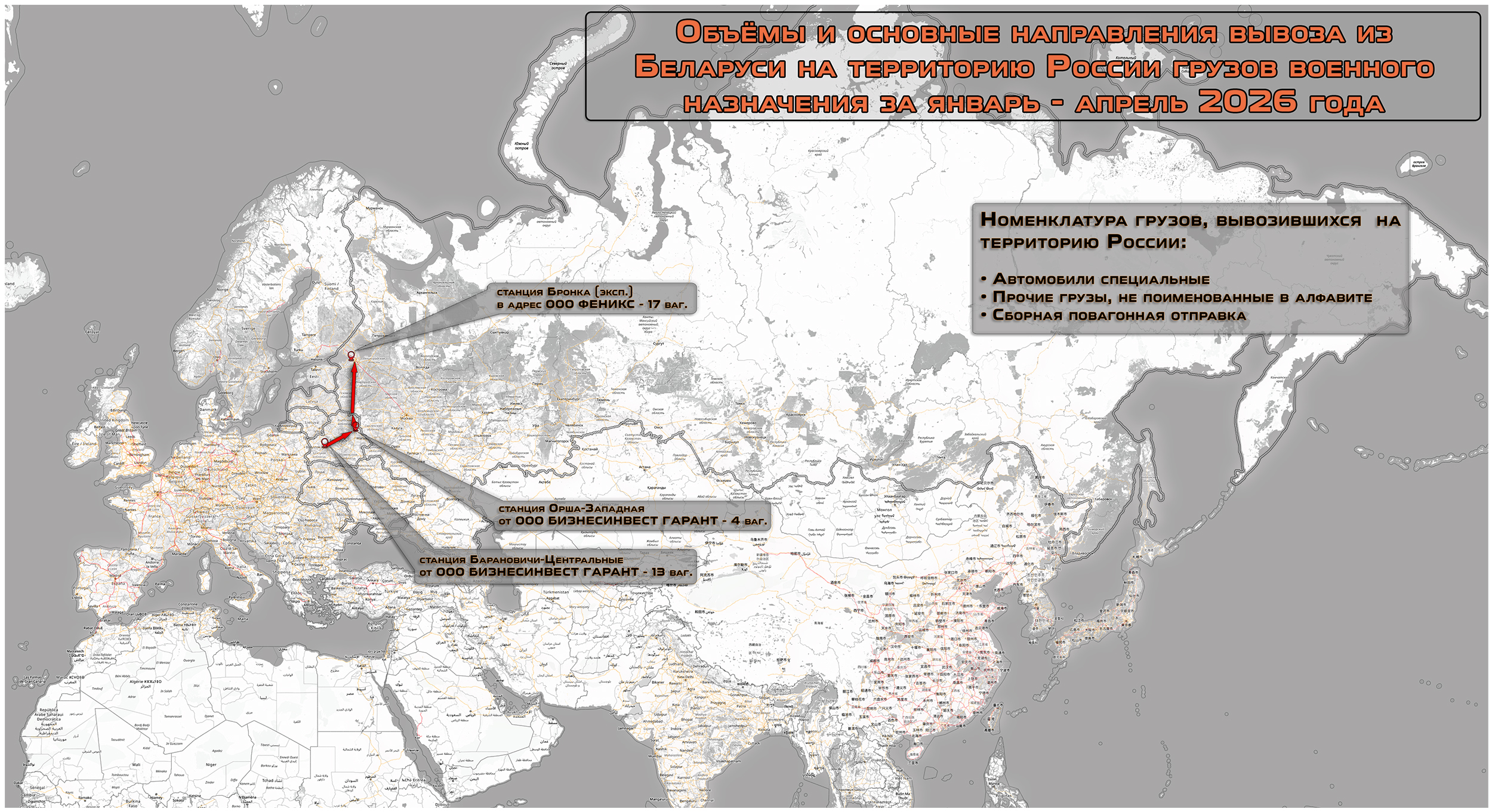
Transportation was carried out in the following directions.
- Baranovichi-Tsentralnye — Bronka
From Baranovichi-Tsentralnye station (Baranovichi Division of the Belarusian Railway) to Bronka exp. station (Oktyabrskaya Railway), Businessinvest Garant LLC dispatched 13 flatcars to Phoenix LLC, including:
- 12 flatcars with cargo “Special automobiles” (ETSNG code 381091);
- 1 flatcar with combined carload shipment.
The main cargo name indicates the transportation of special automotive equipment. However, the available railway data does not specify its manufacturer, models, or final foreign customer.
The actual contents of the consolidated wagon-load shipment are also not disclosed. It could have included equipment, components, or other property accompanying the main consignment, but confirming such a connection based on available information is not possible.
Businessinvest Garant LLC acted as the railway sender and organizer of export logistics in this transportation, not the manufacturer of the transported equipment.
- Orsha-Zapadnaya — Bronka
From Orsha-Zapadnaya station (Vitebsk Division of Belarusian Railway) to Bronka Exp. station (Oktyabrskaya Railway), LLC “Businessinvest Garant” dispatched 4 gondola cars with cargo “Other goods not listed in the alphabetical index” (ETSNG code 693087) to LLC “Phoenix.”
The generalized cargo name does not allow for determining the actual contents of the gondola cars. The coincidence of the sender, recipient, destination station, and transportation period suggests a connection to the batch of special vehicles dispatched from Baranovichi-Tsentralnye. However, it cannot be assumed that components, equipment, or support property for this equipment were transported in the gondola cars without additional data.
The logistics scheme used in March 2026 had been previously recorded in 2024. At that time, 21 railway transport units with military cargo, intended for subsequent transshipment to a sea vessel and export to third countries, were dispatched from Belarus to Bronka station.
Phoenix LLC also acted as the recipient on Russian territory, and Businessinvest Garant LLC handled the freight forwarding. The State Military-Industrial Committee of the Republic of Belarus was indicated as the railway sender in 2024.
The established volume of transportation in 2024 included:
- 15 railcars with special automobiles;
- 2 railcars with consolidated wagon-load shipments;
- 3 railcars with radar equipment;
- 1 railcar for cargo attendants.
Thus, in March 2026, the main elements of the previously identified scheme were repeated: Bronka destination station, Russian recipient LLC “Phoenix,” participation of LLC “Businessinvest Garant,” and one of the main cargo categories — “Special automobiles” with ETSNG code 381091.
The totality of identified episodes shows that Businessinvest Garant LLC is regularly involved in the forwarding of military and special purpose cargo exported from Belarus to third countries. The company may provide the railway stage of transportation, processing of necessary documents, interaction with Russian recipients and port infrastructure, as well as organizing subsequent sea delivery.
Additional insight into the nature of the company’s operations is provided by requests sent directly to Businessinvest Garant LLC for the organization of transport and forwarding services for JSC MZKT products. As examples, documents for planned deliveries of equipment to the United Arab Emirates and Pakistan are attached to the publication.
Example of requirements for forwarding JSC MZKT products to the United Arab Emirates:
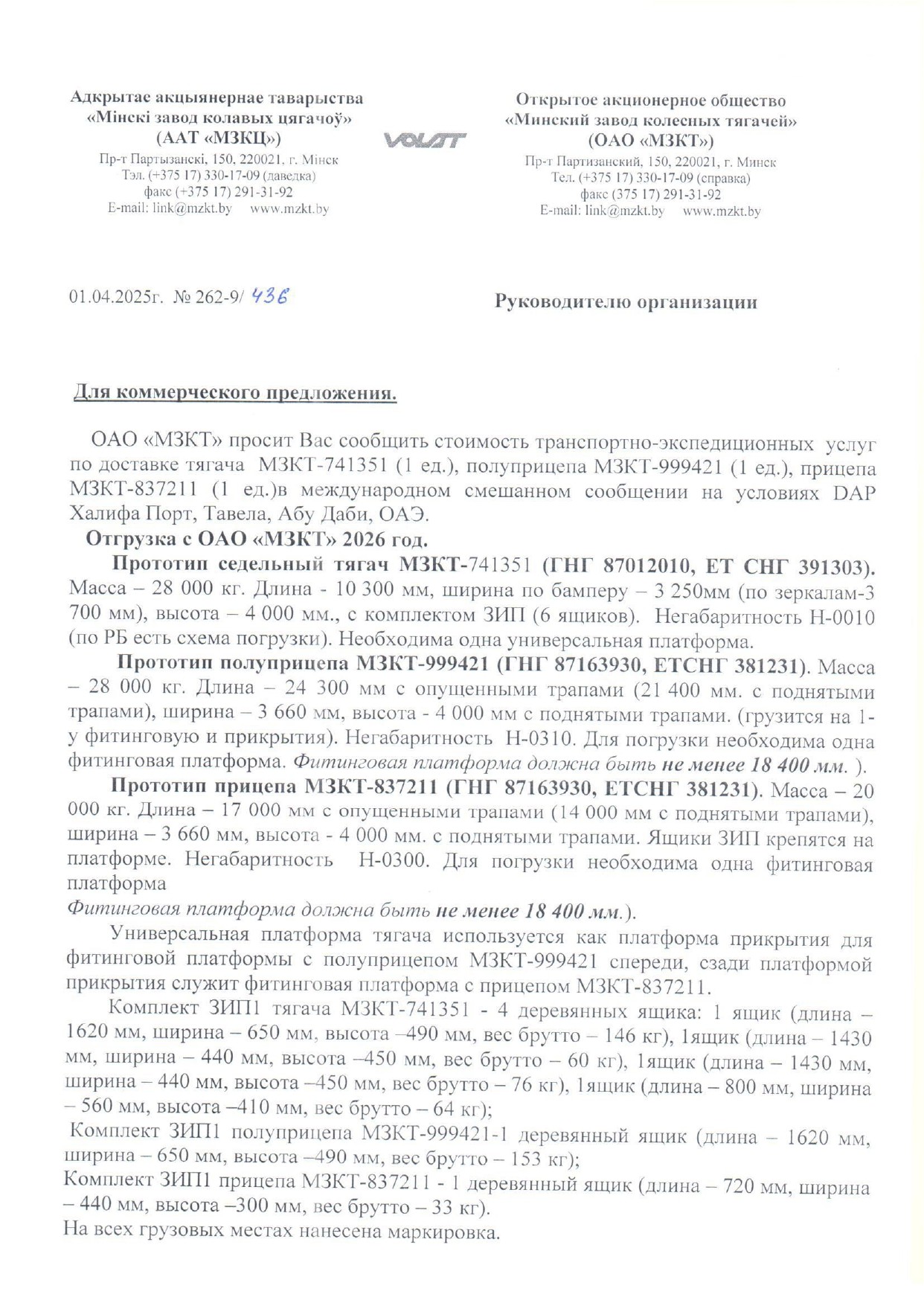
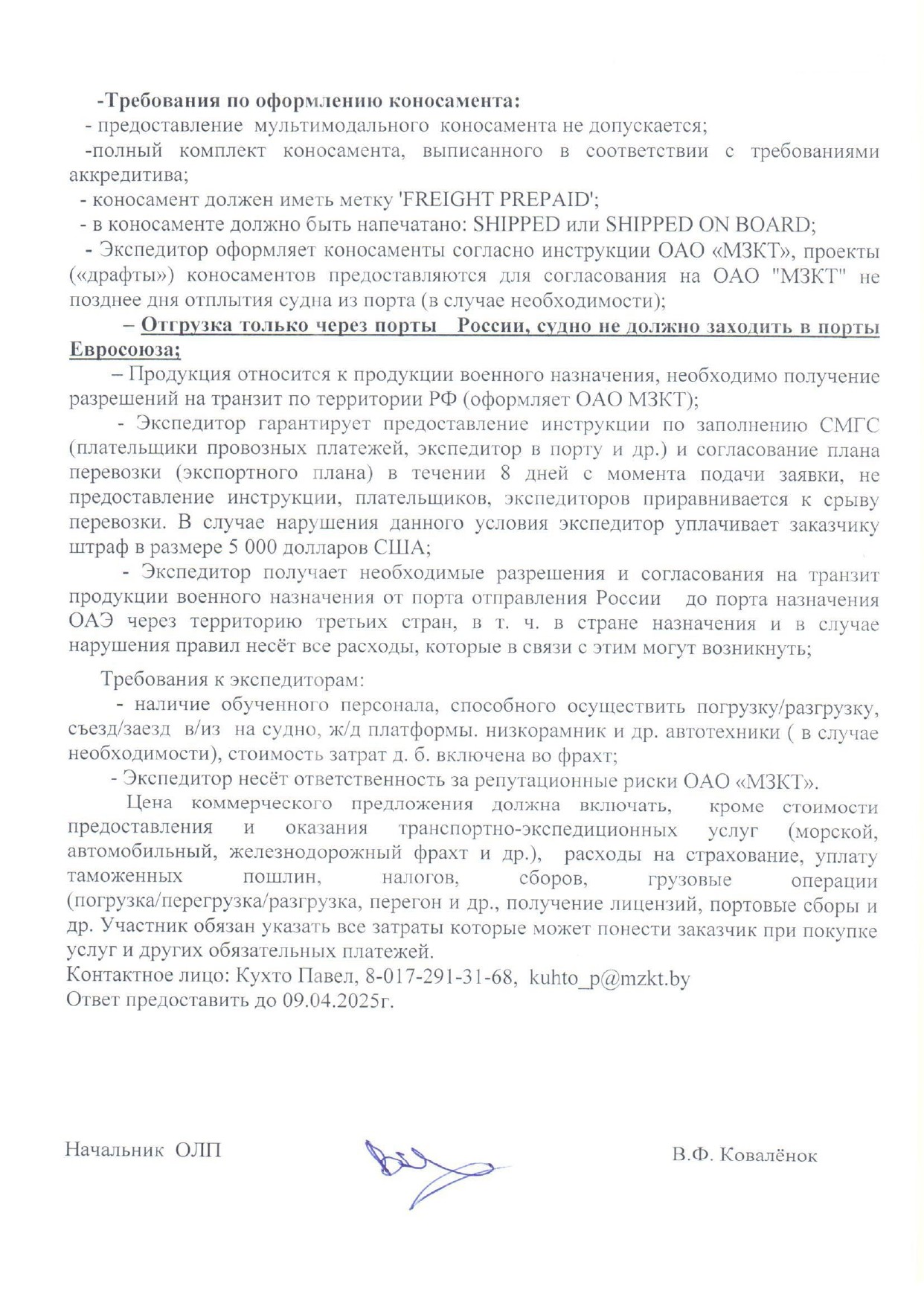
Example of requirements for forwarding JSC MZKT products to Pakistan:

A direct connection between these documents and the March 2026 shipments has not been established. However, the coincidence of the cargo profile, the involvement of Businessinvest Garant LLC, and the use of Russian seaports allow them to be considered as examples of requirements that could have been imposed when organizing the export transportation in question. The documents do not reliably determine the final destination country of the consignment.
One of the requests concerned the delivery of an MZKT-741351 tractor, an MZKT-999421 semi-trailer, and an MZKT-837211 trailer to Khalifa Port in Abu Dhabi. Another concerned the delivery of an MZKT-930001 chassis to Pakistan. In both cases, the products were classified as military, and their export was only permitted through Russian seaports.
The forwarder was responsible for organizing the railway and sea stages of transportation, coordinating the export plan, preparing bills of lading and other shipping documents, obtaining permits for the transit of military products through the territory of Russia and, if necessary, other states, as well as performing customs and port procedures. Specific conditions concerned the sea vessel’s route and permissible ports of call.
The attached requests characterize the possible structure of export transportation and the functions of Businessinvest Garant LLC, but do not confirm that the cargo identified in March 2026 was sent to the UAE or Pakistan. They also do not allow asserting that the transported special automobiles were manufactured by JSC MZKT.
In general, the identified 17 railcars should be considered an export consignment of military or special purpose products, transiting through a Russian seaport to a third country. The core of the consignment consisted of special automobiles transported on 12 flatcars. The nomenclature of the cargo on another flatcar and in four gondola cars is not disclosed in the shipping data.
The exact models of equipment, its manufacturer, foreign customer, and destination country have not been established. However, the repetition of the scheme identified in 2024, the involvement of Businessinvest Garant LLC and Phoenix LLC, and the dispatch of goods to Bronka station allow these shipments to be classified as international export, rather than Russian domestic, traffic.
Conclusions
Railway transport between Belarus and Russia in 2025 and early 2026 maintained a stable military and military-industrial character. This included not only the movement of weapons, ammunition, and military equipment, but also the transportation of units, supplies of special automotive chassis, infrastructure materials, spare parts, fuel, and other property necessary for the operation of military facilities.
In 2025, 764 railcars were imported from the Russian Federation to Belarus, while 1,154 railcars traveled in the opposite direction. However, these figures cannot be directly interpreted as the volume of transferred weaponry. They include the return of Belarusian units after training at Russian training grounds, the temporary arrival of Russian units for exercises, the dispatch of equipment for repair and storage, and the subsequent return of previously moved property. Therefore, to assess actual deliveries, it is necessary to distinguish targeted cargo shipments from training, repair, and return train consists.
The structure of incoming shipments changed significantly during 2025. In Q1, they were primarily related to the preparation of a military parade and the supply of the Russian radio-technical node “Baranovichi.” In Q2–Q3, the main volume was formed by the return of Belarusian units after training in Russia and the temporary arrival of Russian units for exercises. Simultaneously, in September, large deliveries of armaments and ammunition to Belarusian arsenals and storage bases began. In Q4, targeted shipments of missile armaments, aviation ammunition, air defense equipment and property, armored vehicles, special vehicles, spare parts, and cartridges predominated.
In total, 96 railcars registered with “Explosive materials” cargo passed in the incoming direction in 2025. At least 83 of them were related to targeted deliveries of armaments and ammunition to Belarusian military facilities. The rest were part of returning Belarusian units, temporarily arrived Russian troop trains, or were delivered to the Krichev-6 facility. The main volume of identified targeted deliveries of armaments and ammunition occurred in September–December 2025.
Outgoing shipments had a more pronounced industrial and warehouse component. In 2025, JSC Minsk Wheel Tractor Plant dispatched 281 railcars of products by railway transport, primarily intended for enterprises of the Russian defense-industrial complex. Another 202 gondola cars with reinforced concrete sleepers and turnout bearers produced by JSC Spetszhelezobeton were delivered to cosmodromes, Strategic Missile Forces facilities and the 12th Main Directorate of the Russian Ministry of Defence, arsenals, storage bases, Navy facilities, and Railway Troops units.
A separate stable trend was the removal of ammunition from Belarusian storage facilities. In September–December 2025, 168 railcars, including 157 railcars with “Explosive materials” cargo and 11 railcars for cargo attendants, were sent from bases and arsenals in Bobr, Tsentrolit, Bronnaya Gora, and Dobrush to Russian GRAU arsenals. Shipments were made to centralized arsenals where the reception, accounting, inspection, sorting, and further distribution of received ammunition could take place. At the same time, the removal of Belarusian stocks occurred in parallel with counter-deliveries of armaments and ammunition from Russia.
In January–April 2026, the nature of shipments changed. Only 20 tank cars with gas oil for the Russian radio-technical node “Baranovichi” arrived in Belarus. No other established shipments of armaments, ammunition, military equipment, or organized troop trains were identified during this period. In the opposite direction, 219 railcars were dispatched, of which 126 were MZKT products, 76 were JSC “Spetszhelezobeton” products, and 17 were other military shipments.
Thus, in early 2026, railway exchange returned to a structure dominated by industrial cooperation and infrastructure support. Mass transportation of units, export of ammunition from Belarusian arsenals, and large training train consists, characteristic of the second half of 2025, were not recorded. The main directions remained the supply of special wheeled chassis to Russian defense industry enterprises and reinforced concrete products to facilities with significant internal railway networks.
A separate group consisted of 17 railcars that passed through Bronka station to Russian port infrastructure in March 2026. The coincidence of participants and route with the previously identified scheme makes it highly probable that this shipment was a stage of further export of military or special purpose products to a third country. However, the final customer, destination country, manufacturer, and exact nomenclature of the equipment have not been established.
Overall, the established shipments demonstrate the deep interconnectedness of Belarusian and Russian military logistics. The Belarusian Railway is used simultaneously for moving units, supplying military facilities, exporting ammunition, servicing Russian-Belarusian industrial cooperation, and organizing export routes through Russian ports. At the same time, quantitative indicators in railcars reflect the overall scale of logistical activity, but to assess actual deliveries of weapons and materiel, it is necessary to differentiate industrial, targeted, temporary, return, and transit shipments.
- Related materials:
Military transportation on the Belarusian Railway in Q2–Q3 2025;
Volumes of import and export of ammunition from the territory of Belarus in September 2025;
Resumption of ammunition export from Belarusian arsenals for the needs of the Russian Armed Forces;
Import of a large consignment of ammunition from Russia to Belarus;
Export of Belarusian products for strategic facilities in Russia and import of Russian Armed Forces equipment to Belarus in Q1 2025;
Railway export of MZKT products and military cargo to Russia based on 2024 results;
Deliveries of Russian weapons to Belarus in Q4 and for the whole of 2024;
Import by railway of Russian weapons and ammunition to Belarus for 9 months of 2024;
Ammunition was exported by railway from Belarus to attacked arsenals in Russia;
Information on the export of ammunition from storage arsenals of the Republic of Belarus for 2022 and early 2023;
Quantity of military equipment transferred by the Republic of Belarus to the Armed Forces of the Russian Federation in October 2022.