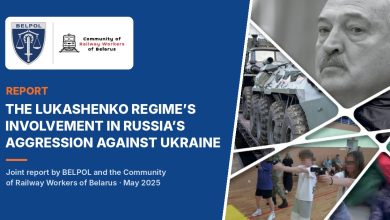
The BELPOL initiative, with the participation of the Community of Railway Workers of Belarus, has prepared the report “Sanctions: Empirical Impact on the Lukashenka Regime.” Twelve sections of the report, based on documentary evidence including classified material, examine how international restrictive measures affect industry—including military production—financial operations, foreign economic relations, and Belarus’s infrastructure. A separate section explains why lifting sanctions without a change in political conditions does not eliminate the reasons for which they were imposed.
Section 8, “Combined Effect of Sanctions: A Case Study,” was prepared by our team. The Belarusian Railway was chosen as the case study. Belarusian Railway enabled the formation of the invasion force in Ukraine, the transport and evacuation of personnel, equipment, and ammunition, the shipment of ammunition to Russia, and the movement of Russian Armed Forces units to Belarusian training grounds (detailed in our previous joint report with BELPOL).
Disruption of BKG Electric Locomotive Deliveries
Belarusian Railway concluded a contract with China National Electric Import & Export Corp., CUEC, and CRRC Datong for the delivery of 15 single-section freight electric locomotives, with full delivery scheduled by the end of 2023. The designs were approved, credit financing was approved, and contracts were signed. The electric locomotives were never delivered.
China has not officially joined EU and U.S. sanctions, but the manufacturer must account for the risk of secondary sanctions. The design of BKG electric locomotives relies heavily on equipment from Alstom, Bombardier, ABB, and Knorr-Bremse, and the manufacturer is unwilling to estimate timelines or prospects for redesign without Western components. By mid-2024, the Chinese side began using the phrase “normalization of the situation” in Belarus in official correspondence. This effectively constitutes a refusal to deliver until political conditions and the sanctions regime change. The delivery was moved into the “Belarus–China: Partnership–2030” cooperation plan—that is, postponed indefinitely (details).
Operation of the Existing Fleet
Belarusian Railway operates 30 Chinese-manufactured freight electric locomotives: 12 two-section BKG1 units and 18 single-section BKG2 units. Spare parts from Chinese partners arrive irregularly and in volumes that do not meet operational requirements. The most acute shortages are brake pads and the absence of new wheelsets, which has left part of the locomotive fleet idle (details).
For more complex assemblies and components, the railway is forced to procure through Russian gray-market channels and intermediaries. Non-original spare parts lead to increased failures, a higher number of unscheduled repairs, and accelerated wear of locomotives. The actual service life of the fleet is declining relative to design expectations.
Stadler and PESA Multiple-Unit Rolling Stock
Belarusian Railway operates 47 units of European-manufactured multiple-unit rolling stock: 19 Pesa Bydgoszcz diesel multiple units and 28 Stadler Bussnang and Stadler Minsk CJSC electric multiple units. At least 15 of them are out of service, reportedly due to the absence of parts, components, and consumables (details).
In May 2022, PESA refused to repair a diesel multiple unit for Belarusian Railway and subsequently declined to supply spare parts or service the entire fleet, stating that further cooperation would constitute a direct violation of EU sanctions. Series DP diesel multiple units are being restored through workaround schemes and shell companies, with spare-parts costs rising several-fold and the use of substitutes reducing reliability. When a diesel multiple unit breaks down, it is replaced in the timetable by a locomotive-hauled train consist. The railway no longer receives manufacturer software, and there are virtually no qualified specialists left for this volume of work.
Stadler’s position is less categorical. Contracts for five-car interregional FLIRT electric multiple units have been completed, and service maintenance of previously delivered electric multiple units continues. However, since June 4, 2022, the Fanipol plant has faced restrictions on the import of electronic and electrical products, and the situation with wheelsets for electric multiple units is critical (details).
Loss of Transit
As of 2025, transit volumes over Belarusian Railway infrastructure have fallen back to 2015–2016 levels and continue to decline (details). Transit has traditionally been one of the railway’s most profitable activities and a source of foreign-currency revenue due to haulage distance, volumes, and settlement in foreign currency. For Belarusian Railway, this loss is irreplaceable.
The main causes of the decline are: the EU’s phased refusal to import Russian oil, petroleum products, and coal, much of which transited westward through Belarus; EU bans on the export and transit of a wide range of goods through Belarus and Russia; and the cessation of exports of certain Belarusian cargoes through Lithuanian and Latvian ports. The shift of exports to Russian ports has increased haulage distances and operating costs and reduced route capacity (details). Shippers and consignees are restructuring logistics chains to bypass Belarus and Russia, and in many cases this reorientation is irreversible even if restrictions are eased.
Conclusions
The impact of sanctions on Belarusian Railway is not short-term but structural. Renewal of locomotive traction rolling stock is blocked, the sustainability of operation of the existing fleet is undermined, and the railway’s transit-based operating model is destroyed.
The report’s overall conclusion: sanctions are working. The authors cite the release of political prisoners as the principal evidence. In their assessment, the subject of negotiations with the regime should not be the lifting of sanctions but the threat of imposing new ones.
The full text of the report in Russian and English is available below:
|
Russian-language version of the report:
|
English-language version of the report:
|