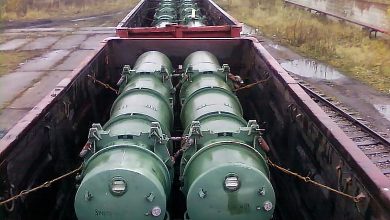
In the Slutsk district of the Minsk region, approximately 60 kilometers from the capital, one of the most sensitive and potentially dangerous industrial projects in recent years is being implemented. This concerns the construction of production facilities for CJSC “Zavod Korpusnykh Izdeliy” (ZKI), designed for the mass production of artillery and rocket munitions. This facility is of strategic importance to the current Belarusian authorities, primarily in the context of Russia’s ongoing war against Ukraine and Belarus’s systemic involvement in the military and military-industrial logistics of the Russian Federation.
The choice of site for ZKI raises serious questions from the outset. In 1996, a fire occurred near the village of Pavlovka, at a former missile component disposal center, followed by the detonation of munitions equivalent to approximately 1,200 railcars. The facility was effectively destroyed. In subsequent years, the territory remained abandoned while continuing to pose an elevated danger due to the possible presence of unexploded ordnance and contamination with explosive residues.
Despite this, in 2023 the country’s top leadership decided to locate a new military facility on this site. Construction began in late 2023 based on a classified order by Alexander Lukashenka dated November 2, 2023, No. 181-rp-s. The project is designated under the code name “Uchastok” (Site). The former arsenal in the Pavlovka area was chosen as the primary site.
According to investigative materials from our colleagues at BELPOL (part 1, part 2 and analytical note), production buildings for ZKI are being erected on this territory, designed for filling artillery and rocket munitions with explosives, final assembly, and storage of both raw materials and components (trinitrotoluene, hexogen, aluminum powder, casings, powder charges) as well as finished products.
Reference: The production and storage complex of CJSC “Zavod Korpusnykh Izdeliy” (ZKI) is structurally divided into three main sites, each performing separate functions in the overall technological cycle of artillery and rocket munition production:
– Site No. 1 concentrates the processes that are most dangerous in terms of industrial, fire and explosion safety. Two large production buildings connected by a technological gallery are located here. One houses the filling of artillery shells and warheads of 122 mm rockets with explosives using the batch pressing method. The second building contains an artillery round assembly section equipped with a production line of Russian origin supplied by the Tekhnodinamika Group. In the immediate vicinity of these buildings is a separate workshop for filling rocket warheads with explosives by pouring, using a Chinese-made line.
This site also houses warehouses for explosive and chemical components, including trinitrotoluene, hexogen and aluminum powder, as well as warehouses for munition casings, structural and mechanical parts, and powder charges. According to available data, the storage capacity is designed for a three-month supply of the chemical components used to make explosives. Site No. 1 also contains administrative and auxiliary buildings, including an administrative building with a canteen and life-support facilities. A fire station is located in the immediate vicinity, which indirectly indicates the high level of potential danger of the operations performed here.
– Site No. 2 is intended for the final stages of the production cycle. The main building for final assembly of rockets is located here, equipped with an assembly line made by the Tekhnodinamika Group. This site also contains finished product warehouses, raw material and component warehouses, rocket casing warehouses, and administrative and auxiliary buildings. In addition, underground storage facilities are provided for temporary storage of munitions and individual components during production and batch assembly.
– Site No. 3 is used for finished product storage and serves exclusively as a warehouse zone. Its capacity is designed for one month’s output, approximately ten thousand artillery rounds and up to ten thousand rockets. The concentration of such a volume of finished munitions in one place further underlines the need for strict compliance with industrial, transport, and fire and explosion safety standards.
The facility’s design capacity under a two-shift regime is stated at no less than 120,000 rocket projectiles for Grad MLRS per year and approximately 120,000 artillery rounds of 152 mm caliber per year. This effectively involves deploying continuous serial production of munitions classified as particularly dangerous products, requiring strict compliance with industrial, transport, and fire and explosion safety standards at all stages of the technological and logistical chains.
Logistics and the Initial Rejection of Direct Railway Connection
When designing such facilities, logistics is always a key element. Given the production volumes and nature of the cargo, it was obvious that deliveries of raw materials, components, and shipment of finished products should be carried out primarily by railway transport. This corresponds to both economic feasibility and established practice for transporting explosives and munitions on an industrial scale.
Initially, the option of constructing a non-public siding from Slutsk station directly to the ZKI territory was considered. Such an approach is standard and normatively justified for defence enterprises: it minimizes the number of transshipment operations, eliminates the need to transport explosives on public roads, and allows concentration of all the most dangerous processes within a single guarded, restricted, and technically prepared zone.
However, this solution was abandoned. The reasons are purely pragmatic and economic: construction of a new siding requires significant capital expenditure, lengthy design and implementation periods, and complex approval procedures. Under conditions requiring the facility to be commissioned in the shortest possible time, an alternative option was chosen—formally faster and cheaper, but fundamentally less safe.
Loading and Unloading Ramp at Novodvortsy Station (Mogilev Division of BCh)

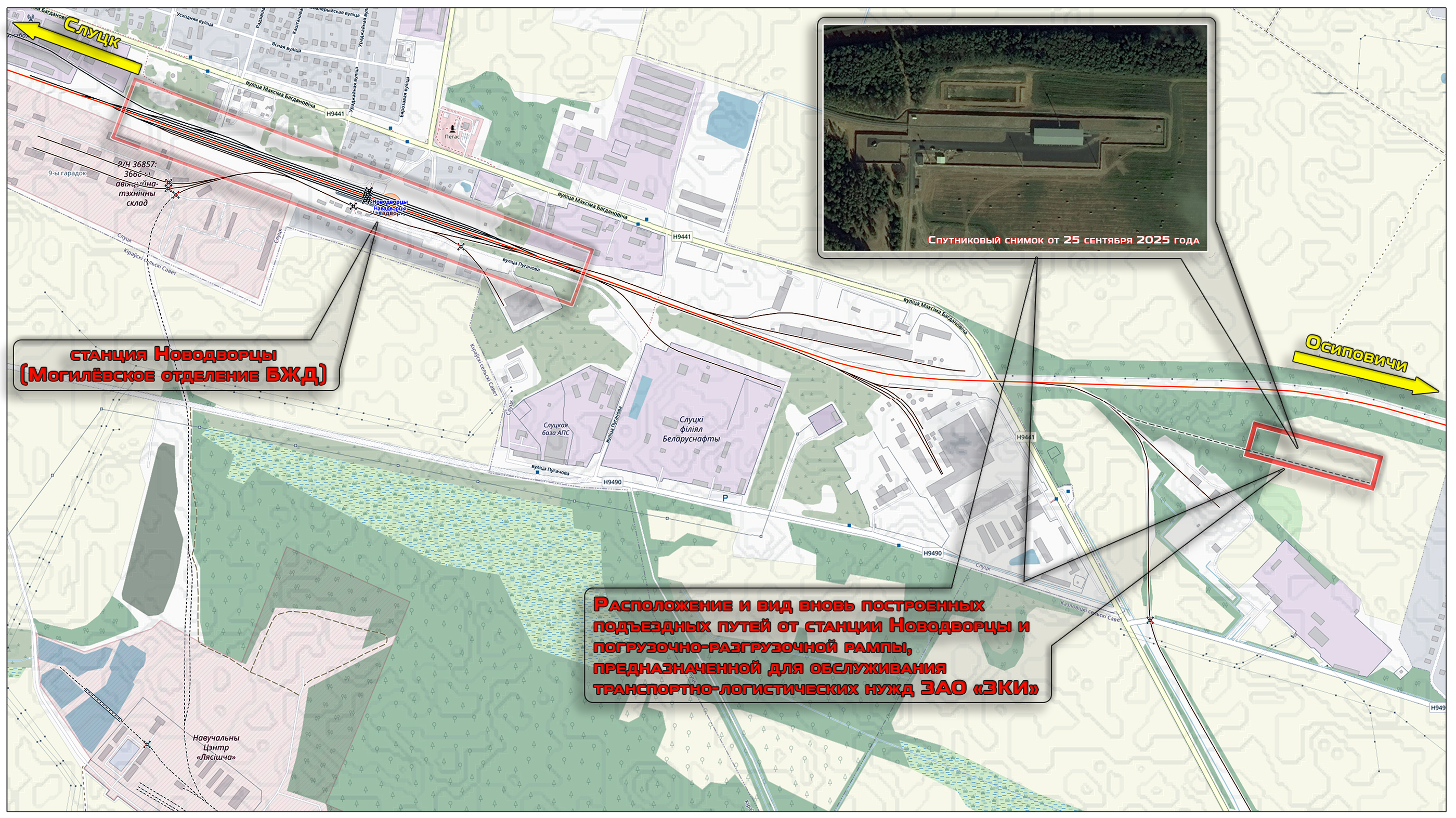
Instead of a direct railway connection to the facility, a scheme with external loading and unloading infrastructure was implemented. A special ramp connected to the Belarusian Railway infrastructure was built near Novodvortsy railway station. Railcars will be placed and removed via a siding from Novodvortsy station (Mogilev Division of BCh). Cargo will then be carried to and from the ZKI territory by road.
The distance between the ramp and ZKI production facilities exceeds 40 kilometers. Thus, the most dangerous stage of the logistics chain—loading and unloading operations for munitions and explosives—has been moved outside the enterprise’s industrial site and is effectively separated from it by dozens of kilometers of public roads.
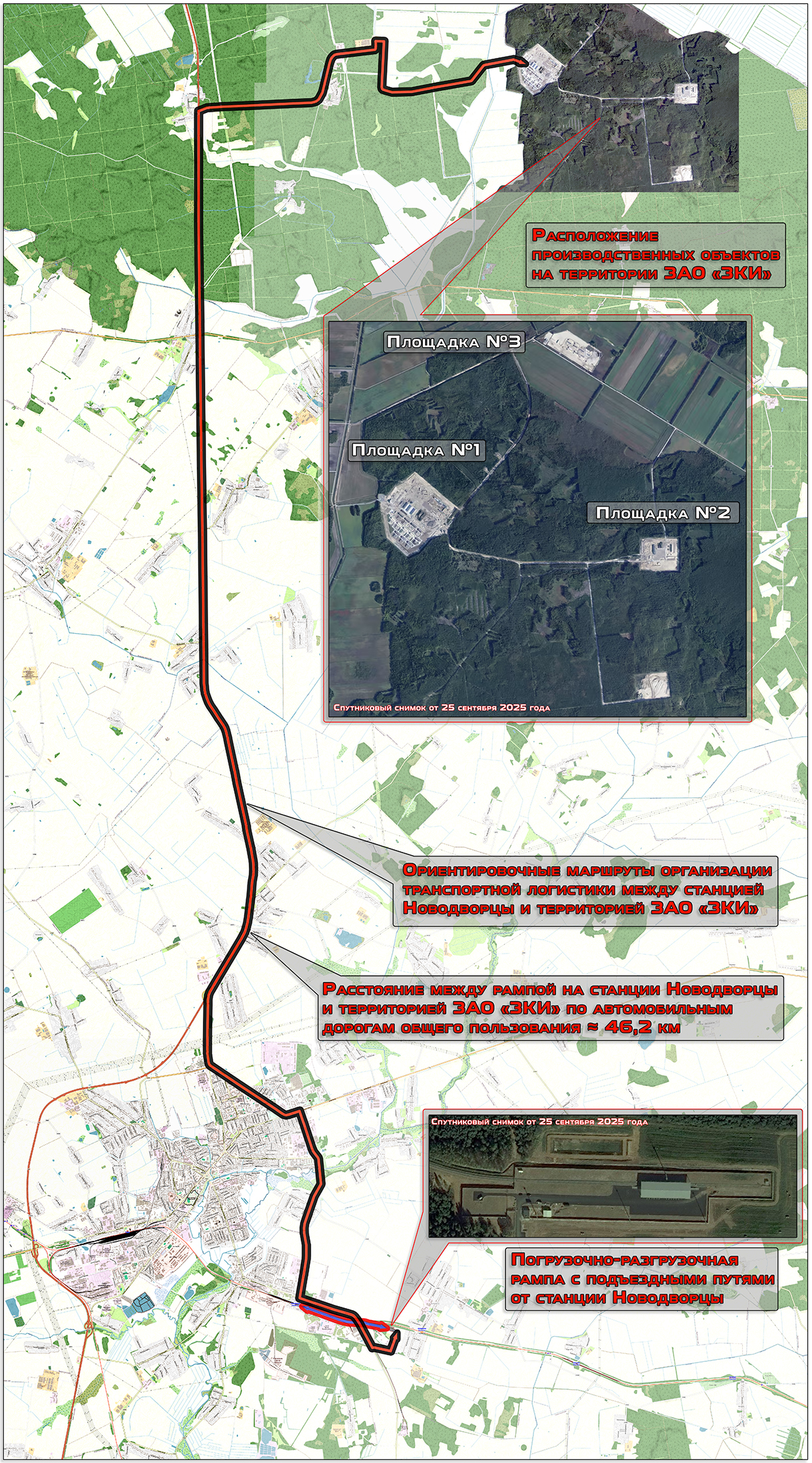
From the standpoint of rules and regulations for handling explosive materials and dangerous goods, this is an extremely problematic and unsafe solution. Loading and unloading operations are precisely the most accident-prone stage of transporting explosives and munitions. Under normal conditions, such operations are performed either directly on the manufacturer’s premises or within specialized military arsenals and bases equipped with appropriate protective structures, exclusion zones, and multi-level monitoring systems.
In the case under consideration, loading of finished products and unloading of raw materials, including explosives and components for their production (trinitrotoluene, hexogen, and other explosives), are planned at a separate facility that is not part of the production complex. Munitions and explosive materials are transported by road on public highways passing in immediate proximity to populated areas. Such a scheme contradicts the very logic of industrial and transport safety and multiplies the risk of incidents along the entire route.
Regulatory Aspect: Why the Implemented Scheme Contradicts the Basic Logic of Industrial Safety and Explosives Handling
From the standpoint of current and previously applied industrial safety standards in the post-Soviet space, transportation and transshipment of explosives and munitions is classified as particularly dangerous work, for which the key principle is minimizing the number of operations, including loading and unloading, and distances between stages in technological chains.
The operational practice of defence enterprises—both in the former USSR and in the post-Soviet space—is built on the same principle: loading and unloading of munitions must be carried out either directly on the enterprise’s territory or within specially equipped military arsenals, warehouses, and storage bases located within a unified restricted perimeter with production. This approach directly follows from the logic of fire and explosion safety requirements, since transshipment operations are precisely the most accident-prone.
The implemented scheme, in which the loading and unloading ramp is located more than 40 kilometers from ZKI production facilities, effectively violates this principle. As a result, dangerous cargo is subjected twice to additional transportation by road, which multiplies the cumulative risks—both technical and human.
The implemented logistics scheme appears from the outside as a deliberate expansion of the potential impact zone in case of accident, fire, or unauthorized detonation, which directly contradicts basic requirements for facilities working with explosives and dangerous products.
Economics versus Safety
The reasons for choosing precisely this scheme lie exclusively in the economic and administrative sphere. Construction of a separate siding to ZKI was deemed too costly and time-consuming. At the same time, ensuring transport service for the new munitions production is required urgently.
In the context of Russia’s war against Ukraine and high demand for munitions, priority was given to construction speed and cost minimization. Under such circumstances, safety issues for the population, personnel, and surrounding infrastructure in the existing Belarusian reality are undoubtedly relegated to secondary importance.
Military-Logistical Context
ZKI logistics cannot be viewed in isolation from the overall military context. Belarus has repeatedly been used by the Russian Federation as rear territory for deployment, training, and supply of military units, as well as for storage and transportation of munitions (as discussed in detail in our publications devoted to military transport). The railway infrastructure of BCh is a key element of this logistics.
The production of artillery and rocket munitions in the Slutsk district logically fits into the system of meeting the needs of the Russian army. In this context, railway transport acquires special significance as the primary channel for delivering finished products in the interests of the Russian Federation. Accordingly, any compromises in the area of safety when organizing such transport carry risks not only of local but also interstate scale.
“Ownerless” Infrastructure of Elevated Danger
Construction of the loading and unloading ramp was carried out by BCh, with OJSC “Dorstroymontazhtrest” as the direct contractor. Formally, the facility was created in the interests of ZKI. However, after construction was completed, a question arose that, according to some reports, remains unresolved to this day: who should accept the ramp onto their balance sheet and bear responsibility for its operation.
Given the ramp’s location, the current cargo intensity of Novodvortsy station and the entire Slutsk–Osipovichi section, this facility has no practical value for the Belarusian Railway. Under these conditions, accepting the ramp onto the balance sheet is viewed by BCh management as economically unjustified.
Meanwhile, ZKI is expected to reach design capacity only after 2027–2028, and cargo shipments are planned in small batches—no more than once per month. This situation means additional expenses for maintaining the ramp for ZKI itself, which in turn does not suit the enterprise’s management. For this reason, neither the State Committee for Military Industry nor ZKI management demonstrates readiness to accept the facility onto their balance sheet.
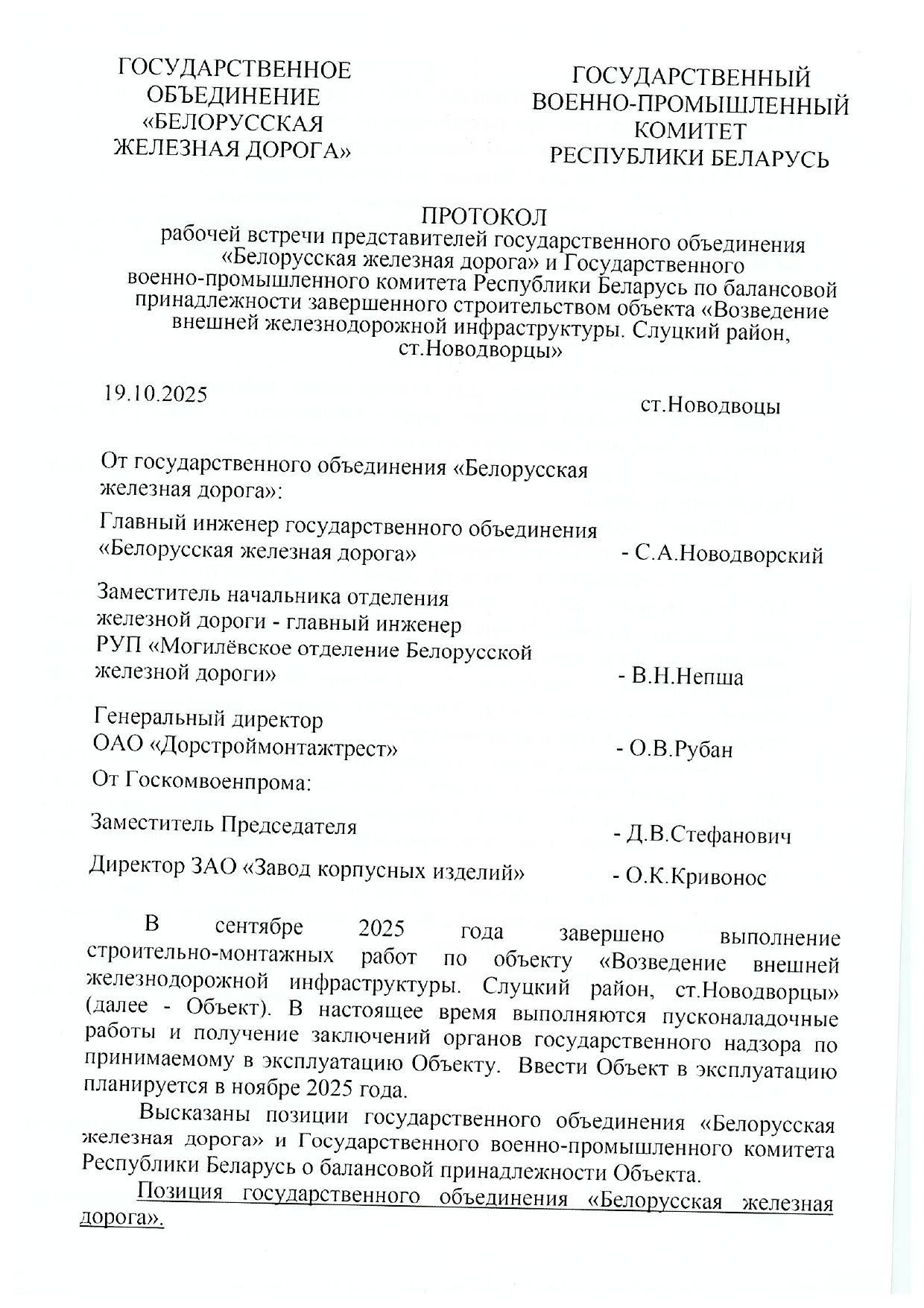
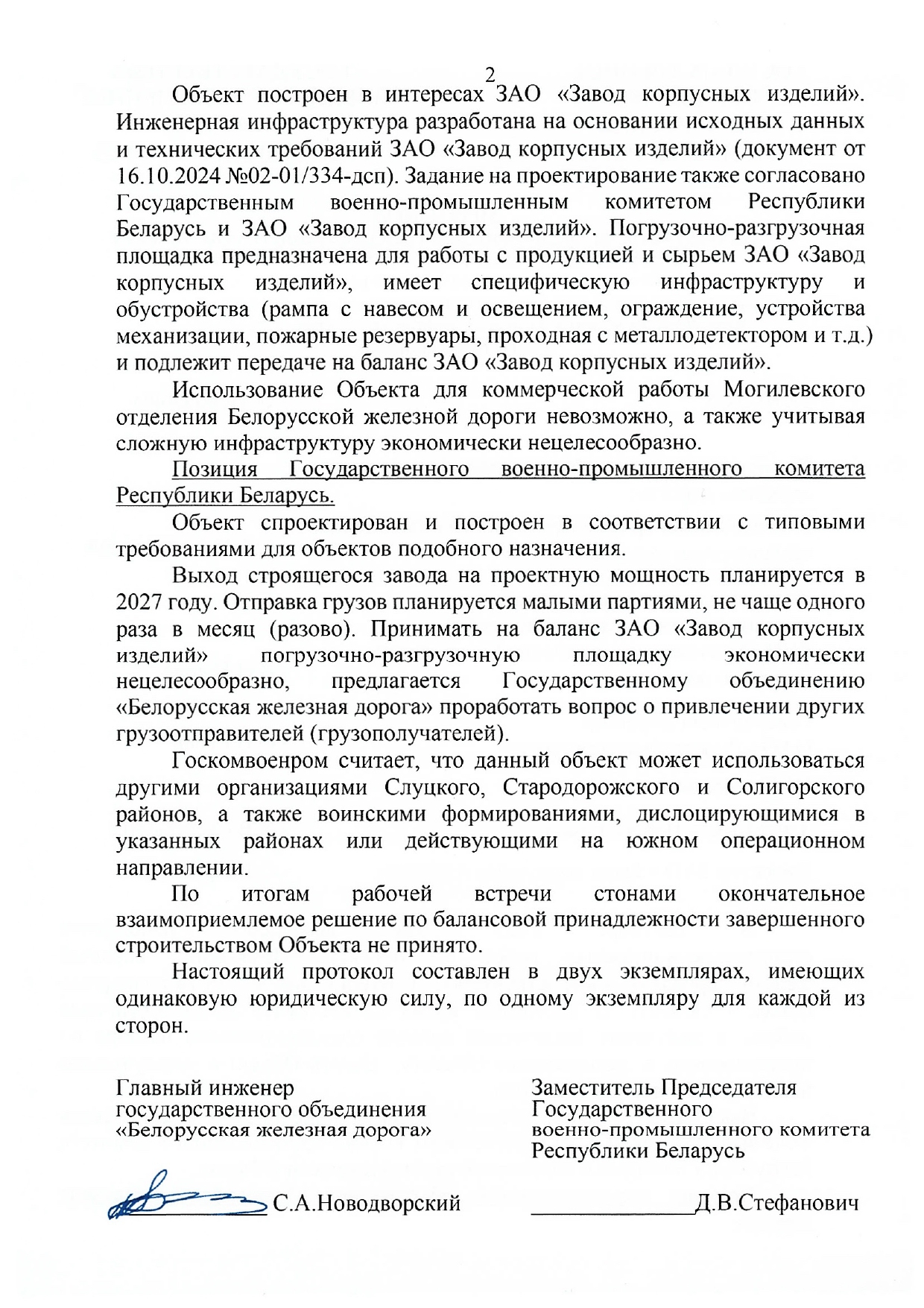
Negotiations between the parties have effectively reduced to mutual shifting of responsibility. As of the present time, no agreed decision on the ramp’s balance sheet ownership exists.
As a result, a paradoxical situation has been created: a facility of elevated danger, designed for working with munitions and explosives, has been completed but effectively remains “ownerless” from the standpoint of legal and operational responsibility.
Conclusion
The story of ZKI’s railway logistics is a telling example of how, under conditions of political haste and focus on short-term effect, decisions are made that create potential risks of catastrophic scale. Moving the most dangerous stage of the logistics chain outside the enterprise, the significant distance of loading and unloading infrastructure from production, and the absence of an entity responsible for the asset have effectively already created a stable zone of elevated accident danger.
The created infrastructure potentially threatens personnel and residents of adjacent territories, while none of the involved agencies is prepared to fully answer for its operation and the consequences of possible incidents.