Official resources of the Ministries of Defence of the Republic of Belarus and the Russian Federation on December 30, 2025 published video materials about the alleged combat deployment in Belarus of the Oreshnik medium-range ballistic missile (MRBM), deployed as part of a mobile ground-based missile system (PGMS).
However, the staged video footage used in the published materials was reportedly filmed on the territory of the former Krichev-6 airbase. According to some reports, Russia is preparing the infrastructure for deploying this system at the same site in the Mogilev region, located a few kilometers from the state border with the Russian Federation.
In the materials broadcast by state information resources and dedicated to this event, specialists note the absence of the complex's launch vehicle (self-propelled launcher / PGMS launcher) among the equipment demonstrated*. All videos show only three types of vehicles involved in the maintenance of the complex: a communication vehicle, a Typhoon armored vehicle, and, presumably, a combat duty support vehicle. It should be emphasized that when the entire missile system convoy is moving, the vehicle performing the functions of a launcher (wheeled tractor) is absent in all shown footage. This issue is discussed in more detail in the investigation by our colleagues from BELPOL.
* The composition of the Oreshnik MRBM battalion may include (according to estimates):
– three launchers based on the MZKT-79291 chassis;
– a combat duty support vehicle (15V240M) (according to some reports, three vehicles – one for each launcher);
– a command post (15V180);
– a communication vehicle (15V190);
– an engineering camouflage and support vehicle (15M69M);
– a unified thermal vehicle TM-80M;
– security and escort vehicles, used to ensure the safety and cover of the complex (armored vehicles and other security vehicles).
At the same time, it should be noted that even the demonstrated transport elements of the complex required delivery to the Republic of Belarus. Their transfer using railway transport is the most obvious solution. Transporting equipment of such dimensions by road transport involves significant organizational and technical difficulties, including the need to use special wheeled transporters, organize and escort convoys, as well as preliminary preparation, inspection, and security of routes. Transporting equipment “under its own power” also faces similar limitations and leads to significant fuel consumption. Furthermore, moving such equipment on public roads does not allow for the required level of secrecy.
The practice of transporting units of the Strategic Missile Forces and the 12th Main Directorate of the Ministry of Defence of the Russian Federation shows that the transportation of such equipment and material assets is carried out primarily by railway transport; the use of aviation is limited and auxiliary.
Thus, the delivery of auxiliary and support elements of the complex, recorded in the video materials, to the Republic of Belarus was carried out by railway transport.
According to our information, units of the Strategic Missile Forces of the Russian Federation (SMF) with the equipment featured in the videos (without launchers and without MRBMs) arrived at the former Krichev-6 airbase (currently disbanded) approximately between December 18 and December 20, 2025, via the Ponyatovka (RZD) — Shestyorovka (BCh) interstate junction point.
The specified Ponyatovka — Shestyorovka interstate junction point is located on the single-track non-electrified section Roslavl — Krichev and is currently virtually unused. The stations on the section are under autonomous control (centralized traffic control — CTC — is absent), and the main type of signaling system and communication is semi-automatic block (SAB). Passenger traffic is absent in any form, and freight traffic is episodic — with the dispatch of transfer and service trains if necessary. The Krichev (BCh) — Roslavl (RZD) section is considered low-activity and effectively a dead end on both sides of the border (on the Belarusian side, traffic reaches Shestyorovka station, on the Russian side — Ponyatovka station). Nevertheless, the railway infrastructure, although largely worn out and requiring upgrade, is still present and capable of handling freight trains.
The territory of the disbanded Krichev airbase (Krichev-6) is indicated as the unloading site for the delivered elements of the complex, where, according to available information, infrastructure was being prepared for their deployment.
Until recently, any railway infrastructure on the territory of the disbanded airbase was completely absent. It is likely that, as part of the preparation for the import of the specified missile system into Belarus, work was carried out on the Shestyorovka — Krichev-1 section to lay railway tracks onto the territory of Krichev-6.
Another feature of this section is the presence of the now liquidated Krichev-2 station.
The station was not busy, and until 2016, communication with it was carried out by one pair of economy-class passenger trains per day on weekends, using diesel multiple unit rolling stock (DR, DDB, DRB series diesel multiple units) from Krichev station to Shestyorovka station, followed by a change in the direction of movement back. From 2017, passenger traffic towards Roslavl was completely discontinued. As of 2024, passenger traffic through this station was completely absent.
Before the infrastructure upgrade on the territory of Krichev-6, the length of the Shestyorovka — Krichev-1 block section was about 30 kilometers.
Immediately before the import of equipment and its supporting elements, featured in the video materials, into Belarus, the following work was carried out on the Shestyorovka — Krichev-1 block section and the adjacent territory:
- at a distance of about 18 kilometers from Shestyorovka station (and 12 kilometers from Krichev-1 station, respectively), an locally operated manual turnout with a branch towards the Krichev-6 territory was installed on the block section;
- a siding to the territory of the disbanded Krichev airbase, approximately 900 meters long, was laid;
- loading and unloading ramps were equipped.
In addition, construction work was carried out on the airbase territory, not directly related to the railway infrastructure and, presumably, aimed at creating conditions for the deployment, storage, and maintenance of the delivered equipment, as well as for accommodating equipment and personnel. The specified construction work is ongoing.
It should be noted separately that the manual turnout laid on the Krichev-1 — Shestyorovka block section is not equipped with any signaling system for its position. In other words, the train driver can only find out the prepared route by directly approaching the turnout indicator.
Based on the foregoing, the technology for delivering the imported elements of the complex generally appears as follows: a freight train (troop train), having passed the Ponyatovka — Shestyorovka interstate junction point from the RZD side, arrived at Shestyorovka station. After this, the Shestyorovka — Krichev-1 block section was closed, a station employee (shunting supervisor), authorized to manage shunting operations, boarded the locomotive, and the train driver was issued the appropriate departure permit (track warrant, key-staff, or other options provided in such cases). The train then proceeded to the manual turnout, where the work supervisor disembarked. After the entire troop train consist passed beyond the switch points of the turnout in the direction of Krichev-1 station, the work supervisor switched the turnout towards the siding to the Krichev-6 territory and gave the command to shunt the train with the wagons leading for a distance of approximately 1200–1500 meters to the unloading site at the loading and unloading ramps.
According to available estimates and documents, the work carried out on the Shestyorovka — Krichev-1 block section and on the territory of the disbanded Krichev airbase (Krichev-6) was performed as part of the organization and construction of a certain logistics center. The customer for this construction was the Mogilev Regional Executive Committee, which is clearly an inadequate cover for the work carried out as part of a Russian military initiative in Belarus. This is also supported by the fact that access to real data on this construction project is limited to a very small circle of people, including those at the BCh.
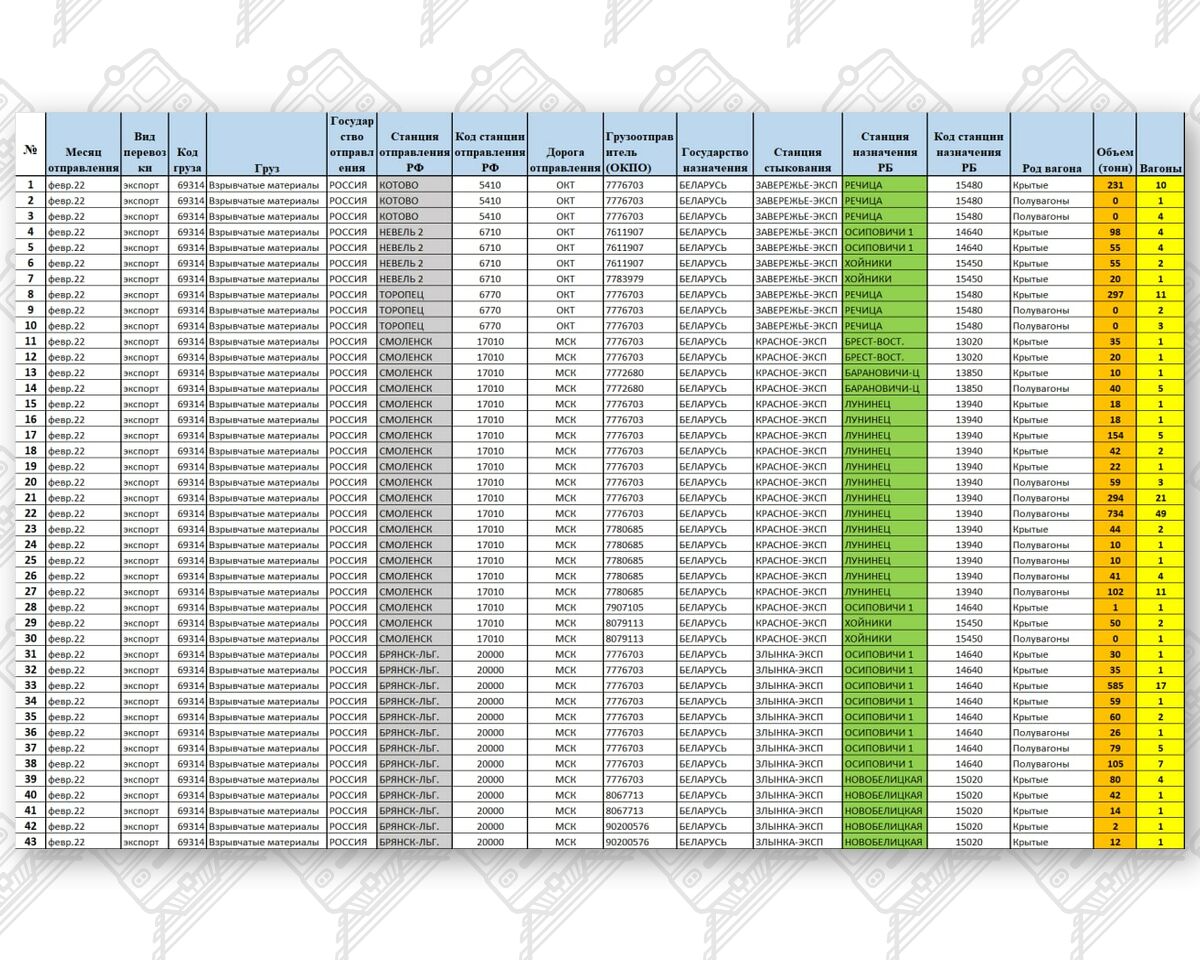
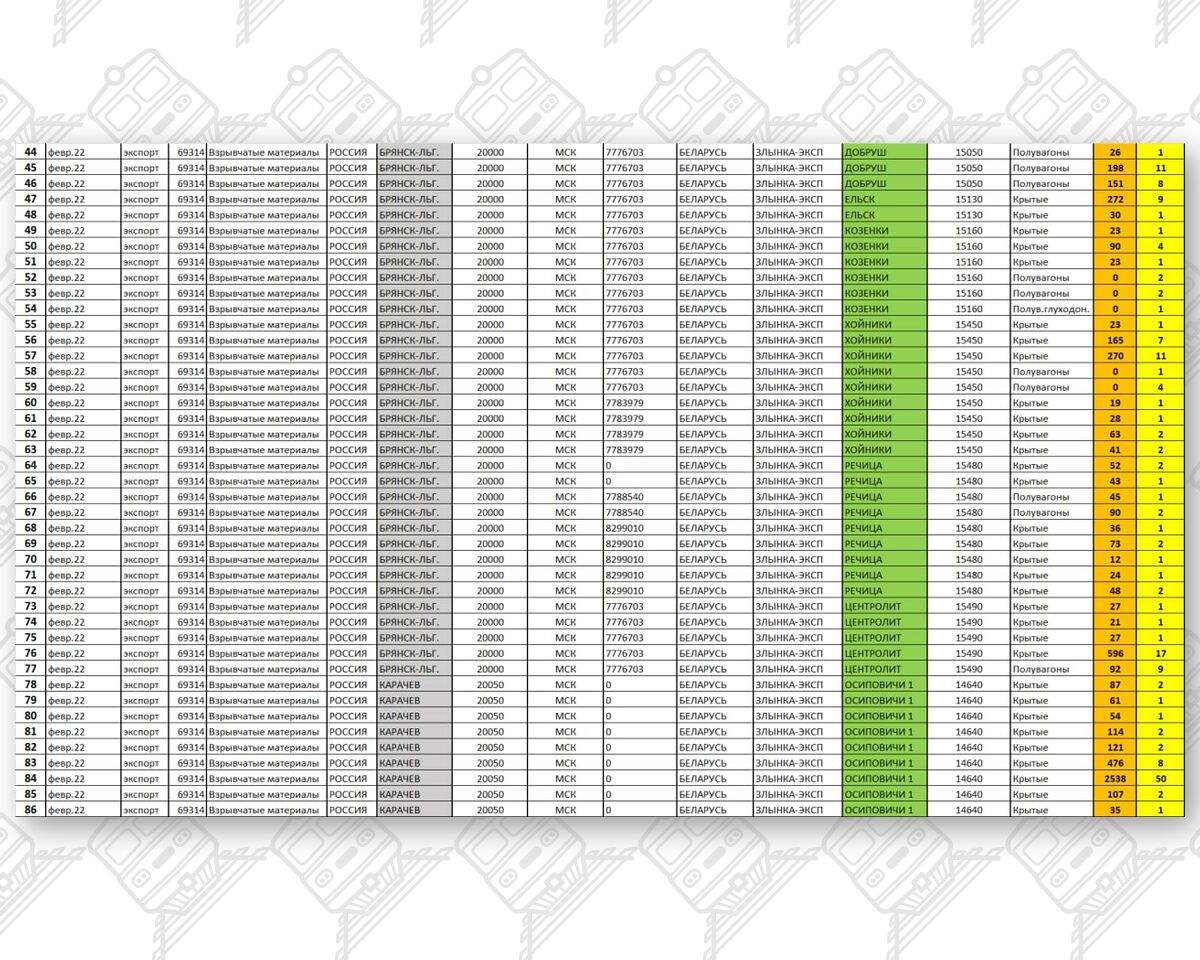
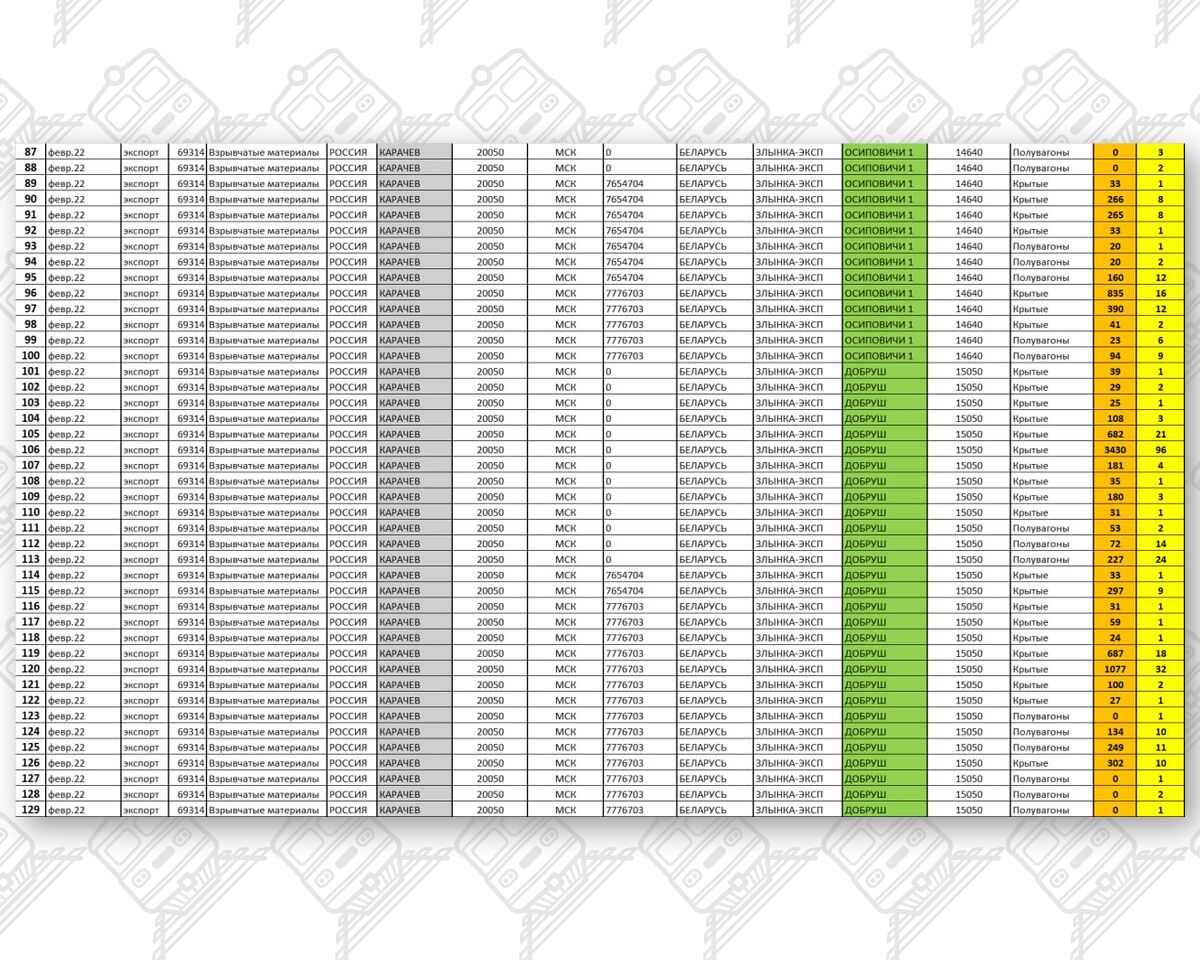
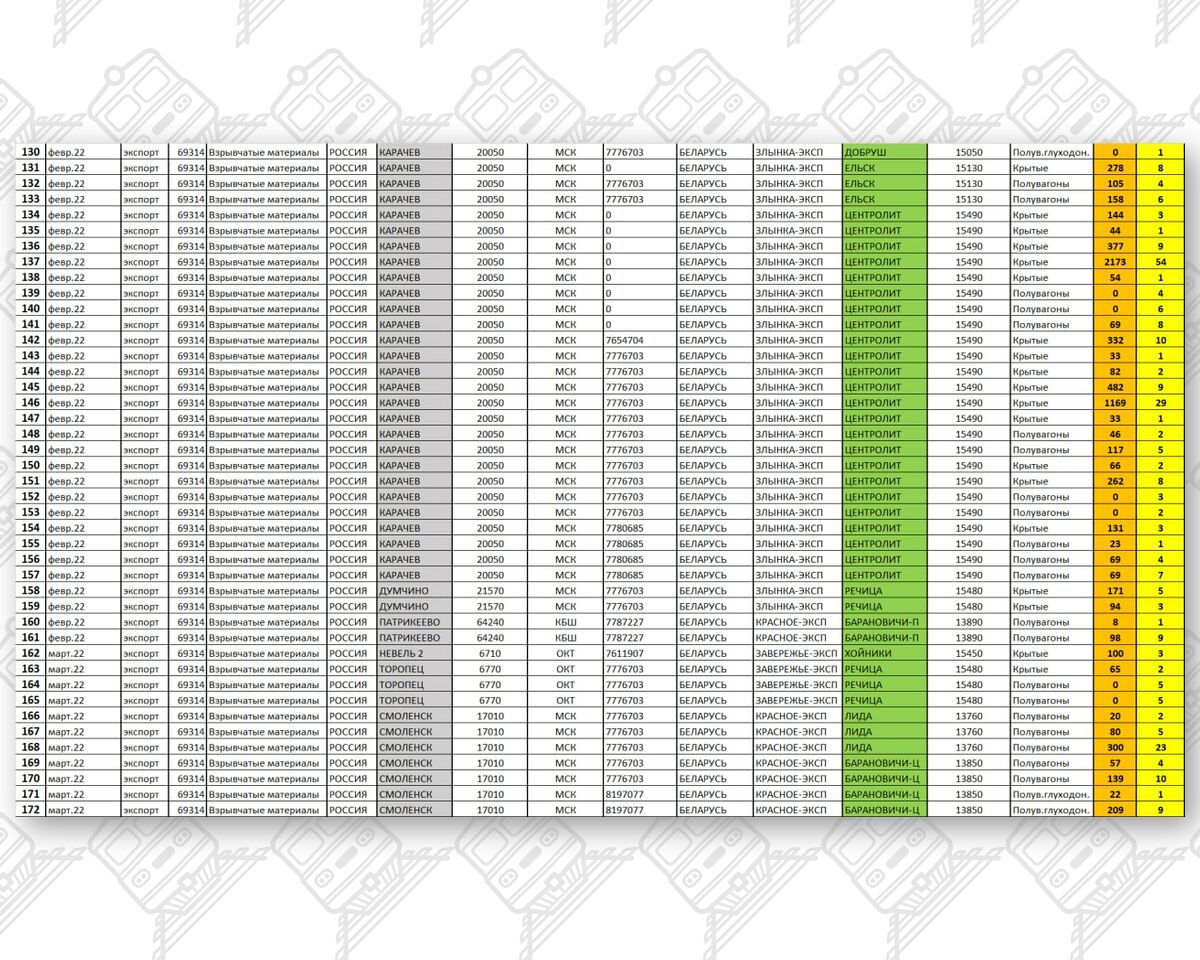
The absence of recorded information about the movement of oversized cargo from the Russian Federation to Belarus in November–December 2025 supports the conclusion that self-propelled launchers for the Oreshnik medium-range ballistic missile (MRBM), which are part of the mobile ground-based missile system (PGMS), were not imported into the Republic of Belarus.
With dimensions of approximately 17.0 × 3.4 × 4.0 meters, this cargo falls into the category of oversized*, which requires compliance with specific conditions for transit and passage through the section.
* According to its dimensional parameters, when transported on a standard flatcar, the specified vehicle may require classification as oversized cargo, primarily due to its height from the railhead level and its lateral outline in the 1400–4000 mm zone. The specific degree and index of oversized cargo are determined based on the transverse profile of the cargo and the type of flatcar used.
In addition, the movement of oversized cargo, according to established BCh tradition, is accompanied by the presence of “high-ranking” management, mainly from the transport department (D), at their workplaces, as well as observers from among the so-called “security personnel” behind the operational and train dispatcher staff. However, according to our data, during the presumed period of equipment import in November–December 2025, no oversized cargo was moved across the territory of the Republic of Belarus at all, and no corresponding “reinforcements” or duties were observed.
All of this, taken together, indirectly indicates that no truly critically significant cargo was moved along the Belarusian railway during the specified period.
However, Krichev-6 is not the only site in the Republic of Belarus where active construction and development of military infrastructure is currently underway with the participation of the Russian military, including the arrangement and upgrade of railway communications.
Thus, on the territory of the 1405th Artillery Ammunition Base (military unit 42707), located near the village of Bolshaya Gorozha, Osipovichi district, Mogilev region, a project for the construction of a military infrastructure facility is being implemented, which includes the development of railway support, as well as facilities for accommodating personnel and motor vehicles.
The specified 1405th Artillery Ammunition Base occupies an area of approximately 236 hectares. Ammunition of various types is stored and maintained on its territory, which initially creates increased requirements for logistics, operation mode, and infrastructure support of the facility.
An important circumstance is that, according to the available design, estimate, and technical documentation, the customer for the construction is FKP “Capital Construction Customer Directorate of the Ministry of Defence of the Russian Federation.” In this regard, the created infrastructure belongs to the category of military infrastructure facilities of the Russian Federation being implemented in the Republic of Belarus. This circumstance is of fundamental importance, as it unequivocally determines the actual ownership and intended purpose of the facility.
Currently, in the area of Bolshaya Gorozha village, the construction of railway sidings is underway, which, according to available data, are in the final stage. The project itself was developed back in 2018, adjusted in 2020, and officially named: “Construction of railway sidings with the arrangement of four loading and unloading ramps at the 1405th Artillery Ammunition Base, Mogilev region, Osipovichi district.”
However, the actual implementation of the project began significantly later. According to available data, preparatory work on the base territory, including clearing and felling forest areas, began in 2023. In 2024, the facility entered an active construction phase, covering not only railway infrastructure but also the construction of auxiliary facilities on the arsenal territory. Such a time gap between the development of design documentation and its practical implementation is typical for military infrastructure facilities and reflects the phased decision-making taking into account the changing military-logistical situation.
Individual aspects of the project for the construction and upgrade of infrastructure on the territory of the 1405th Artillery Ammunition Base were previously considered by colleagues from BELPOL as part of their investigation.
The project documentation records a fundamentally important point: in the area of Gorozha halt on the Osipovichi-2 — Yelizovo block section, it is not just the arrangement of an siding that is envisaged, but actually the formation of a new passing loop (station) element of the railway infrastructure.
The design solutions provide for:
- the construction of a station on the Osipovichi-2 — Yelizovo block section in the area of Gorozha halt;
- reception and departure track No. 2 with a useful length of at least 1050 meters;
- safety siding No. 3 with a useful length of 50 meters;
- private siding No. 4;
- passing track No. 5;
- loading and unloading track No. 6 with a useful length of 150 meters.
The documentation separately emphasizes the division of design standards: up to the base boundary (up to PK 24+20), the tracks are designed according to the standards for 1520 mm gauge railways, while on the base territory itself, industrial railway transport standards are applied. This indicates the dual — main line and departmental — nature of the created infrastructure.
Additionally, it should be noted that in accordance with the requirements of TKP V 229-2009, the rolling stock reception and transfer area and the freight area are classified as hazard category E6, which directly indicates increased safety requirements for the operation of the facility.
The official customer of the project from the Belarusian side is indicated as State Institution “Bobruisk Operational Directorate of the Armed Forces.” The maximum estimated cost of construction was approximately 28 million Belarusian rubles. The project envisages the organization of regular, high-volume railway freight turnover of ammunition through the created infrastructure.
It should be noted that the design indicators reflect the pre-war, normal operating mode of the facility. While in 2016–2018, the actual railway freight turnover of the 1405th Artillery Ammunition Base was measured in hundreds of tonnes per year, after the start of Russia's full-scale war against Ukraine, the volumes of ammunition export increased manifold and, according to available data, exceeded 25,000 tonnes in 2022 and early 2023. This contrast clearly demonstrates the transition of the facility to an intensive military logistics mode.
The choice of the 1405th Artillery Ammunition Base territory for the placement of a new infrastructure facility can hardly be considered accidental. It is important to note that the project itself was developed during a period when the base functioned primarily as a long-term storage facility. However, after the start of Russia's full-scale war against Ukraine, the facility effectively transitioned to a new mode of operation — regular and intensive export and maintenance of various types of ammunition, which is clearly reflected in the sharp increase in railway freight turnover.
Under the prevailing conditions, the previously existing infrastructure proved incapable of accommodating trains, simultaneously processing multiple troop trains, and safely transferring rolling stock. This led to the previously laid down design solutions no longer meeting the new wartime logistical requirements. This explains the implementation of a major railway facility directly on the arsenal territory — within the framework of the already operating military regime of operation and security.
The nature of the design solutions also points to this. The formation of station-type reception and departure tracks, the creation of a protected freight area, the implementation of security and monitoring systems, as well as the direct participation of the Ministry of Defence of the Russian Federation structures in the project, indicate that the created infrastructure is not being used as a temporary or one-off solution. Placing the facility inside the arsenal minimizes publicity, simplifies the secrecy regime, and allows for its integration into the existing military logistics system without additional formalities. As a result, the ammunition base is consistently transforming into a stable element of military railway infrastructure, designed for regular and long-term use in the interests of the Armed Forces of the Russian Federation.
This “event” is being implemented as part of the Union State program “Improvement of military infrastructure facilities planned for joint use in the interests of ensuring the regional grouping of troops (forces) of the Republic of Belarus and the Russian Federation.” The construction is financed from the Union State budget, with the Republic of Belarus accounting for approximately 40 percent of the total financial burden of the project.
From the outside, such a scheme may create the impression of a joint infrastructure project, but an analysis of information about the customer, purpose, and technical content of the facility leaves no doubt that the created infrastructure is being implemented in the interests of the Armed Forces of the Russian Federation.
The facility in the Bolshaya Gorozha area is not a situational or emergency solution but represents an element of long-term military logistics planning. Unlike the Krichev direction, where simplified and minimally sufficient railway solutions are currently being implemented, in Bolshaya Gorozha, a significantly more technologically advanced and formally documented approach is being realized.
The project provides for the construction of a turnout to the base territory with an electric interlocking system, with both local and train dispatcher control capabilities, as well as the implementation of block section devices aimed at ensuring traffic safety (such technical solutions are currently not recorded at infrastructure facilities in the Krichev-6 area). It is likely that the capital intensity and complexity of these solutions were one of the reasons for the shift in the project's implementation deadlines from the initially planned 2024.
An analysis of satellite images as of December 24, 2025, shows that the construction of railway infrastructure in the area of the 1405th Artillery Ammunition Base is in its final stages. The images clearly show the formed track development, backfilled and leveled earthworks, laid sections of sidings, as well as the outlines of the freight area and loading/unloading platforms. The absence of large-scale earthworks and the preservation of the objects' configuration in a series of images indicate the project's transition from the active construction phase to the completion stage and preparation of the infrastructure for operation.
Overall, the construction project in Bolshaya Gorozha demonstrates a more thorough and systematic approach to the deployment and support of military infrastructure compared to a number of other sites in Belarus. Here, a temporary scheme or adaptation for a one-time event is not being formed, but a stable and technologically well-thought-out element of railway military logistics, designed for long-term operation.
The totality of recorded facts allows us to view what is happening around Krichev-6 and Bolshaya Gorozha as elements of a single process of forming and consolidating the military infrastructure of the Armed Forces of the Russian Federation in the Republic of Belarus. However, at present, the fact of the import and deployment of Oreshnik MRBM combat missile systems, including launchers, on the territory of Belarus has not been confirmed by documentary or factual evidence. Only the arrival of auxiliary and support equipment, not related to the complex's combat assets, has been recorded.
In the case of Krichev-6, it is a phased preparation of the site: creating minimally necessary railway and auxiliary infrastructure, ensuring covert delivery of equipment, and forming conditions for the possible permanent presence of personnel. The nature and direction of this work allow for a high degree of probability to consider the territory of the former airbase as a prospective site for the deployment of a Russian military base or another permanently operating military facility, which is in the early stages of formation, but not as the actual location of the Oreshnik MRBM at this moment.
Collectively, these examples indicate not disparate or situational measures, but a consistent and systematic expansion of the military infrastructure and logistical presence of the Armed Forces of the Russian Federation in Belarus, implemented through both accelerated preparatory solutions and major long-term projects. At this stage, these processes indicate the formation of an infrastructural base, while the fact of the deployment of the Oreshnik MRBM complex itself on the territory of the Republic of Belarus remains unconfirmed.