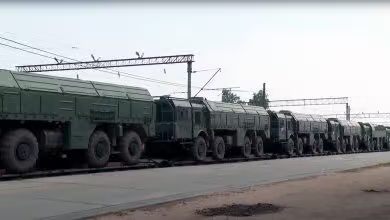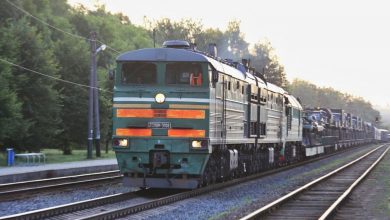
In late August 2026, the Belarusian Railway experienced a shortage of empty serviceable universal flatcars with floor decking available for loading. According to sources involved in the organization of the transportation process on the Belarusian Railway, some flatcars from the railway's inventory fleet and the privately owned fleet of RUE “BELINTERTRANS — Transport and Logistics Center” (BTLC) have already been allocated for military transport requests or reserved for upcoming dispatches. As a result, other shippers receive fewer railcars or are forced to wait for their delivery.
The exact number of flatcars involved has not yet been determined. The loading stations, the composition of the formed troop trains, and their routes are also unknown. It is impossible to determine these parameters from a single instance of railcar shortage.
The timing of the flatcar shortage coincided with another combat training event. From August 25 to September 10, the Armed Forces of Belarus are conducting an operational-tactical exercise with the branches of the Air Force and Air Defence Forces. The second stage is planned to take place at the Ashuluk training ground in Russia, where live firing by aviation and anti-aircraft missile units is scheduled.
According to sources, dispatches to Ashuluk explain only a small part of the current demand for flatcars and are not the cause of the deficit. The remaining railcars have been allocated for other ongoing or upcoming military transport requests, the routes and composition of which have not yet been determined.
Reference: Inventory and privately owned fleet. In the Automated Database of Freight Railcar Rolling Stock (ABD PV), the owner, usage status, railway, and home station are recorded separately for each railcar. The Belarusian Railway's inventory fleet includes railcars registered under the Belarusian Railway administration. For BTLC railcars, the owner and usage status are indicated as “own,” so they are not part of the Belarusian Railway's inventory fleet, even if they are assigned to a station on the Belarusian network.
The accounting status should not be confused with the railcar type. Universal flatcars are used for transporting wheeled and tracked vehicles. Container flatcars are primarily designed for container transport and cannot always replace universal ones.
How flatcars are used in military transport
Weapons and military equipment in troop trains are mainly transported on flatcars. Tanks, infantry fighting vehicles, armored personnel carriers, self-propelled artillery systems, engineering vehicles, and automotive equipment are loaded onto them. Depending on the composition of the transported unit and the troop train scheme, several dozen flatcars may be required for one troop train. Personnel, property, ammunition, and fuel and lubricants are transported in other types of railcars. Railcars with explosives are placed in the train consist in compliance with established buffer-wagon requirements; empty cars or railcars with non-hazardous goods can be used as buffer railcars.
Not just any nearby flatcar can be supplied for military loading. Railcars are selected by type, length, and carrying capacity, after which their technical serviceability and commercial suitability for transporting specific equipment are checked. Empty flatcars are sent to the loading station, delivered, and positioned at the loading area. After the equipment is placed and secured, the correctness of the loading is checked, the train consist is formed, and transportation documents are processed.
A flatcar is occupied not only during the troop train's journey. For another shipper, it becomes unavailable as soon as it is sent to the military loading station and becomes available for loading again only after unloading, removal from the loading area, inspection, and subsequent regulation of the empty railcar flow. Therefore, a shortage for loading is possible even without a reduction in the operational rolling stock: railcars are serviceable but have already been allocated for another request.
In current operation, the result is already noticeable: there is a shortage of empty serviceable flatcars to meet other requests.
How military transport has already created a flatcar deficit
Such a deficit was documented, for example, in September 2021, when the joint strategic exercises “Zapad-2021” took place in Belarus and Russia.
During that period, the Belarusian Railway could not provide flatcars for additional requests from JSC “Gomselmash”. JSC “BELAZ” also faced a shortage of railcars. In a response to the enterprise, the then Minister of Transport and Communications, Alexey Avramenko, indicated that there were no available flatcars due to the fulfillment of a state order related to “national security” issues.
JSC “KATEK” received a similar response. In correspondence with the enterprise, it was directly stated that flatcars from the railway's inventory fleet were being used for military equipment transport. Due to the inability to ship finished products within the agreed deadlines, the enterprise warned of export revenue losses, penalties, and failure to meet obligations to counterparties.
Another official telegram suggests that part of the Belarusian rolling stock might have been outside the Belarusian Railway. The Russian side was asked to approve the use of universal flatcars from Belarus's inventory fleet in intra-Russian traffic — for loading wheeled and tracked vehicles, despite the existing urgent return regime for these railcars.
A quick return of railcars for new requests after the exercises was also not expected. The Ministry of Transport's reference document indicated that a significant part of the rolling stock was to be sent for maintenance; these railcars were expected to be out of service for several weeks.
The 2021 documents are particularly indicative: they record not only the transfer of railcars for military equipment but also direct refusals to industrial enterprises. Now, sources again report a shortage of Belarusian Railway and BTLC flatcars, but there are currently no documents that can establish the number of railcars involved and their location.
How many flatcars are required for one troop train
The number of railcars that may be required for planned military transport can be judged by the troop trains of Belarusian units that traveled to Russian training grounds in 2025.
In August, three troop trains of Air Force and Air Defence Forces units were sent to the Ashuluk training ground. For the transport of their equipment, 104 flatcars were used: 41 in the troop train of the 15th Anti-Aircraft Missile Brigade, 27 in the 49th Radio-Technical Brigade, and 36 in the 120th Anti-Aircraft Missile Brigade. In late August and early September, these same units returned to Belarus.
Another 36 flatcars were part of the troop train of the 336th Rocket Artillery Brigade, sent to the Kapustin Yar training ground. The troop train was dispatched from Belarus in June and returned in early August. Therefore, mechanically adding its 36 flatcars to the 104 flatcars from the August dispatches to Ashuluk is not possible: the transportations were carried out at different times, and the same railcars could have been reused. However, the composition of each troop train is known: between 27 and 41 flatcars were required for equipment alone.
Additionally, in August–September 2025, for participation in the “Zapad-2025” and CSTO exercises, six Russian troop trains with a total composition of 184 railcars arrived in Belarus, including 165 flatcars. These railcars cannot be automatically accounted for when assessing the load on the Belarusian Railway and BTLC rolling stock: the trains arrived from Russia, and the ownership of each flatcar was not determined separately. But the ratio of railcars within these trains is indicative: out of 184 railcars, 165 were flatcars carrying equipment.
The 2025 data shows the order of demand: for transporting the equipment of one unit, 27 to 41 flatcars were required, and upon the unit's return, a comparable volume of rolling stock had to be used again. It is not possible to calculate the current deficit based on this data — the composition of the 2026 troop trains and the number of simultaneously fulfilled requests are unknown.
What the experience of early 2022 shows
Comparing the current flatcar shortage with January–February 2022 would be incorrect. There is currently no data on a comparable volume of transport, nor on the mass arrival of Russian units, nor on the accumulation of troop trains in any direction. Early 2022 is relevant here only as an example of how early a large-scale troop redeployment manifests in the operational work of the railway.
On January 16, 2022, Russian troop trains began arriving in Belarus — officially for preparation for the “Allied Resolve” exercise. On January 17, we reported the start of the redeployment. By January 21, more than 33 troop trains had arrived in the country.
Later, using railway documentation, we were able to reconstruct the total volume of imports. In January 2022, 5,229 railcars were sent to the Ministry of Defence of Belarus, and another 3,292 in February. This quantity includes railcars of all types, not just flatcars: personnel, property, ammunition, fuel and lubricants, and other goods were transported along with equipment.
On February 24, Russia launched a full-scale invasion of Ukraine, including from the territory of Belarus. By this time, the movement of troop trains and railway documents already indicated the deployment of the Russian grouping.
Currently, among the listed signs, only a shortage of flatcars has been recorded. The assessment will change if the shortage persists, the number of unmet requests increases, a mass dispatch of empty railcars to military loading stations begins, the acceptance and handover of railcars through Belarusian-Russian interstate junction points changes, or new routes for military troop trains appear. Our current data does not show such a combination of signs.
Military personnel in the Transportation Management Centre and backup control scheme
At the railway level, military transport is coordinated with the participation of the Transportation Department (D), which includes the main Transportation Management Centre (TMC) of the Belarusian Railway. As we reported in June 2026, a permanent group of representatives from military structures is located on the eighth floor of the building on Stekolny Lane. Its core consists of representatives from the military transport authorities of the Ministry of Defence of Belarus. They interact with Belarusian Railway services regarding transport plans and conditions, preparation and supply of rolling stock, and passage of military troop trains. Operational orders for train movement remain with the Belarusian Railway's dispatching staff.
In August, it became known that the Belarusian Railway is preparing a backup scheme for managing the transportation process in case of destruction, serious damage, or prolonged unavailability of the main TMC. This work includes defining duty shifts and preparing backup workstations. The purpose of the reserve is to maintain the possibility of centralized train movement control, including during military transport operations.
The preparation of backup workstations is not directly related to the current flatcar shortage. This is a separate effort in case of loss of the main TMC.
What is known now
According to sources, some flatcars from the Belarusian Railway's inventory fleet and BTLC's privately owned fleet have already been allocated for military transport requests or reserved for upcoming dispatches. As a result, the railway cannot fully provide flatcars to other shippers.
The exact number of railcars involved, loading stations, and the composition and routes of the troop trains are currently unknown. There are no signs in the available data of a redeployment comparable in scale to January–February 2022.
If you have additional information
We ask employees of the Belarusian Railway, BTLC, and enterprises whose flatcar supply volume has been reduced or whose deadlines have been postponed, to share any known information.
You can contact us by any convenient and secure method — all available contacts are listed on the feedback page.